
Mapa mental
Fault
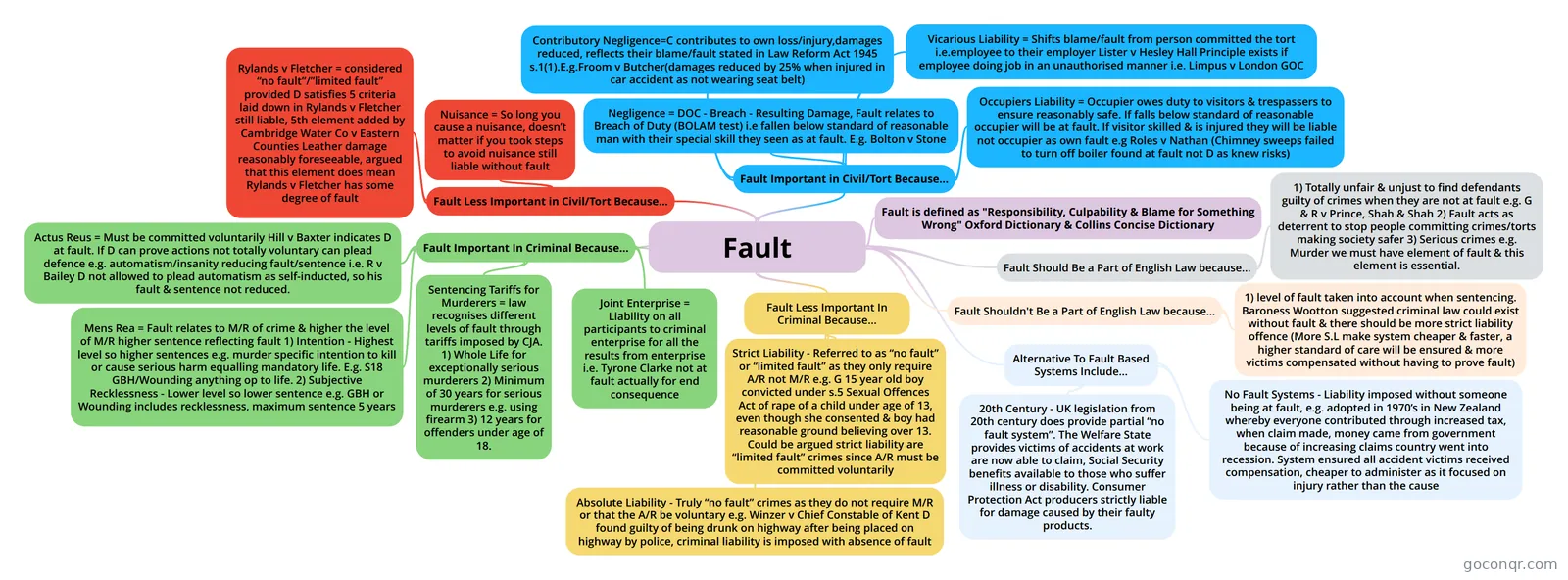
Mind map: Fault in Law and Tort
Contenido del mapa
Fault
Fault is defined as "Responsibility, Culpability & Blame for Something Wrong" Oxford Dictionary & Collins Concise Dictionary
Fault Important in Civil/Tort Because...
- Negligence = DOC - Breach - Resulting Damage, Fault relates to Breach of Duty (BOLAM test) i.e fallen below standard of reasonable man with their special skill they seen as at fault. E.g. Bolton v Stone
- Occupiers Liability = Occupier owes duty to visitors & trespassers to ensure reasonably safe. If falls below standard of reasonable occupier will be at fault. If visitor skilled & is injured they will be liable not occupier as own fault e.g Roles v Nathan (Chimney sweeps failed to turn off boiler found at fault not D as knew risks)
- Contributory Negligence=C contributes to own loss/injury,damages reduced, reflects their blame/fault stated in Law Reform Act 1945 s.1(1).E.g.Froom v Butcher(damages reduced by 25% when injured in car accident as not wearing seat belt)
- Vicarious Liability = Shifts blame/fault from person committed the tort i.e.employee to their employer Lister v Hesley Hall Principle exists if employee doing job in an unauthorised manner i.e. Limpus v London GOC
Fault Less Important in Civil/Tort Because...
- Nuisance = So long you cause a nuisance, doesn’t matter if you took steps to avoid nuisance still liable without fault
- Rylands v Fletcher = considered “no fault”/”limited fault” provided D satisfies 5 criteria laid down in Rylands v Fletcher still liable, 5th element added by Cambridge Water Co v Eastern Counties Leather damage reasonably foreseeable, argued that this element does mean Rylands v Fletcher has some degree of fault
Fault Important In Criminal Because...
- Actus Reus = Must be committed voluntarily Hill v Baxter indicates D at fault. If D can prove actions not totally voluntary can plead defence e.g. automatism/insanity reducing fault/sentence i.e. R v Bailey D not allowed to plead automatism as self-inducted, so his fault & sentence not reduced.
- Mens Rea = Fault relates to M/R of crime & higher the level of M/R higher sentence reflecting fault 1) Intention - Highest level so higher sentences e.g. murder specific intention to kill or cause serious harm equalling mandatory life. E.g. S18 GBH/Wounding anything op to life. 2) Subjective Recklessness - Lower level so lower sentence e.g. GBH or Wounding includes recklessness, maximum sentence 5 years
- Sentencing Tariffs for Murderers = law recognises different levels of fault through tariffs imposed by CJA. 1) Whole Life for exceptionally serious murderers 2) Minimum of 30 years for serious murderers e.g. using firearm 3) 12 years for offenders under age of 18.
- Joint Enterprise = Liability on all participants to criminal enterprise for all the results from enterprise i.e. Tyrone Clarke not at fault actually for end consequence
Fault Less Important In Criminal Because...
- Strict Liability - Referred to as “no fault” or “limited fault” as they only require A/R not M/R e.g. G 15 year old boy convicted under s.5 Sexual Offences Act of rape of a child under age of 13, even though she consented & boy had reasonable ground believing over 13. Could be argued strict liability are “limited fault” crimes since A/R must be committed voluntarily
- Absolute Liability - Truly “no fault” crimes as they do not require M/R or that the A/R be voluntary e.g. Winzer v Chief Constable of Kent D found guilty of being drunk on highway after being placed on highway by police, criminal liability is imposed with absence of fault
Fault Should Be a Part of English Law because...
- 1) Totally unfair & unjust to find defendants guilty of crimes when they are not at fault e.g. G & R v Prince, Shah & Shah 2) Fault acts as deterrent to stop people committing crimes/torts making society safer 3) Serious crimes e.g. Murder we must have element of fault & this element is essential.
Fault Shouldn't Be a Part of English Law because...
- 1) level of fault taken into account when sentencing. Baroness Wootton suggested criminal law could exist without fault & there should be more strict liability offence (More S.L make system cheaper & faster, a higher standard of care will be ensured & more victims compensated without having to prove fault)
Alternative To Fault Based Systems Include...
- No Fault Systems - Liability imposed without someone being at fault, e.g. adopted in 1970’s in New Zealand whereby everyone contributed through increased tax, when claim made, money came from government because of increasing claims country went into recession. System ensured all accident victims received compensation, cheaper to administer as it focused on injury rather than the cause
- 20th Century - UK legislation from 20th century does provide partial “no fault system”. The Welfare State provides victims of accidents at work are now able to claim, Social Security benefits available to those who suffer illness or disability. Consumer Protection Act producers strictly liable for damage caused by their faulty products.
Información
- Descripción
- A level (Essay's) [A-Level] Law Mapa Mental sobre Fault, creado por Kieran Deaville el 12/03/2017.
- Creado por
- Kieran Deaville
- Visitas
- 0
- Valoración