
Mapa mental
INVESTIGATIONS
Contenido del mapa
INVESTIGATIONS
SELF-REPORT
- Questionnaires & Interviews
- Two types: Non-directive & Fully structured
- Non-directive is good for counselling and therapy
- Fully structured gives the experimenter the answers they want quickly
- Different types of question: Closed questions, open questions & rating scales
- Two types: Non-directive & Fully structured
- RELIABILITY ISSUES - Based on personal opinion - questions often open to interpretation
- IMPROVED - use more closed questions with categorised answers - repeat experiment
- VALIDITY ISSUES - Participants may lie or give desired answers - often qual data, considered unvalid
- IMPROVED - avoid leading questions - inforce confidentiality - use a pilot
- ETHICS - Doesn't always fully reveal what investigation is investigating - confidentiality - can ask personal question
- STRENGTHS - source of primary data (valid) - large amount of data quickly
- WEAKNESSES - open questions often subjective - response bias & social desirability
- Questionnaires & Interviews
OBSERVATION
- Participant and non-participant
- Better understanding - naturalistic - investigator bias - deceptive - highly subjective
- Ethically good - no investigator bias - generally objective - May misinterpret - unnaturalistic
- Time and event sampling
- ETHICS - Obtaining consent and keeping it covert difficult - whether to include results of those unhappy with being part
- RELIABILITY ISSUES - Dependent on the opinions of observer (subjective) - human error e.g. miss things
- IMPROVED - Inter-rater reliability - watch through one-sided mirror
- VALIDITY ISSUES - Behaviours may be misinterpreted
- IMPROVED - Use a pilot - then decide whether test is valid
- STRENGTHS - First hand knowledge, both types of data, likely to get natural behaviour
- WEAKNESSES - Observer effects - Observer bias - Ethical issues
- Participant and non-participant
EXPERIMENT
- STRENGTHS - First hand knowledge - easy to establish casual relationship - large samples
- WEAKNESSES - Investigator bias - extraneous variables - ecological validity (mundane realism)
- Laboratory, Field & Natural
- Takes place in an environment controlled by the experimenter
- Takes place in the subject's natural environment
- IV is naturally occuring (also called Quasi-Experiment)
- RELIABILITY ISSUES - Analysing the data from experiment could be subjective or human error - participants have individual differences so complete reliability hard to achieve
- IMPROVED - inter-rater analysis - use matched pairs design
- VALIDITY ISSUES - Does the test actually test the dependent variable in relation to the independent variable - lab experiments may not be ecologically valid - are extraneous variables eliminated
- IMPROVED - conduct a pilot study - use field experiments or Quasi-experiments
- DESIGNS
- Independent measures - groups include different participants in each one which are not made to resemble each other
- Lacks reliability
- Repeated measures - groups are carried across between conditions so the participants are exactly the same
- Can result in order effects
- Matched Pairs - groups include different participants in each one but are made to resemble each other in their characteristics
- Difficult to make them fully resemble each other, time consuming
- Independent measures - groups include different participants in each one which are not made to resemble each other
- Null and alternative hypotheses
- Null - saying there is will be no difference between two conditions
- Alternative - there will be a difference between two conditions
- OPERATIONALISE!
- Null - saying there is will be no difference between two conditions
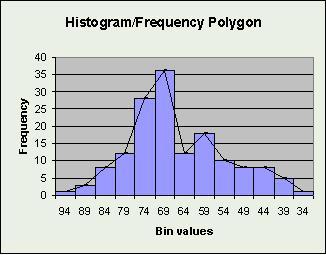
- Displayed by frequency polygons & histograms
CORRELATION
- STRENGTHS - Shows the relationship between two co-variables and strength - not unethical at all - starting point for research
- WEAKNESSES - Cannot assume cause and effect - secondary data so risks with validity
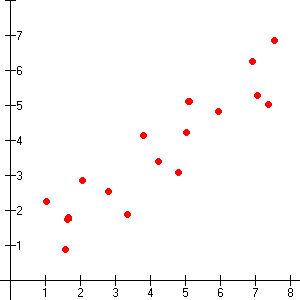
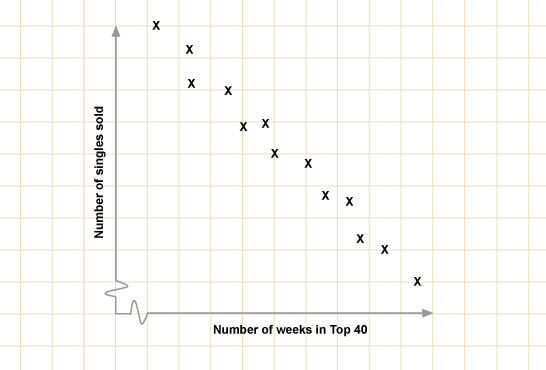
- Positive or negative correlation
- ETHICS - good as all data is secondary and no participants are involved
TYPES OF SAMPLE
- Snowball - Investigator approaches one participant who in turn approaches several others and the sample 'snowballs' to become a large sample
- Opportunity - Not really a 'technique', researcher uses people that are readily available, usually known to investigator prior to experiment
- Random - All target population have an equal chance of being selected, usually using a computer to ensure complete randomness, very rarely used
- Systematic - Finding a starting point within a target population and then obtaining subsequent participants by using a constant interval e.g. every 10th person
- Stratified - Target population is divided into subgroups and then random samples are taken from the subgroups
Imágenes y archivos del mapa
Información
- Descripción
- OCR Psychology Investigation Paper Revision
- Creado por
- barkerjames14
- Visitas
- 104
- Etiquetas
- Valoración