
Mapa mental
Religious Experience Key Terms/Definitions and Concepts
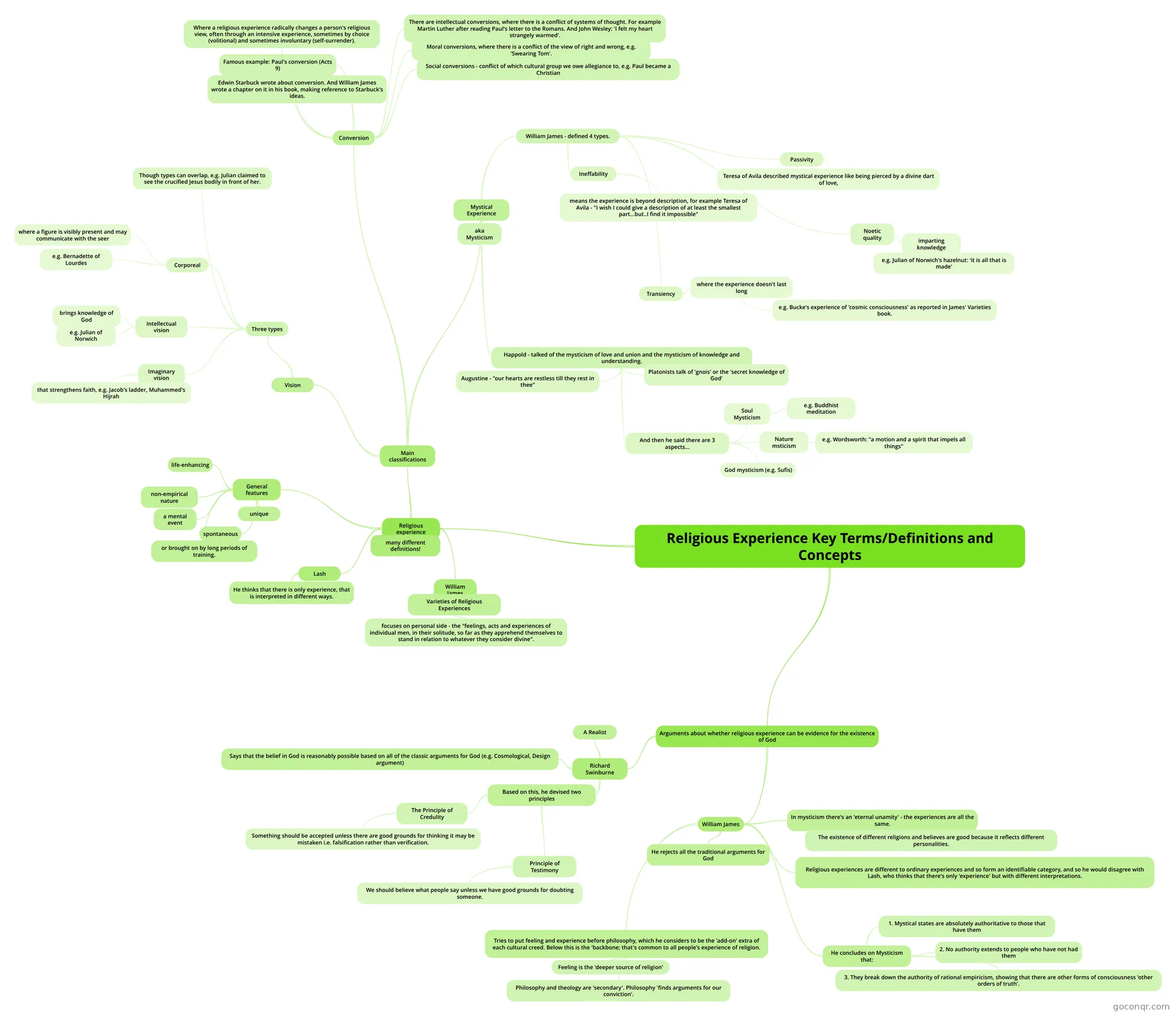
Mind map: religious experience key terms
Contenido del mapa
Religious Experience Key Terms/Definitions and Concepts
Religious experience
- many different definitions!
- Lash
- He thinks that there is only experience, that is interpreted in different ways.
- William James
- Varieties of Religious Experiences
- focuses on personal side - the "feelings, acts and experiences of individual men, in their solitude, so far as they apprehend themselves to stand in relation to whatever they consider divine".
- Varieties of Religious Experiences
- General features
- non-empirical nature
- a mental event
- spontaneous
- or brought on by long periods of training.
- unique
- life-enhancing
- Main classifications
- Vision
- Three types
- Intellectual vision
- brings knowledge of God
- e.g. Julian of Norwich
- Imaginary vision
- that strengthens faith, e.g. Jacob's ladder, Muhammed's Hijrah
- Corporeal
- where a figure is visibly present and may communicate with the seer
- e.g. Bernadette of Lourdes
- Though types can overlap, e.g. Julian claimed to see the crucified Jesus bodily in front of her.
- Intellectual vision
- Three types
- Conversion
- Where a religious experience radically changes a person's religious view, often through an intensive experience, sometimes by choice (volitional) and sometimes involuntary (self-surrender).
- Famous example: Paul's conversion (Acts 9)
- Edwin Starbuck wrote about conversion. And William James wrote a chapter on it in his book, making reference to Starbuck's ideas.
- There are intellectual conversions, where there is a conflict of systems of thought. For example Martin Luther after reading Paul's letter to the Romans. And John Wesley: 'I felt my heart strangely warmed'.
- Moral conversions, where there is a conflict of the view of right and wrong, e.g. 'Swearing Tom'.
- Social conversions - conflict of which cultural group we owe allegiance to, e.g. Paul became a Christian
- Mystical Experience
- aka Mysticism
- William James - defined 4 types.
- Ineffability
- means the experience is beyond description, for example Teresa of Avila - "I wish I could give a description of at least the smallest part...but..I find it impossible"
- Noetic quality
- imparting knowledge
- e.g. Julian of Norwich's hazelnut: 'it is all that is made'
- imparting knowledge
- Transiency
- where the experience doesn't last long
- e.g. Bucke's experience of 'cosmic consciousness' as reported in James' Varieties book.
- where the experience doesn't last long
- Passivity
- Teresa of Avila described mystical experience like being pierced by a divine dart of love,
- Ineffability
- Happold - talked of the mysticism of love and union and the mysticism of knowledge and understanding.
- Augustine - "our hearts are restless till they rest in thee"
- Platonists talk of 'gnois' or the 'secret knowledge of God'
- And then he said there are 3 aspects...
- Soul Mysticism
- e.g. Buddhist meditation
- Nature msticism
- e.g. Wordsworth: "a motion and a spirit that impels all things"
- God mysticism (e.g. Sufis)
- Soul Mysticism
- Vision
Arguments about whether religious experience can be evidence for the existence of God
- Richard Swinburne
- Says that the belief in God is reasonably possible based on all of the classic arguments for God (e.g. Cosmological, Design argument)
- Based on this, he devised two principles
- The Principle of Credulity
- Something should be accepted unless there are good grounds for thinking it may be mistaken i.e. falsification rather than verification.
- Principle of Testimony
- We should believe what people say unless we have good grounds for doubting someone.
- The Principle of Credulity
- A Realist
- William James
- He rejects all the traditional arguments for God
- Tries to put feeling and experience before philosophy, which he considers to be the 'add-on' extra of each cultural creed. Below this is the 'backbone; that's common to all people's experience of religion.
- Feeling is the 'deeper source of religion'
- Philosophy and theology are 'secondary'. Philosophy 'finds arguments for our conviction'.
- In mysticism there's an 'eternal unamity' - the experiences are all the same.
- The existence of different religions and believes are good because it reflects different personalities.
- Religious experiences are different to ordinary experiences and so form an identifiable category, and so he would disagree with Lash, who thinks that there's only 'experience' but with different interpretations.
- He concludes on Mysticism that:
- 1. Mystical states are absolutely authoritative to those that have them
- 2. No authority extends to people who have not had them
- 3. They break down the authority of rational empiricism, showing that there are other forms of consciousness 'other orders of truth'.
- Richard Swinburne
Información
- Descripción
- A-Level (Religious Experience) RS Mapa Mental sobre Religious Experience Key Terms/Definitions and Concepts, creado por markt13eduacc el 15/05/2014.
- Creado por
- markt13eduacc
- Visitas
- 45
- Valoración