
Mapa mental
State Policy & Education Part 2
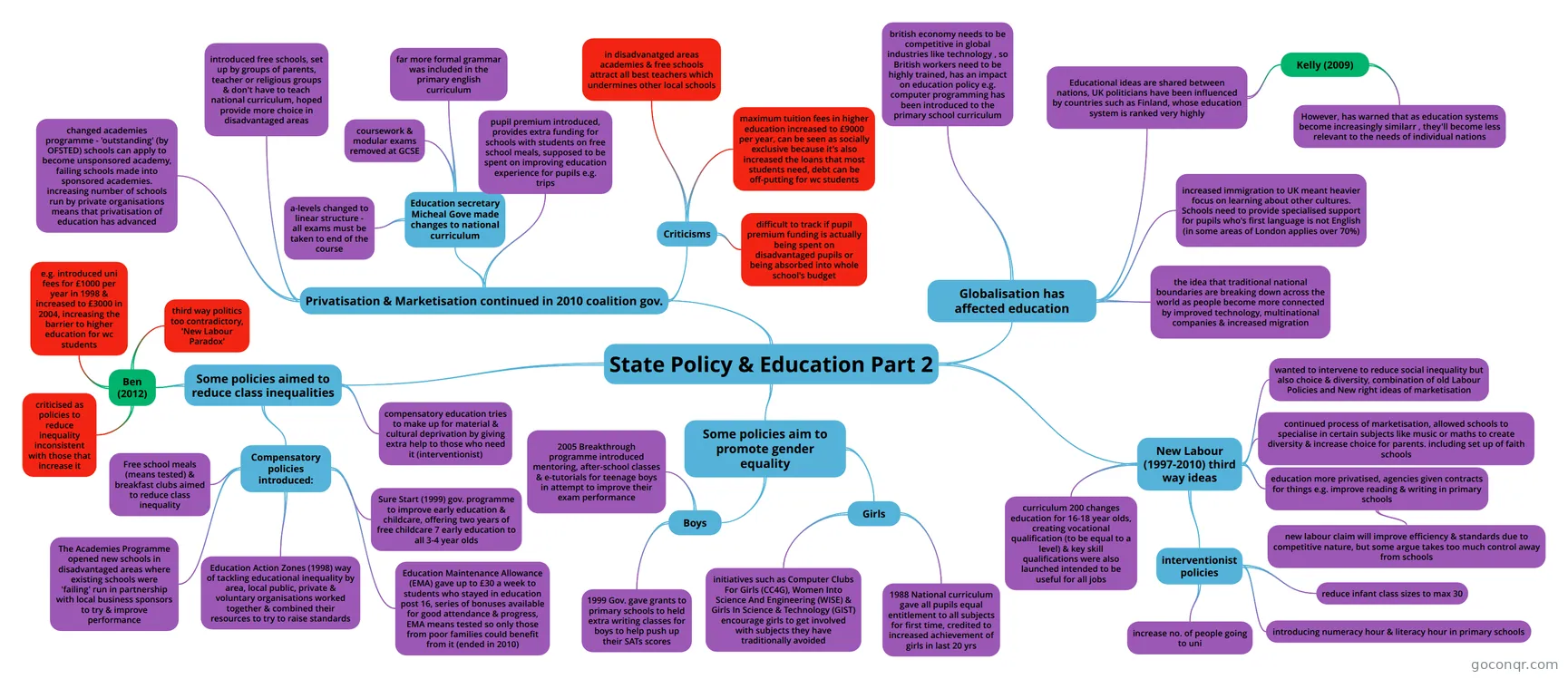
Mind map: State Policy & Education Part 2
Contenido del mapa
State Policy & Education Part 2
New Labour (1997-2010) third way ideas
- wanted to intervene to reduce social inequality but also choice & diversity, combination of old Labour Policies and New right ideas of marketisation
- continued process of marketisation, allowed schools to specialise in certain subjects like music or maths to create diversity & increase choice for parents. including set up of faith schools
- education more privatised, agencies given contracts for things e.g. improve reading & writing in primary schools
- new labour claim will improve efficiency & standards due to competitive nature, but some argue takes too much control away from schools
- interventionist policies
- reduce infant class sizes to max 30
- introducing numeracy hour & literacy hour in primary schools
- increase no. of people going to uni
- curriculum 200 changes education for 16-18 year olds, creating vocational qualification (to be equal to a level) & key skill qualifications were also launched intended to be useful for all jobs
Some policies aim to promote gender equality
- Girls
- 1988 National curriculum gave all pupils equal entitlement to all subjects for first time, credited to increased achievement of girls in last 20 yrs
- initiatives such as Computer Clubs For Girls (CC4G), Women Into Science And Engineering (WISE) & Girls In Science & Technology (GIST) encourage girls to get involved with subjects they have traditionally avoided
- Boys
- 1999 Gov. gave grants to primary schools to held extra writing classes for boys to help push up their SATs scores
- 2005 Breakthrough programme introduced mentoring, after-school classes & e-tutorials for teenage boys in attempt to improve their exam performance
- Girls
Some policies aimed to reduce class inequalities
- compensatory education tries to make up for material & cultural deprivation by giving extra help to those who need it (interventionist)
- Compensatory policies introduced:
- Sure Start (1999) gov. programme to improve early education & childcare, offering two years of free childcare 7 early education to all 3-4 year olds
- Education Maintenance Allowance (EMA) gave up to £30 a week to students who stayed in education post 16, series of bonuses available for good attendance & progress, EMA means tested so only those from poor families could benefit from it (ended in 2010)
- Education Action Zones (1998) way of tackling educational inequality by area, local public, private & voluntary organisations worked together & combined their resources to try to raise standards
- Free school meals (means tested) & breakfast clubs aimed to reduce class inequality
- The Academies Programme opened new schools in disadvantaged areas where existing schools were 'failing' run in partnership with local business sponsors to try & improve performance
- Ben (2012)
- criticised as policies to reduce inequality inconsistent with those that increase it
- e.g. introduced uni fees for £1000 per year in 1998 & increased to £3000 in 2004, increasing the barrier to higher education for wc students
- third way politics too contradictory, 'New Labour Paradox'
Privatisation & Marketisation continued in 2010 coalition gov.
- changed academies programme - 'outstanding' (by OFSTED) schools can apply to become unsponsored academy, failing schools made into sponsored academies. increasing number of schools run by private organisations means that privatisation of education has advanced
- introduced free schools, set up by groups of parents, teacher or religious groups & don't have to teach national curriculum, hoped provide more choice in disadvantaged areas
- Education secretary Micheal Gove made changes to national curriculum
- a-levels changed to linear structure - all exams must be taken to end of the course
- coursework & modular exams removed at GCSE
- far more formal grammar was included in the primary english curriculum
- pupil premium introduced, provides extra funding for schools with students on free school meals, supposed to be spent on improving education experience for pupils e.g. trips
- Criticisms
- in disadvanatged areas academies & free schools attract all best teachers which undermines other local schools
- difficult to track if pupil premium funding is actually being spent on disadvantaged pupils or being absorbed into whole school's budget
- maximum tuition fees in higher education increased to £9000 per year, can be seen as socially exclusive because it's also increased the loans that most students need, debt can be off-putting for wc students
Globalisation has affected education
- the idea that traditional national boundaries are breaking down across the world as people become more connected by improved technology, multinational companies & increased migration
- british economy needs to be competitive in global industries like technology , so British workers need to be highly trained, has an impact on education policy e.g. computer programming has been introduced to the primary school curriculum
- increased immigration to UK meant heavier focus on learning about other cultures. Schools need to provide specialised support for pupils who's first language is not English (in some areas of London applies over 70%)
- Educational ideas are shared between nations, UK politicians have been influenced by countries such as Finland, whose education system is ranked very highly
- Kelly (2009)
- However, has warned that as education systems become increasingly similarr , they'll become less relevant to the needs of individual nations
- Kelly (2009)
Información
- Descripción
- A level (Education) Sociology Mapa Mental sobre State Policy & Education Part 2, creado por Hannah Atkinson el 29/05/2017.
- Creado por
- Hannah Atkinson
- Visitas
- 3
- Valoración