
Mapa mental
B3f: Growth and development
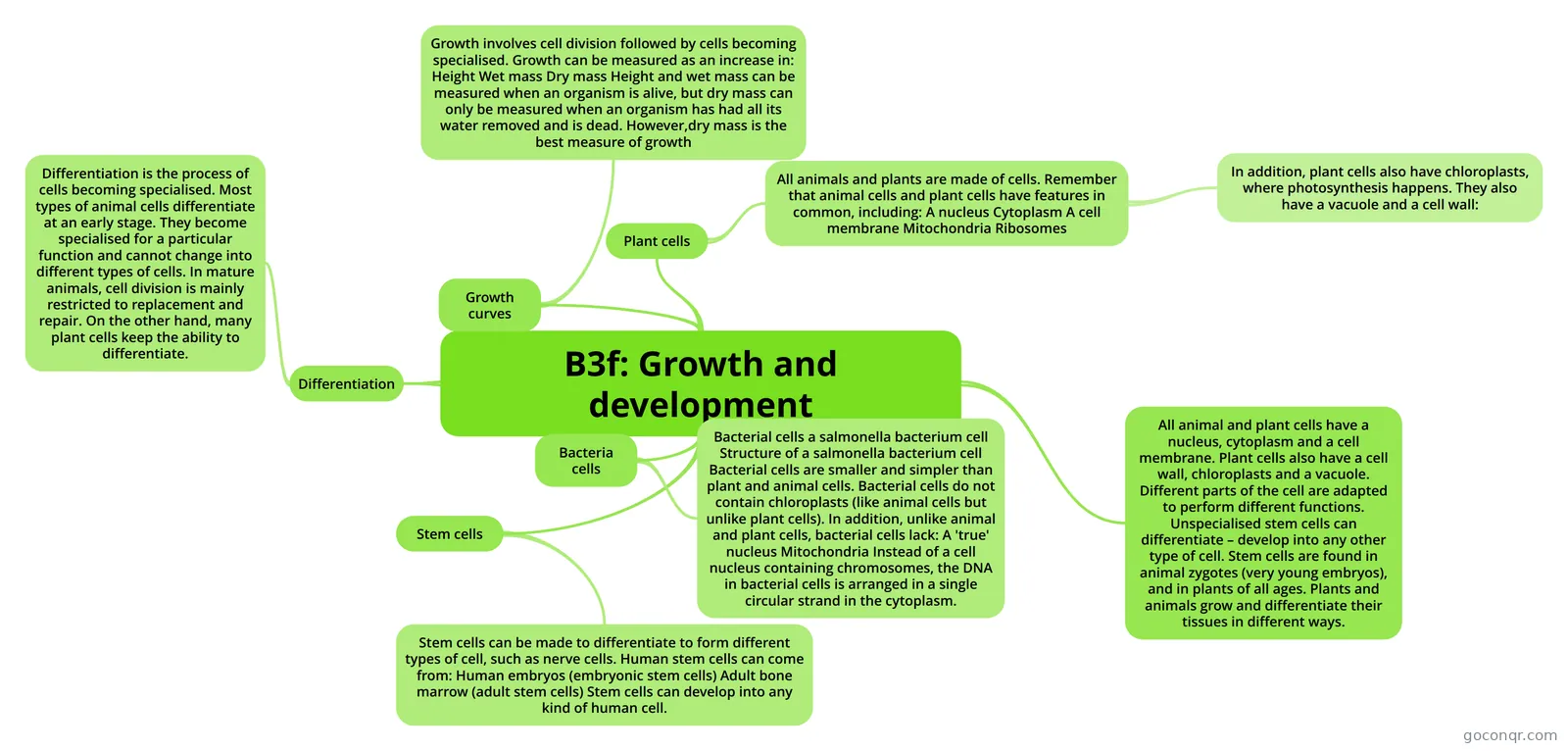
Mind map: Growth and development
Contenido del mapa
B3f: Growth and development
All animal and plant cells have a nucleus, cytoplasm and a cell membrane. Plant cells also have a cell wall, chloroplasts and a vacuole. Different parts of the cell are adapted to perform different functions. Unspecialised stem cells can differentiate – develop into any other type of cell. Stem cells are found in animal zygotes (very young embryos), and in plants of all ages. Plants and animals grow and differentiate their tissues in different ways.
Plant cells
- All animals and plants are made of cells. Remember that animal cells and plant cells have features in common, including: A nucleus Cytoplasm A cell membrane Mitochondria Ribosomes
- In addition, plant cells also have chloroplasts, where photosynthesis happens. They also have a vacuole and a cell wall:
- All animals and plants are made of cells. Remember that animal cells and plant cells have features in common, including: A nucleus Cytoplasm A cell membrane Mitochondria Ribosomes
Bacteria cells
- Bacterial cells a salmonella bacterium cell Structure of a salmonella bacterium cell Bacterial cells are smaller and simpler than plant and animal cells. Bacterial cells do not contain chloroplasts (like animal cells but unlike plant cells). In addition, unlike animal and plant cells, bacterial cells lack: A 'true' nucleus Mitochondria Instead of a cell nucleus containing chromosomes, the DNA in bacterial cells is arranged in a single circular strand in the cytoplasm.
Growth curves
- Growth involves cell division followed by cells becoming specialised. Growth can be measured as an increase in: Height Wet mass Dry mass Height and wet mass can be measured when an organism is alive, but dry mass can only be measured when an organism has had all its water removed and is dead. However,dry mass is the best measure of growth
Differentiation
- Differentiation is the process of cells becoming specialised. Most types of animal cells differentiate at an early stage. They become specialised for a particular function and cannot change into different types of cells. In mature animals, cell division is mainly restricted to replacement and repair. On the other hand, many plant cells keep the ability to differentiate.
Stem cells
- Stem cells can be made to differentiate to form different types of cell, such as nerve cells. Human stem cells can come from: Human embryos (embryonic stem cells) Adult bone marrow (adult stem cells) Stem cells can develop into any kind of human cell.
Información
- Descripción
- GCSE Biology Mapa Mental sobre B3f: Growth and development, creado por Matthew Scammells el 08/06/2014.
- Creado por
- Matthew Scammells
- Visitas
- 29
- Valoración