
Mapa mental
AP BIO Unit 2: Enzymes
Contenido del mapa
AP BIO Unit 2: Enzymes
The Energy of Life
- metabolic pathways
- metabolism: all of the chemical reactions that take place within an organism
- forms of energy
- kinetic
- energy not in motion
- thermal energy: heat
- the combination of all the movement of the particles in a substance
- the energy most difficult to use for doing work
- potential
- the energy of motion
- chemical energy
- the potential energy stored within the bonds (chemical makeup) of a substance-- the potential of energy available for release in a chemical reaction
- kinetic
- The laws of energy transformation
- 1st law of thermodynamics
- energy cannot be created or destroyed, only transferred or transformed
- 2nd law of thermodynamics
- every energy transfer or transformation increases the entropy of the universe
- 1st law of thermodynamics
- biological order and disorder
- even when the entropy of a certain system is reduced, the overall energy of the universe may be increased due to the production of heat energy
- metabolic pathways
the free energy changes of a reaction tell us whether or not it occurs spontaneously
- free energy change (ΔG), stability, and equilibrium
- ΔG= energy of reactants - energy of products
- reactions with a negative ΔG are spontaneous, exergonic
- reactions with a positive ΔG are non-spontaneous, endergonic
- things are naturally moving towards equilibrium?
- ΔG= energy of reactants - energy of products
- free energy and metabolism
- free energy change (ΔG), stability, and equilibrium
ATP powers cellular work by coupling exergonic reactions to endergonic reactions
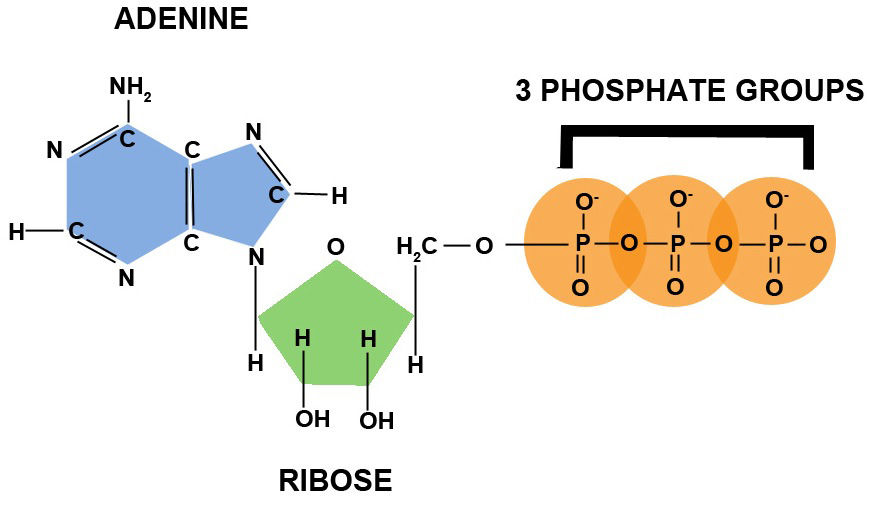
- the structure and hydrolysis of atp
- ATP= adenosine TRI phosphate
- tends to lose one phosphate group, becomes ADP: adenosine DIphosphate
- phosphate groups tend to detach because of their negative charge (negatives next to each other--> like charges repel)
- tends to lose one phosphate group, becomes ADP: adenosine DIphosphate
- ATP= adenosine TRI phosphate
- how the hydrolysis of ATP performs work
- the regeneration of ATP
- from ADP?
- the structure and hydrolysis of atp
Enzymes speed up metabolic reactions by lowering energy barriers
- the activation energy barrier
- EsubA: activation energy
- the input energy required for an endergonic reaction to begin
- how enzymes speed up reactions
- substrate specificity of enzymes
- structure of enzymes specific to fit enzymes: proteins (3, 4 structures)
- some enzymes are nucleic acids
- induced fit
- when a substrate enters an enzyme's active site, the enzyme's structure changes slightly to grip more tightly around the substrate
- substrate: what is catalyzed by the enzyme
- enzyme: a biological catalyst
- structure of enzymes specific to fit enzymes: proteins (3, 4 structures)
- catalysis in an enzyme's active site
- substrate enters an enzyme's active site, it catalyzed
- effects of local conditions on enzyme activity
- effects of temperature and pH
- enzyme has an optimal pH and temp where catalysis is most efficient
- temp
- temp: below optimal point, as temp increases efficiency increases...
- temp= average heat energy, heat energy= average motion of particles in a substance... more temp=more motion of molecules= substrates will enter enzymes faster
- past optimal point, as temp increases efficiency decreases
- too much heat (too much motion of particles) can cause protein denaturation-- weak bonds holding together a protein's 3°/4° structures (what creates its function) are broken
- temp: below optimal point, as temp increases efficiency increases...
- pH
- either more acidic or more basic than optimal point= less efficient
- can cause protein denaturation...
- ex: enzymes in stomach made specifically to function at pH of 2 (pH of stomach acid)... other enzymes would denature in that state
- either more acidic or more basic than optimal point= less efficient
- temp
- enzyme has an optimal pH and temp where catalysis is most efficient
- cofactors
- molecules needed for/that aid in an enzyme's catalysis
- conenzymes: organic (molecule) cofactors
- enzyme inhibitors
- needed for when enough of end product has been catalyzed
- competitive inhibitors
- fit directly into an enzyme's active site, blocking substrates from doing so
- noncompetitive inhibitors
- fit into a site on the enzyme other than the active site, change the enzyme's structure so the enzyme will no longer fit
- effects of temperature and pH
- the evolution of enzymes
- the activation energy barrier
regulation of enzyme activity helps control metabolism
- allosteric regulation of enzymes
- can be both
- allosteric site
- site on an enzyme where allosteric regulators attach-- not the active site
- allosteric activators and inhibitors
- feedback inhibition
- specific localization of enzymes within the cell
- allosteric regulation of enzymes
Imágenes y archivos del mapa
Información
- Descripción
- AP AP BIO Mapa Mental sobre AP BIO Unit 2: Enzymes, creado por Meredith W el 30/09/2017.
- Creado por
- Meredith W
- Visitas
- 157
- Etiquetas
- Valoración