
Mapa mental
Enzymes
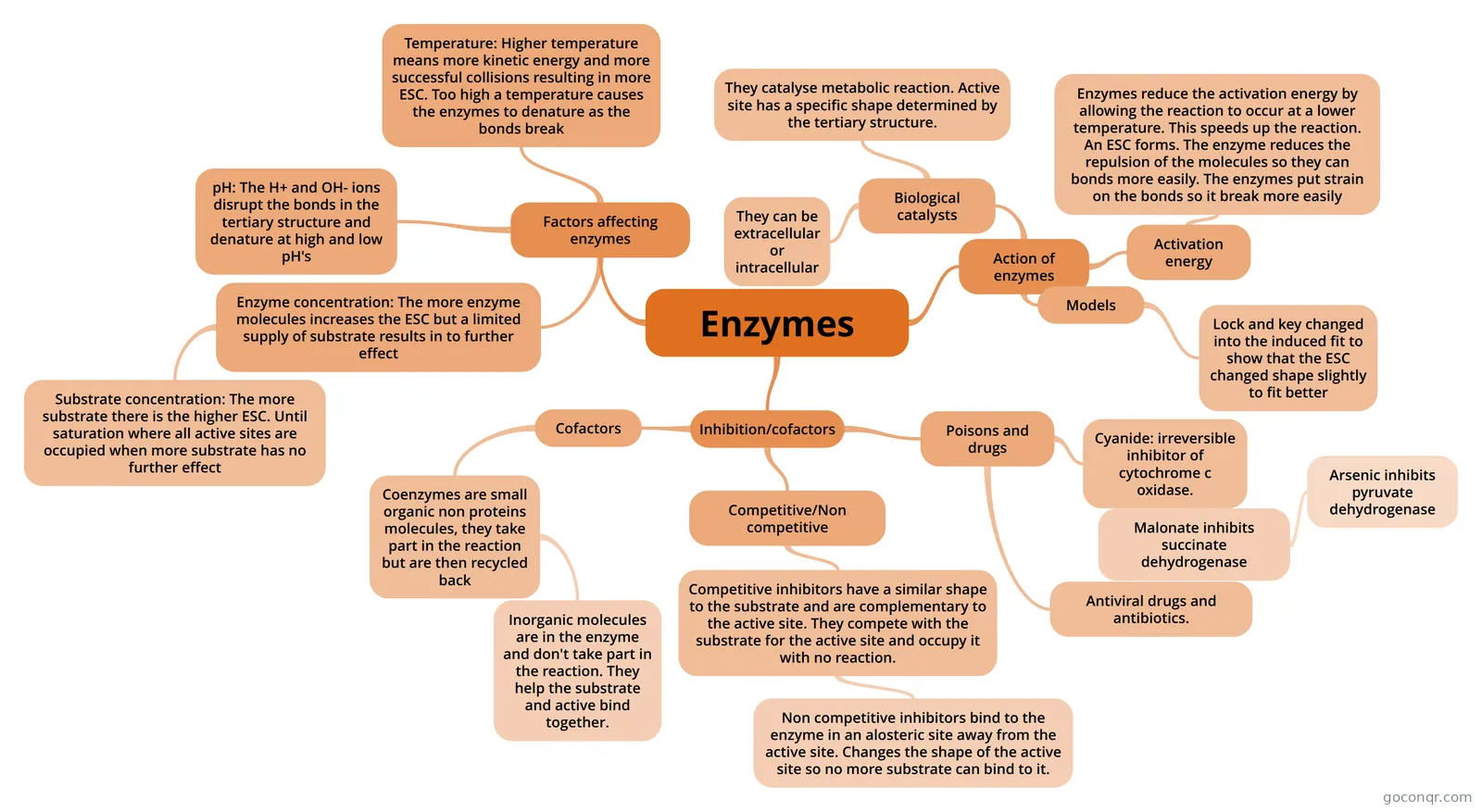
Mind map: Enzymes
Contenido del mapa
Enzymes
Action of enzymes
- Biological catalysts
- They catalyse metabolic reaction. Active site has a specific shape determined by the tertiary structure.
- They can be extracellular or intracellular
- Activation energy
- Enzymes reduce the activation energy by allowing the reaction to occur at a lower temperature. This speeds up the reaction. An ESC forms. The enzyme reduces the repulsion of the molecules so they can bonds more easily. The enzymes put strain on the bonds so it break more easily
- Models
- Lock and key changed into the induced fit to show that the ESC changed shape slightly to fit better
- Biological catalysts
Factors affecting enzymes
- Temperature: Higher temperature means more kinetic energy and more successful collisions resulting in more ESC. Too high a temperature causes the enzymes to denature as the bonds break
- pH: The H+ and OH- ions disrupt the bonds in the tertiary structure and denature at high and low pH's
- Enzyme concentration: The more enzyme molecules increases the ESC but a limited supply of substrate results in to further effect
- Substrate concentration: The more substrate there is the higher ESC. Until saturation where all active sites are occupied when more substrate has no further effect
Inhibition/cofactors
- Cofactors
- Coenzymes are small organic non proteins molecules, they take part in the reaction but are then recycled back
- Inorganic molecules are in the enzyme and don't take part in the reaction. They help the substrate and active bind together.
- Coenzymes are small organic non proteins molecules, they take part in the reaction but are then recycled back
- Competitive/Non competitive
- Competitive inhibitors have a similar shape to the substrate and are complementary to the active site. They compete with the substrate for the active site and occupy it with no reaction.
- Non competitive inhibitors bind to the enzyme in an alosteric site away from the active site. Changes the shape of the active site so no more substrate can bind to it.
- Competitive inhibitors have a similar shape to the substrate and are complementary to the active site. They compete with the substrate for the active site and occupy it with no reaction.
- Poisons and drugs
- Cyanide: irreversible inhibitor of cytochrome c oxidase.
- Malonate inhibits succinate dehydrogenase
- Arsenic inhibits pyruvate dehydrogenase
- Malonate inhibits succinate dehydrogenase
- Antiviral drugs and antibiotics.
- Cyanide: irreversible inhibitor of cytochrome c oxidase.
- Cofactors
Información
- Descripción
- (F212) Biology Mapa Mental sobre Enzymes, creado por Nikita96 el 28/05/2013.
- Creado por
- Nikita96
- Visitas
- 116
- Etiquetas
- Valoración