
Mapa mental
C8 - Chemical Analysis

Contenido del mapa
C8 - Chemical Analysis
Purity
- Only one compound or element - not mixed with anything else
- A melting or boiling point can tell you the purity
- Specific to element/compounds
- Closer = more pure
- Impure = lower melting/higher boiling
- Specific to element/compounds
Formulations
- Useful mixture with precise purpose
- components measured specifically to perform function
- Pharmacy
- Consumption
- Shelf Life
- Concentration
- Packaging - ratio/percent of each component = suitable decisions
Paper Chromatography
- Mobile phase = molecules can move (liquid or gas)
- more time spent here = quicker movement through stationary
- Stationary phase = molecules cannot move (solid or thick liquid)
- Distance dependent on how soluble they are + how attracted to the paper they are
- higher solubility + low attraction = more time in mobile = further
- ink = soluble
- pencil = insoluble
- Rf values
- Is a certain substance in a mixture
- Measure pure substance Rf (reference) - compare to Rf spots in mixture
- Change of solvent = Rf changes
- Mixture + Reference spot in all solvents is the same = substance present
- Mixture + Reference spot in all solvents is the same = substance present
- Is a certain substance in a mixture
- Mobile phase = molecules can move (liquid or gas)
Gas Tests
- Chlorine = bleaches litmus paper (may turn red before Cl is acidic
- Oxygen = relights glowing splint
- Carbon Dioxide = bubble through limewater turning it cloudy
- Hydrogen = squeaky pop from lit splint
Tests for Anions
- Dilute acid for carbonates
- 1. Add drops of dilute acid
- 2. Connect test tube to test tube of limewater
- 3. Carbonate = present if limewater turns cloudy (CO2)
- Sulfates
- 1. Add HCl
- gets rid of carbonates which also produce a white precipitate
- 2. Add barium chloride
- 3. Sulfate ions = white precipitate forms
- 1. Add HCl
- Halides
- 1. Add dilute nitric acid
- 2. Add silver nitrate
- Chloride = white precip
- Bromide = cream precip
- Iodide = yellow precip
- Dilute acid for carbonates
Tests for Cations
- Flame Test
- 1. Clean loop by dipping in HCl + putting through flame
- 2. Dip in solid/solution
- 3. Put through flame
- Lithium
- Sodium
- Potassium
- Calcium
- Copper
- Works for single metal ions
- Flame Emission Spectroscopy
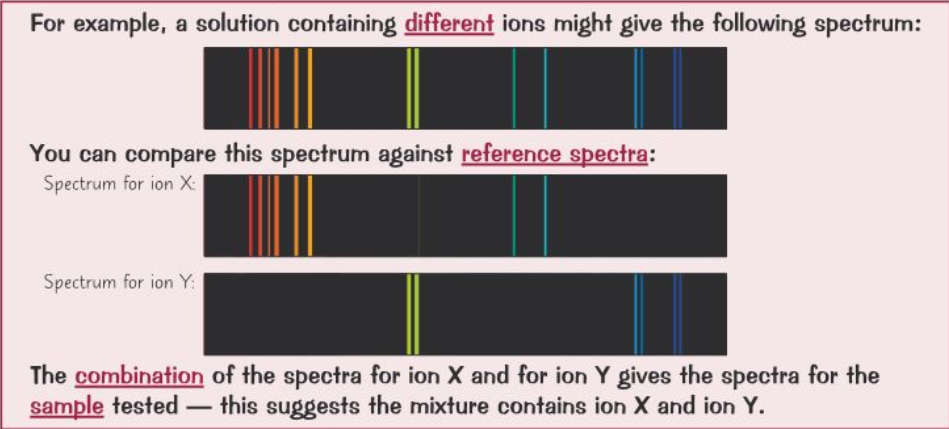
- Heat causes electrons to change energy levels. Drop back = transfer light
- Identify wavelengths create line spectrum
- Higher concentration = more intense
- No two ions have the same line spectrum - can identify more than one ion
- Advantages
- More accurate
- Flame tests rely on the human eye
- Very fast/automated
- Very sensitive
- More accurate
- Flame Emission Spectroscopy
- Sodium hydroxide forms a precipitate
- Calcium
- Copper (II)
- Iron (II)
- Iron (III)
- Aluminium
- White then redissolves to be colourless
- Magnesium
- Most metal hydroxides = insoluble
- Flame Test
Imágenes y archivos del mapa
Información
- Descripción
- An overview of the C8 topic, Chemical Analysis, from the AQA Chemistry GCSE course.
- Creado por
- Jamie Howell
- Visitas
- 363
- Etiquetas
- Valoración