
Mapa mental
The Progressive Era
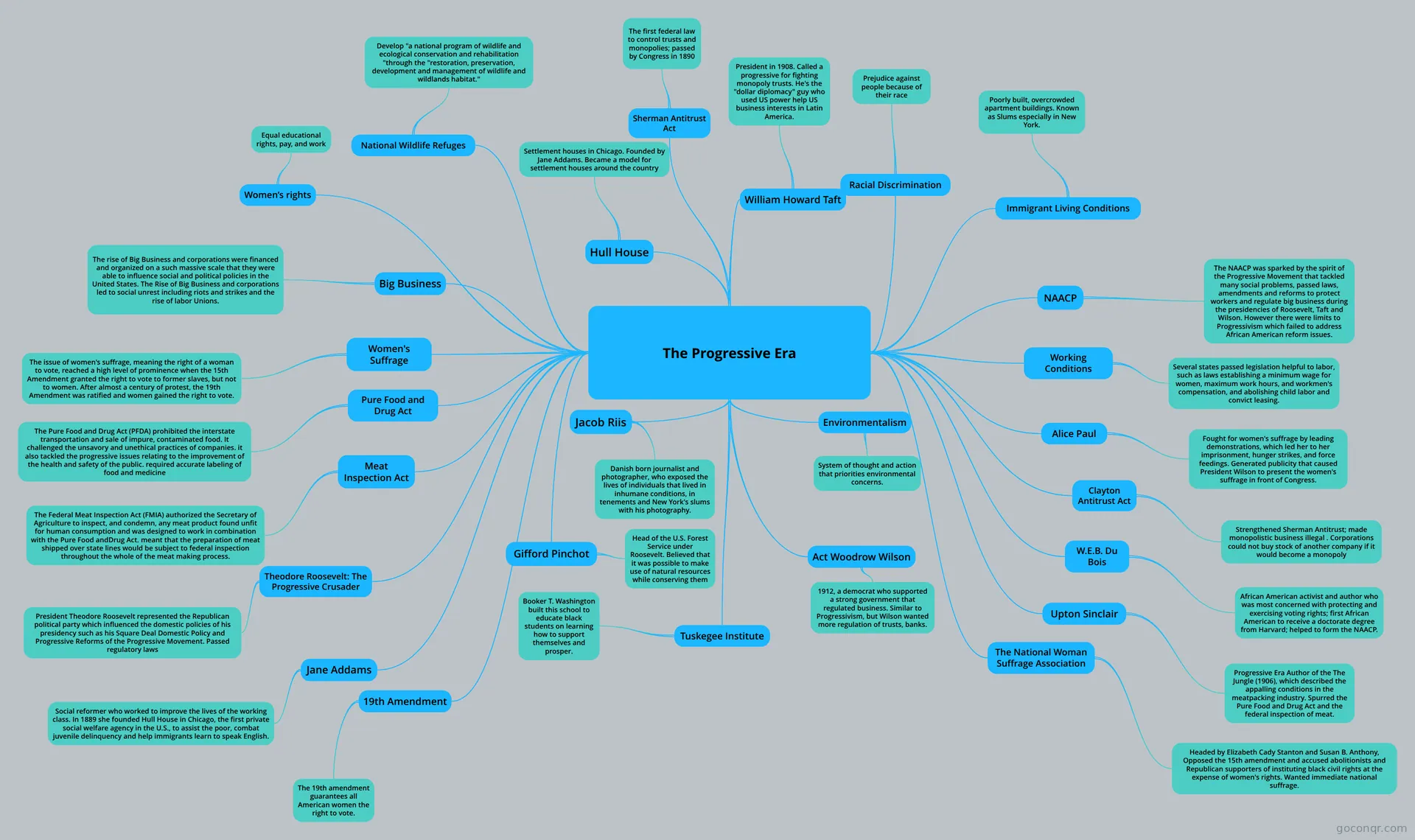
Mind map: The Progressive Era
Contenido del mapa
The Progressive Era
Women's Suffrage
- The issue of women's suffrage, meaning the right of a woman to vote, reached a high level of prominence when the 15th Amendment granted the right to vote to former slaves, but not to women. After almost a century of protest, the 19th Amendment was ratified and women gained the right to vote.
Big Business
- The rise of Big Business and corporations were financed and organized on a such massive scale that they were able to influence social and political policies in the United States. The Rise of Big Business and corporations led to social unrest including riots and strikes and the rise of labor Unions.
NAACP
- The NAACP was sparked by the spirit of the Progressive Movement that tackled many social problems, passed laws, amendments and reforms to protect workers and regulate big business during the presidencies of Roosevelt, Taft and Wilson. However there were limits to Progressivism which failed to address African American reform issues.
Pure Food and Drug Act
- The Pure Food and Drug Act (PFDA) prohibited the interstate transportation and sale of impure, contaminated food. It challenged the unsavory and unethical practices of companies. it also tackled the progressive issues relating to the improvement of the health and safety of the public. required accurate labeling of food and medicine
Theodore Roosevelt: The Progressive Crusader
- President Theodore Roosevelt represented the Republican political party which influenced the domestic policies of his presidency such as his Square Deal Domestic Policy and Progressive Reforms of the Progressive Movement. Passed regulatory laws
Upton Sinclair
- Progressive Era Author of the The Jungle (1906), which described the appalling conditions in the meatpacking industry. Spurred the Pure Food and Drug Act and the federal inspection of meat.
Sherman Antitrust Act
- The first federal law to control trusts and monopolies; passed by Congress in 1890
W.E.B. Du Bois
- African American activist and author who was most concerned with protecting and exercising voting rights; first African American to receive a doctorate degree from Harvard; helped to form the NAACP.
Clayton Antitrust Act
- Strengthened Sherman Antitrust; made monopolistic business illegal . Corporations could not buy stock of another company if it would become a monopoly
Alice Paul
- Fought for women's suffrage by leading demonstrations, which led her to her imprisonment, hunger strikes, and force feedings. Generated publicity that caused President Wilson to present the women's suffrage in front of Congress.
Meat Inspection Act
- The Federal Meat Inspection Act (FMIA) authorized the Secretary of Agriculture to inspect, and condemn, any meat product found unfit for human consumption and was designed to work in combination with the Pure Food andDrug Act. meant that the preparation of meat shipped over state lines would be subject to federal inspection throughout the whole of the meat making process.
Tuskegee Institute
- Booker T. Washington built this school to educate black students on learning how to support themselves and prosper.
Jane Addams
- Social reformer who worked to improve the lives of the working class. In 1889 she founded Hull House in Chicago, the first private social welfare agency in the U.S., to assist the poor, combat juvenile delinquency and help immigrants learn to speak English.
William Howard Taft
- President in 1908. Called a progressive for fighting monopoly trusts. He's the "dollar diplomacy" guy who used US power help US business interests in Latin America.
Act Woodrow Wilson
- 1912, a democrat who supported a strong government that regulated business. Similar to Progressivism, but Wilson wanted more regulation of trusts, banks.
19th Amendment
- The 19th amendment guarantees all American women the right to vote.
Working Conditions
- Several states passed legislation helpful to labor, such as laws establishing a minimum wage for women, maximum work hours, and workmen's compensation, and abolishing child labor and convict leasing.
The National Woman Suffrage Association
- Headed by Elizabeth Cady Stanton and Susan B. Anthony, Opposed the 15th amendment and accused abolitionists and Republican supporters of instituting black civil rights at the expense of women's rights. Wanted immediate national suffrage.
Jacob Riis
- Danish born journalist and photographer, who exposed the lives of individuals that lived in inhumane conditions, in tenements and New York's slums with his photography.
Gifford Pinchot
- Head of the U.S. Forest Service under Roosevelt. Believed that it was possible to make use of natural resources while conserving them
Hull House
- Settlement houses in Chicago. Founded by Jane Addams. Became a model for settlement houses around the country
Environmentalism
- System of thought and action that priorities environmental concerns.
National Wildlife Refuges
- Develop "a national program of wildlife and ecological conservation and rehabilitation "through the "restoration, preservation, development and management of wildlife and wildlands habitat."
Immigrant Living Conditions
- Poorly built, overcrowded apartment buildings. Known as Slums especially in New York.
Women’s rights
- Equal educational rights, pay, and work
Racial Discrimination
- Prejudice against people because of their race
Información
- Descripción
- Reform movement from 1890 to 1920 that sought to make state and national politics more democratic and government more efficient.
- Creado por
- Taylor Porter
- Visitas
- 1
- Historial
-
- Creado por Taylor Porter · 20 feb 2018
- Copiado por Taylor Porter · 21 feb 2018
- Valoración