
Mapa mental
The Merchant's Tale
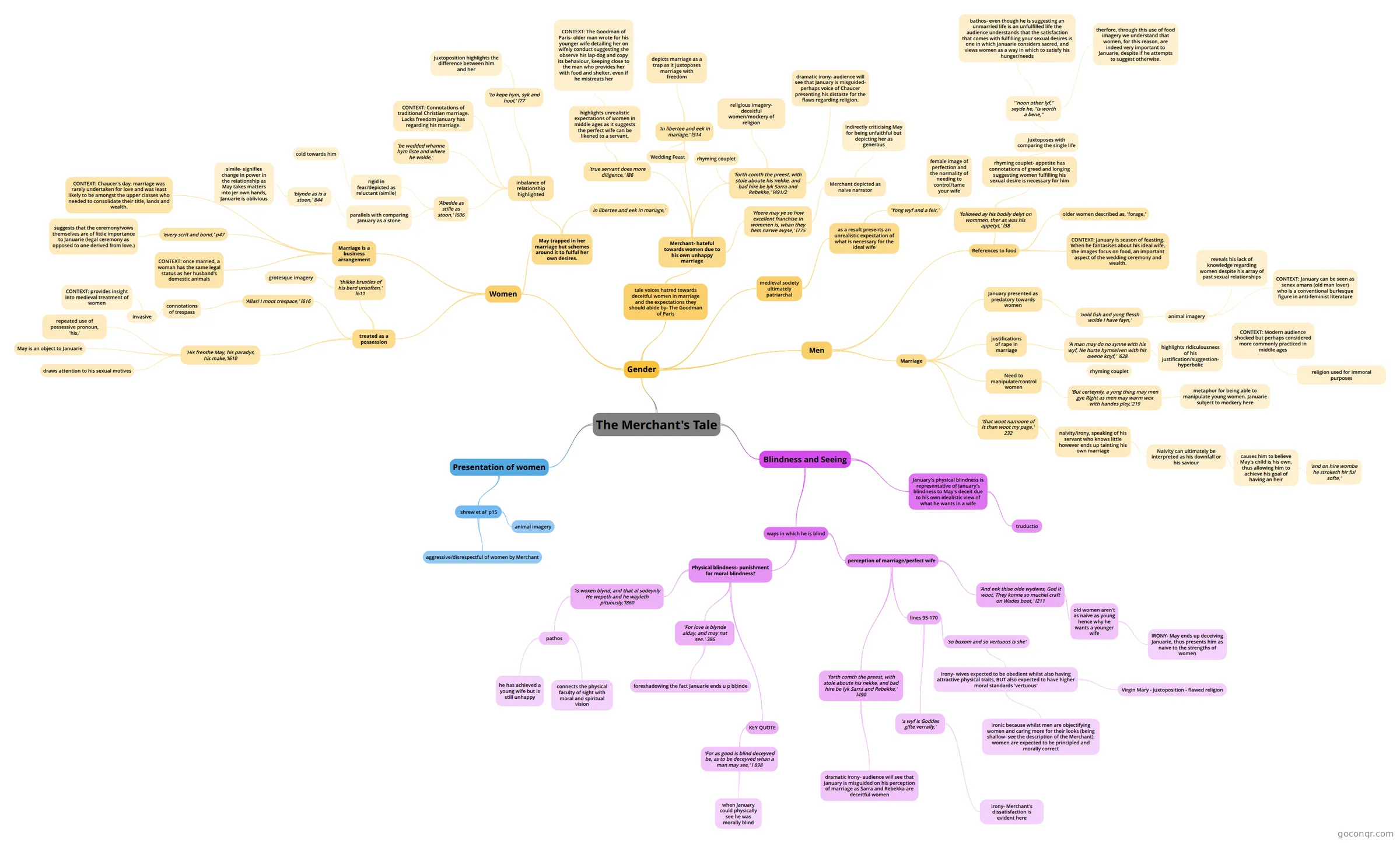
Mind map: The Merchant's Tale
Contenido del mapa
The Merchant's Tale
Presentation of women
- 'shrew et al' p15
- animal imagery
- aggressive/disrespectful of women by Merchant
- 'shrew et al' p15
Blindness and Seeing
- January's physical blindness is representative of January's blindness to May's deceit due to his own idealistic view of what he wants in a wife
- truductio
- ways in which he is blind
- perception of marriage/perfect wife
- lines 95-170
- 'so buxom and so vertuous is she'
- irony- wives expected to be obedient whilst also having attractive physical traits, BUT also expected to have higher moral standards 'vertuous'
- ironic because whilst men are objectifying women and caring more for their looks (being shallow- see the description of the Merchant), women are expected to be principled and morally correct
- Virgin Mary - juxtoposition - flawed religion
- irony- wives expected to be obedient whilst also having attractive physical traits, BUT also expected to have higher moral standards 'vertuous'
- 'a wyf is Goddes gifte verraily,'
- irony- Merchant's dissatisfaction is evident here
- 'so buxom and so vertuous is she'
- 'forth comth the preest, with stole aboute his nekke, and bad hire be lyk Sarra and Rebekke,' l490
- dramatic irony- audience will see that January is misguided on his perception of marriage as Sarra and Rebekka are deceitful women
- 'And eek thise olde wydwes, God it woot, They konne so muchel craft on Wades boot,' l211
- old women aren't as naive as young hence why he wants a younger wife
- IRONY- May ends up deceiving Januarie, thus presents him as naive to the strengths of women
- old women aren't as naive as young hence why he wants a younger wife
- lines 95-170
- Physical blindness- punishment for moral blindness?
- 'is woxen blynd, and that al sodeynly He wepeth and he wayleth pituously,'l860
- pathos
- he has achieved a young wife but is still unhappy
- connects the physical faculty of sight with moral and spiritual vision
- pathos
- 'For love is blynde alday, and may nat see.' 386
- foreshadowing the fact Januarie ends u p bl;inde
- KEY QUOTE
- 'For as good is blind deceyved be, as to be deceyved whan a man may see,' l 898
- when January could physically see he was morally blind
- 'For as good is blind deceyved be, as to be deceyved whan a man may see,' l 898
- 'is woxen blynd, and that al sodeynly He wepeth and he wayleth pituously,'l860
- perception of marriage/perfect wife
- January's physical blindness is representative of January's blindness to May's deceit due to his own idealistic view of what he wants in a wife
Gender
- tale voices hatred towards deceitful women in marriage and the expectations they should abide by- The Goodman of Paris
- Merchant- hateful towards women due to his own unhappy marriage
- 'true servant does more diligence,' l86
- highlights unrealistic expectations of women in middle ages as it suggests the perfect wife can be likened to a servant.
- CONTEXT: The Goodman of Paris- older man wrote for his younger wife detailing her on wifely conduct suggesting she observe his lap-dog and copy its behaviour, keeping close to the man who provides her with food and shelter, even if he mistreats her
- highlights unrealistic expectations of women in middle ages as it suggests the perfect wife can be likened to a servant.
- 'In libertee and eek in mariage,' l514
- Wedding Feast
- depicts marriage as a trap as it juxtoposes marriage with freedom
- 'forth comth the preest, with stole aboute his nekke, and bad hire be lyk Sarra and Rebekke,' l491/2
- rhyming couplet
- religious imagery- deceitful women/mockery of religion
- dramatic irony- audience will see that January is misguided- perhaps voice of Chaucer presenting his distaste for the flaws regarding religion.
- 'Heere may ye se how excellent franchise In wommen is, whan they hem narwe avyse,' l775
- Merchant depicted as naive narrator
- indirectly criticising May for being unfaithful but depicting her as generous
- Merchant depicted as naive narrator
- 'true servant does more diligence,' l86
- Merchant- hateful towards women due to his own unhappy marriage
- medieval society ultimately patriarchal
- as a result presents an unrealistic expectation of what is necessary for the ideal wife
- 'Yong wyf and a feir,'
- female image of perfection and the normality of needing to control/tame your wife
- 'Yong wyf and a feir,'
- as a result presents an unrealistic expectation of what is necessary for the ideal wife
- Men
- References to food
- 'followed ay his bodily delyt on wommen, ther as was his appetyt,' l38
- rhyming couplet- appetite has connotations of greed and longing suggesting women fulfilling his sexual desire is necessary for him
- Juxtoposes with comparing the single life
- '"noon other lyf," seyde he, "is worth a bene,"
- bathos- even though he is suggesting an unmarried life is an unfulfilled life the audience understands that the satisfaction that comes with fulfilling your sexual desires is one in which Januarie considers sacred, and views women as a way in which to satisfy his hunger/needs
- therfore, through this use of food imagery we understand that women, for this reason, are indeed very important to Januarie, despite if he attempts to suggest otherwise.
- '"noon other lyf," seyde he, "is worth a bene,"
- Juxtoposes with comparing the single life
- rhyming couplet- appetite has connotations of greed and longing suggesting women fulfilling his sexual desire is necessary for him
- older women described as, 'forage,'
- CONTEXT: January is season of feasting. When he fantasises about his ideal wife, the images focus on food, an important aspect of the wedding ceremony and wealth.
- 'followed ay his bodily delyt on wommen, ther as was his appetyt,' l38
- Marriage
- January presented as predatory towards women
- 'oold fish and yong flessh wolde I have fayn,'
- animal imagery
- reveals his lack of knowledge regarding women despite his array of past sexual relationships
- CONTEXT: January can be seen as senex amans (old man lover) who is a conventional burlesque figure in anti-feminist literature
- animal imagery
- 'oold fish and yong flessh wolde I have fayn,'
- justifications of rape in marriage
- 'A man may do no synne with his wyf, Ne hurte hymselven with his owene knyf,' '628
- rhyming couplet
- highlights ridiculousness of his justification/suggestion- hyperbolic
- CONTEXT: Modern audience shocked but perhaps considered more commonly practiced in middle ages
- religion used for immoral purposes
- CONTEXT: Modern audience shocked but perhaps considered more commonly practiced in middle ages
- 'A man may do no synne with his wyf, Ne hurte hymselven with his owene knyf,' '628
- Need to manipulate/control women
- 'But certeynly, a yong thing may men gye Right as men may warm wex with handes pley,'219
- metaphor for being able to manipulate young women. Januarie subject to mockery here
- 'But certeynly, a yong thing may men gye Right as men may warm wex with handes pley,'219
- 'that woot namoore of it than woot my page,' 232
- naivity/irony, speaking of his servant who knows little however ends up tainting his own marriage
- Naivity can ultimately be interpreted as his downfall or his saviour
- causes him to believe May's child is his own, thus allowing him to achieve his goal of having an heir
- 'and on hire wombe he stroketh hir ful softe,'
- causes him to believe May's child is his own, thus allowing him to achieve his goal of having an heir
- Naivity can ultimately be interpreted as his downfall or his saviour
- naivity/irony, speaking of his servant who knows little however ends up tainting his own marriage
- January presented as predatory towards women
- References to food
- Women
- May trapped in her marriage but schemes around it to fulful her own desires.
- in libertee and eek in mariage,'
- inbalance of relationship highlighted
- 'to kepe hym, syk and hool,' l77
- juxtoposition highlights the difference between him and her
- CONTEXT: Connotations of traditional Christian marriage. Lacks freedom January has regarding his marriage.
- 'be wedded whanne hym liste and where he wolde,'
- 'Abedde as stille as stoon,' l606
- rigid in fear/depicted as reluctant (simile)
- cold towards him
- parallels with comparing January as a stone
- 'blynde as is a stoon,' 844
- simile- signifies change in power in the relationship as May takes matters into jer own hands, Januarie is oblivious
- 'blynde as is a stoon,' 844
- rigid in fear/depicted as reluctant (simile)
- 'to kepe hym, syk and hool,' l77
- Marriage is a business arrangement
- CONTEXT: Chaucer's day, marriage was rarely undertaken for love and was least likely to be amongst the upper classes who needed to consolidate their title, lands and wealth.
- 'every scrit and bond,' p47
- suggests that the ceremony/vows themselves are of little importance to Januarie (legal ceremony as opposed to one derived from love.)
- CONTEXT: once married, a woman has the same legal status as her husband's domestic animals
- treated as a possession
- 'thikke brustles of his berd unsoften,' l611
- grotesque imagery
- 'Allas! I moot trespace,' l616
- connotations of trespass
- invasive
- CONTEXT: provides insight into medieval treatment of women
- invasive
- connotations of trespass
- 'His fresshe May, his paradys, his make,'l610
- repeated use of possessive pronoun, 'his,'
- May is an object to Januarie
- draws attention to his sexual motives
- 'thikke brustles of his berd unsoften,' l611
- May trapped in her marriage but schemes around it to fulful her own desires.
- tale voices hatred towards deceitful women in marriage and the expectations they should abide by- The Goodman of Paris
Información
- Descripción
- A level English Literature Mapa Mental sobre The Merchant's Tale, creado por Ella T-R el 08/04/2018.
- Creado por
- Ella T-R
- Visitas
- 1
- Historial
-
- Creado por Freya Waters · 14 jun 2017
- Copiado por Ella T-R · 8 abr 2018
- Valoración