
Mapa mental
Theories of sleep
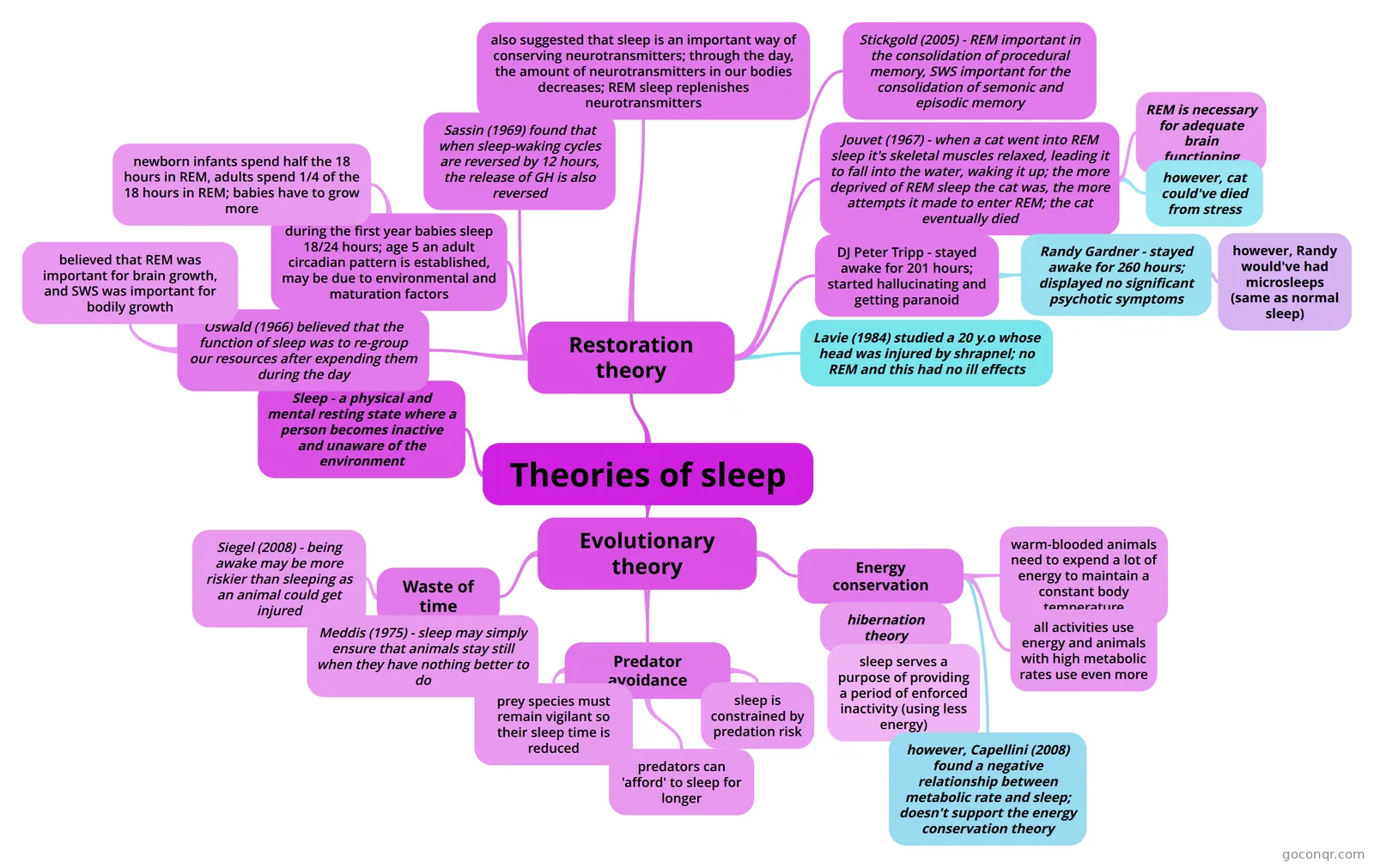
Mind map: Theories of sleep
Contenido del mapa
Theories of sleep
Sleep - a physical and mental resting state where a person becomes inactive and unaware of the environment
Restoration theory
- Oswald (1966) believed that the function of sleep was to re-group our resources after expending them during the day
- believed that REM was important for brain growth, and SWS was important for bodily growth
- during the first year babies sleep 18/24 hours; age 5 an adult circadian pattern is established, may be due to environmental and maturation factors
- newborn infants spend half the 18 hours in REM, adults spend 1/4 of the 18 hours in REM; babies have to grow more
- Sassin (1969) found that when sleep-waking cycles are reversed by 12 hours, the release of GH is also reversed
- also suggested that sleep is an important way of conserving neurotransmitters; through the day, the amount of neurotransmitters in our bodies decreases; REM sleep replenishes neurotransmitters
- Stickgold (2005) - REM important in the consolidation of procedural memory, SWS important for the consolidation of semonic and episodic memory
- Jouvet (1967) - when a cat went into REM sleep it's skeletal muscles relaxed, leading it to fall into the water, waking it up; the more deprived of REM sleep the cat was, the more attempts it made to enter REM; the cat eventually died
- REM is necessary for adequate brain functioning
- however, cat could've died from stress
- DJ Peter Tripp - stayed awake for 201 hours; started hallucinating and getting paranoid
- Randy Gardner - stayed awake for 260 hours; displayed no significant psychotic symptoms
- however, Randy would've had microsleeps (same as normal sleep)
- Randy Gardner - stayed awake for 260 hours; displayed no significant psychotic symptoms
- Lavie (1984) studied a 20 y.o whose head was injured by shrapnel; no REM and this had no ill effects
- Oswald (1966) believed that the function of sleep was to re-group our resources after expending them during the day
Evolutionary theory
- Energy conservation
- warm-blooded animals need to expend a lot of energy to maintain a constant body temperature
- all activities use energy and animals with high metabolic rates use even more
- hibernation theory
- sleep serves a purpose of providing a period of enforced inactivity (using less energy)
- however, Capellini (2008) found a negative relationship between metabolic rate and sleep; doesn't support the energy conservation theory
- Predator avoidance
- sleep is constrained by predation risk
- predators can 'afford' to sleep for longer
- prey species must remain vigilant so their sleep time is reduced
- Waste of time
- Meddis (1975) - sleep may simply ensure that animals stay still when they have nothing better to do
- Siegel (2008) - being awake may be more riskier than sleeping as an animal could get injured
- Energy conservation
Información
- Descripción
- A-Levels (Levels of Consciousness) PY4 Mapa Mental sobre Theories of sleep, creado por Hayd23 el 16/06/2013.
- Creado por
- Hayd23
- Visitas
- 169
- Etiquetas
- Valoración