
Mapa mental
Dinosaurs
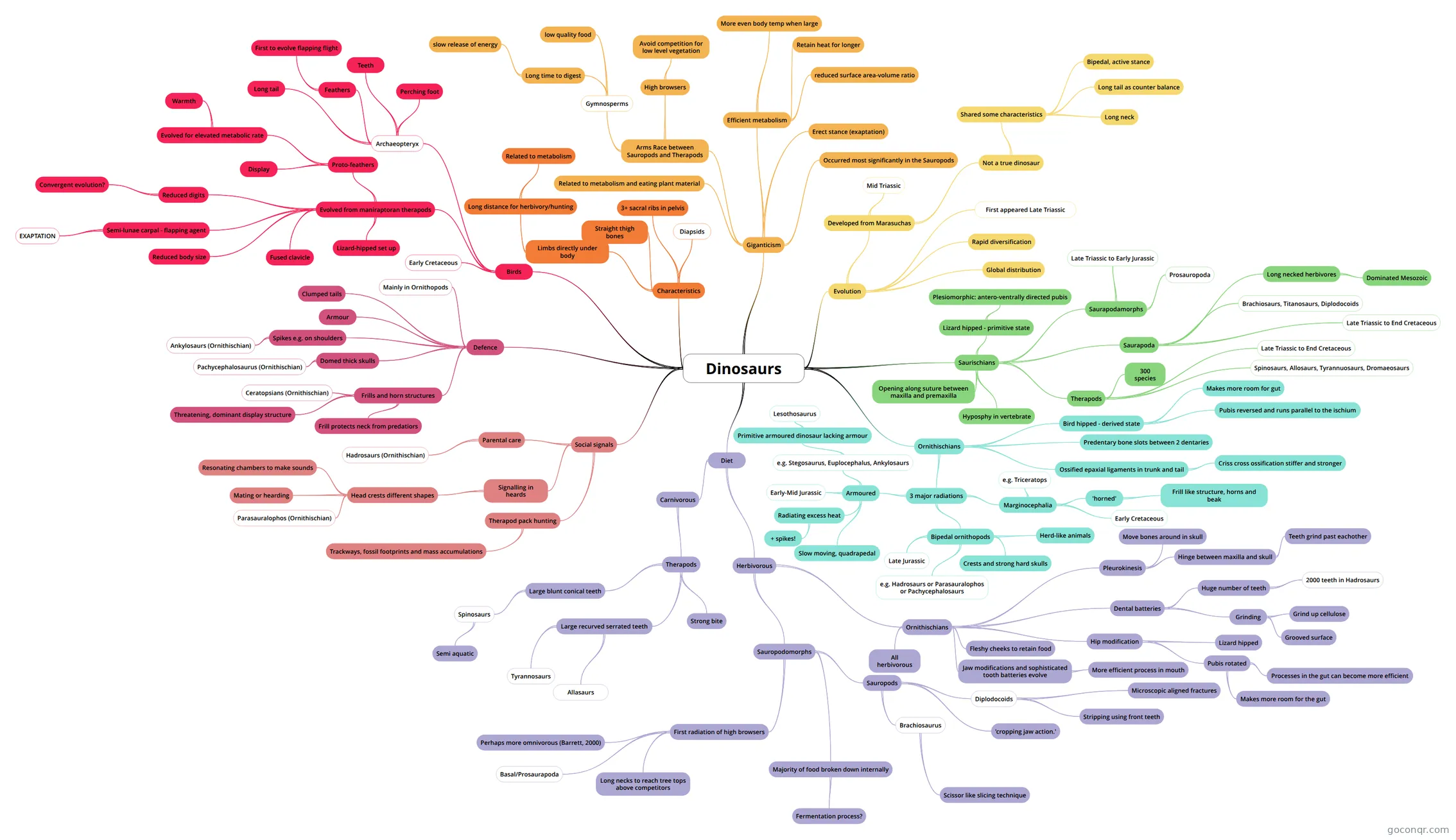
Mind map: Dinosaurs
Contenido del mapa
Dinosaurs
Giganticism
- Occurred most significantly in the Sauropods
- Erect stance (exaptation)
- Efficient metabolism
- reduced surface area-volume ratio
- Retain heat for longer
- More even body temp when large
- Arms Race between Sauropods and Therapods
- High browsers
- Avoid competition for low level vegetation
- Gymnosperms
- low quality food
- Long time to digest
- slow release of energy
- High browsers
- Related to metabolism and eating plant material
Ornithischians
- Bird hipped - derived state
- Pubis reversed and runs parallel to the ischium
- Makes more room for gut
- Predentary bone slots between 2 dentaries
- Ossified epaxial ligaments in trunk and tail
- Criss cross ossification stiffer and stronger
- 3 major radiations
- Armoured
- e.g. Stegosaurus, Euplocephalus, Ankylosaurs
- Primitive armoured dinosaur lacking armour
- Lesothosaurus
- Primitive armoured dinosaur lacking armour
- Early-Mid Jurassic
- Radiating excess heat
- + spikes!
- Slow moving, quadrapedal
- e.g. Stegosaurus, Euplocephalus, Ankylosaurs
- Bipedal ornithopods
- e.g. Hadrosaurs or Parasauralophos or Pachycephalosaurs
- Herd-like animals
- Crests and strong hard skulls
- Late Jurassic
- Marginocephalia
- 'horned'
- Frill like structure, horns and beak
- Early Cretaceous
- e.g. Triceratops
- 'horned'
- Armoured
- Bird hipped - derived state
Defence
- Armour
- Mainly in Ornithopods
- Spikes e.g. on shoulders
- Ankylosaurs (Ornithischian)
- Clumped tails
- Domed thick skulls
- Pachycephalosaurus (Ornithischian)
- Frills and horn structures
- Ceratopsians (Ornithischian)
- Threatening, dominant display structure
- Frill protects neck from predatiors
Saurischians
- Lizard hipped - primitive state
- Plesiomorphic: antero-ventrally directed pubis
- Saurapoda
- Brachiosaurs, Titanosaurs, Diplodocoids
- Long necked herbivores
- Dominated Mesozoic
- Late Triassic to End Cretaceous
- Saurapodamorphs
- Prosauropoda
- Late Triassic to Early Jurassic
- Therapods
- 300 species
- Spinosaurs, Allosaurs, Tyrannuosaurs, Dromaeosaurs
- Late Triassic to End Cretaceous
- Opening along suture between maxilla and premaxilla
- Hyposphy in vertebrate
- Lizard hipped - primitive state
Social signals
- Parental care
- Hadrosaurs (Ornithischian)
- Signalling in heards
- Head crests different shapes
- Resonating chambers to make sounds
- Mating or hearding
- Parasauralophos (Ornithischian)
- Head crests different shapes
- Therapod pack hunting
- Trackways, fossil footprints and mass accumulations
- Parental care
Birds
- Evolved from maniraptoran therapods
- Reduced body size
- Reduced digits
- Convergent evolution?
- Proto-feathers
- Evolved for elevated metabolic rate
- Warmth
- Display
- Evolved for elevated metabolic rate
- Lizard-hipped set up
- Semi-lunae carpal - flapping agent
- EXAPTATION
- Fused clavicle
- Early Cretaceous
- Archaeopteryx
- Teeth
- Long tail
- Feathers
- First to evolve flapping flight
- Perching foot
- Evolved from maniraptoran therapods
Diet
- Herbivorous
- Ornithischians
- Pleurokinesis
- Move bones around in skull
- Hinge between maxilla and skull
- Teeth grind past eachother
- Dental batteries
- Grinding
- Grooved surface
- Grind up cellulose
- Huge number of teeth
- 2000 teeth in Hadrosaurs
- Grinding
- Hip modification
- Lizard hipped
- Pubis rotated
- Makes more room for the gut
- Processes in the gut can become more efficient
- Fleshy cheeks to retain food
- Jaw modifications and sophisticated tooth batteries evolve
- More efficient process in mouth
- All herbivorous
- Pleurokinesis
- Sauropodomorphs
- First radiation of high browsers
- Long necks to reach tree tops above competitors
- Basal/Prosaurapoda
- Perhaps more omnivorous (Barrett, 2000)
- Sauropods
- Brachiosaurus
- Scissor like slicing technique
- Diplodocoids
- Stripping using front teeth
- Microscopic aligned fractures
- 'cropping jaw action.'
- Brachiosaurus
- Majority of food broken down internally
- Fermentation process?
- First radiation of high browsers
- Ornithischians
- Carnivorous
- Therapods
- Large blunt conical teeth
- Spinosaurs
- Semi aquatic
- Spinosaurs
- Large recurved serrated teeth
- Allasaurs
- Tyrannosaurs
- Strong bite
- Large blunt conical teeth
- Therapods
- Herbivorous
Evolution
- Developed from Marasuchas
- Mid Triassic
- Not a true dinosaur
- Shared some characteristics
- Bipedal, active stance
- Long tail as counter balance
- Long neck
- Shared some characteristics
- First appeared Late Triassic
- Rapid diversification
- Global distribution
- Developed from Marasuchas
Characteristics
- Straight thigh bones
- Limbs directly under body
- Long distance for herbivory/hunting
- Related to metabolism
- Long distance for herbivory/hunting
- Diapsids
- 3+ sacral ribs in pelvis
Información
- Descripción
- Mapa Mental sobre Dinosaurs, creado por Asha Bridewell el 20/05/2018.
- Creado por
- Asha Bridewell
- Visitas
- 1
- Valoración