
Mapa mental
Computing Revision
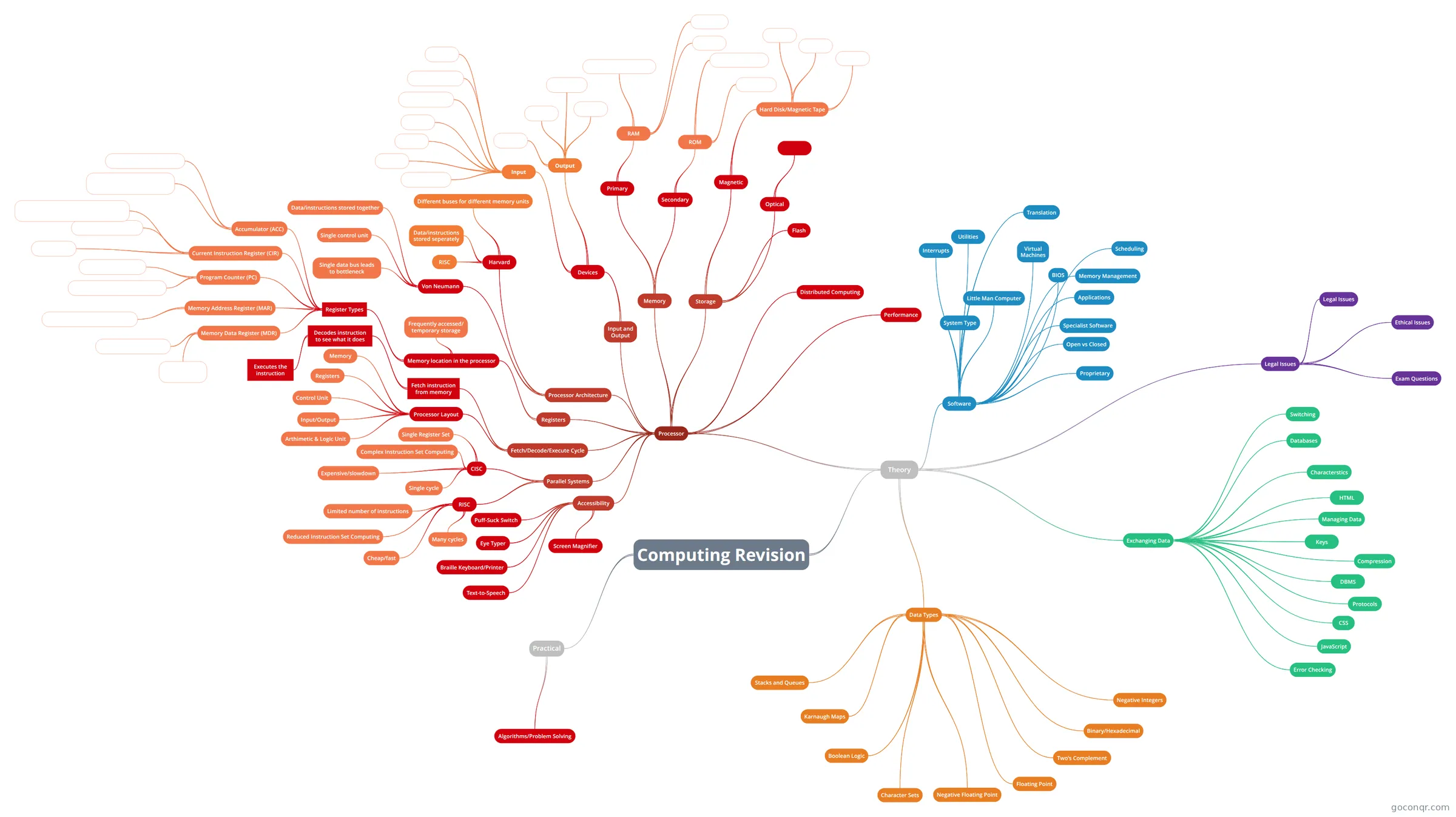
Mind map: Computing revision
Contenido del mapa
Computing Revision
Theory
- Processor
- Fetch/Decode/Execute Cycle
- Processor Layout
- Arthimetic & Logic Unit
- Control Unit
- Registers
- Memory
- Input/Output
- Fetch instruction from memory
- Decodes instruction to see what it does
- Executes the instruction
- Decodes instruction to see what it does
- Processor Layout
- Registers
- Memory location in the processor
- Frequently accessed/ temporary storage
- Register Types
- Memory Data Register (MDR)
- Data currently in use
- Contents of MAR address
- Memory Address Register (MAR)
- Address of next data/instruction
- Program Counter (PC)
- Stores address of next instruction
- Counts programs read
- Current Instruction Register (CIR)
- Holds instruction in use
- Operation (what the instruction means)
- Address/Data
- Accumulator (ACC)
- Holds resultant data (i.e. from calculations/processing)
- Handles all inputs/outputs
- Memory Data Register (MDR)
- Memory location in the processor
- Performance
- Processor Architecture
- Von Neumann
- Single control unit
- Data/instructions stored together
- Single data bus leads to bottleneck
- Harvard
- Data/instructions stored seperately
- Different buses for different memory units
- RISC
- Von Neumann
- Parallel Systems
- RISC
- Reduced Instruction Set Computing
- Limited number of instructions
- Cheap/fast
- Many cycles
- CISC
- Complex Instruction Set Computing
- Single cycle
- Single Register Set
- Expensive/slowdown
- RISC
- Distributed Computing
- Memory
- Primary
- RAM
- Random Access Memory
- Temporary
- Volatile
- RAM
- Secondary
- ROM
- Read Only Memory
- Non Volatile
- ROM
- Primary
- Input and Output
- Devices
- Input
- Mouse
- Keyboard
- Scanner
- Barcode Reader
- Chip & Pin Reader
- Keypad
- Concept Keyboard
- Output
- Monitor
- Headphones
- Speakers
- Printer
- Input
- Devices
- Accessibility
- Eye Typer
- Braille Keyboard/Printer
- Puff-Suck Switch
- Text-to-Speech
- Screen Magnifier
- Storage
- Magnetic
- Hard Disk/Magnetic Tape
- Cheap
- Fast
- Robust
- Hard Disk/Magnetic Tape
- Optical
- Flash
- Magnetic
- Fetch/Decode/Execute Cycle
- Software
- System Type
- Memory Management
- Scheduling
- Interrupts
- Virtual Machines
- BIOS
- Applications
- Specialist Software
- Utilities
- Open vs Closed
- Proprietary
- Translation
- Little Man Computer
- Exchanging Data
- Databases
- Keys
- Managing Data
- DBMS
- Characterstics
- Protocols
- Switching
- Error Checking
- Compression
- HTML
- CSS
- JavaScript
- Data Types
- Binary/Hexadecimal
- Negative Integers
- Two's Complement
- Floating Point
- Negative Floating Point
- Character Sets
- Boolean Logic
- Karnaugh Maps
- Stacks and Queues
- Legal Issues
- Legal Issues
- Ethical Issues
- Exam Questions
- Processor
Practical
- Algorithms/Problem Solving
Información
- Descripción
- Mind Map on Computing Revision, created by Tom Harvey on 16/06/2018.
- Creado por
- Tom Harvey
- Visitas
- 3
- Valoración