
Mapa mental
Phonological Development
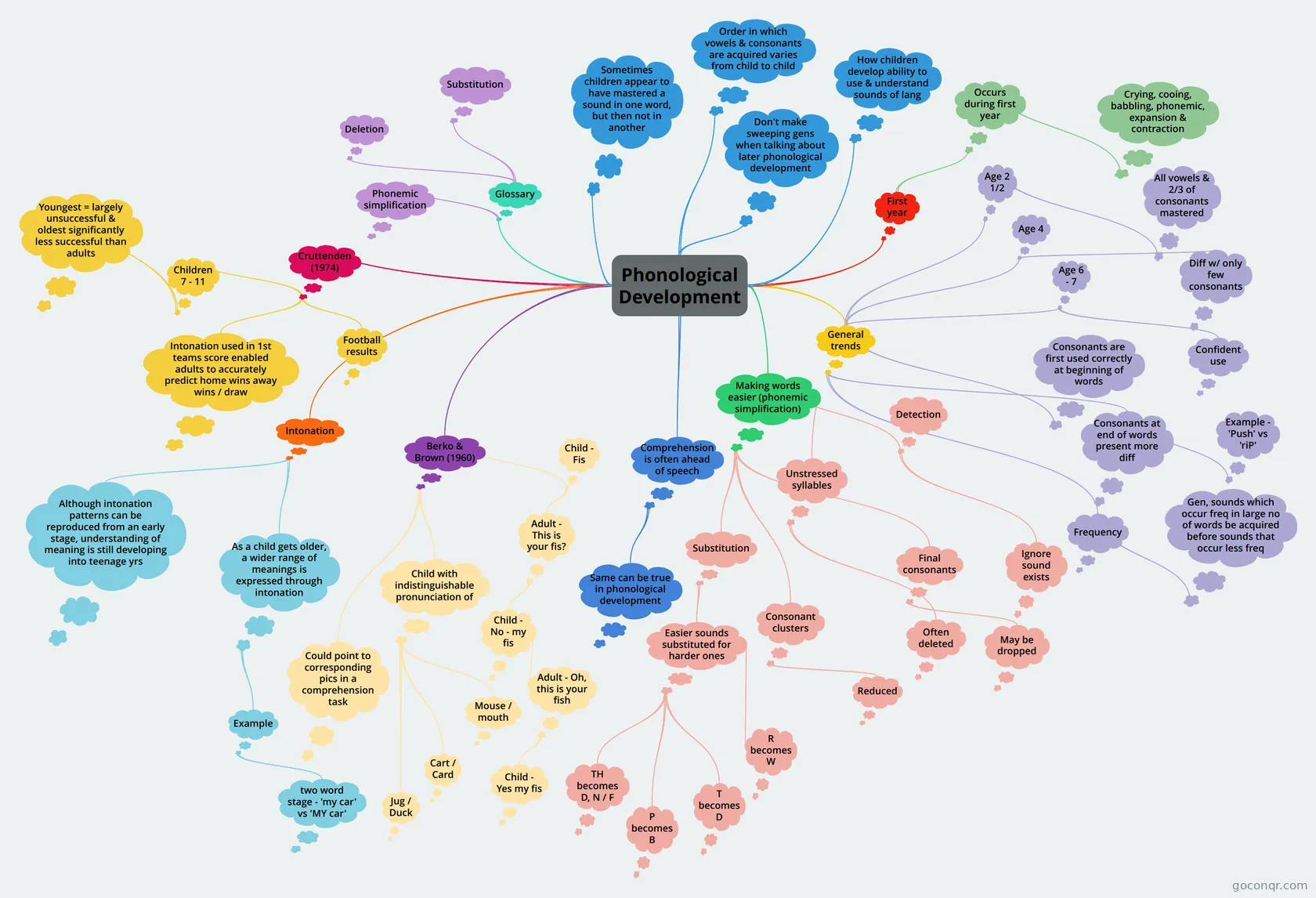
Mind map: Phonological development
Contenido del mapa
Phonological Development
How children develop ability to use & understand sounds of lang
First year
- Occurs during first year
- Crying, cooing, babbling, phonemic, expansion & contraction
- Occurs during first year
Don't make sweeping gens when talking about later phonological development
Order in which vowels & consonants are acquired varies from child to child
Sometimes children appear to have mastered a sound in one word, but then not in another
General trends
- Age 2 1/2
- All vowels & 2/3 of consonants mastered
- Age 4
- Diff w/ only few consonants
- Age 6 - 7
- Confident use
- Consonants are first used correctly at beginning of words
- Consonants at end of words present more diff
- Example - 'Push' vs 'riP'
- Frequency
- Gen, sounds which occur freq in large no of words be acquired before sounds that occur less freq
- Age 2 1/2
Making words easier (phonemic simplification)
- Detection
- Ignore sound exists
- Final consonants
- May be dropped
- Unstressed syllables
- Often deleted
- Consonant clusters
- Reduced
- Substitution
- Easier sounds substituted for harder ones
- R becomes W
- TH becomes D, N / F
- T becomes D
- P becomes B
- Easier sounds substituted for harder ones
- Detection
Comprehension is often ahead of speech
- Same can be true in phonological development
Berko & Brown (1960)
- Child - Fis
- Adult - This is your fis?
- Child - No - my fis
- Adult - Oh, this is your fish
- Child - Yes my fis
- Adult - Oh, this is your fish
- Child - No - my fis
- Adult - This is your fis?
- Child with indistinguishable pronunciation of
- Mouse / mouth
- Cart / Card
- Jug / Duck
- Could point to corresponding pics in a comprehension task
- Child - Fis
Intonation
- As a child gets older, a wider range of meanings is expressed through intonation
- Example
- two word stage - 'my car' vs 'MY car'
- Example
- Although intonation patterns can be reproduced from an early stage, understanding of meaning is still developing into teenage yrs
- As a child gets older, a wider range of meanings is expressed through intonation
Cruttenden (1974)
- Football results
- Intonation used in 1st teams score enabled adults to accurately predict home wins away wins / draw
- Children 7 - 11
- Youngest = largely unsuccessful & oldest significantly less successful than adults
Glossary
- Phonemic simplification
- Deletion
- Substitution
Información
- Descripción
- Child language acquisition mind map on early stages of development
- Creado por
- megan langdon
- Visitas
- 128
- Etiquetas
- Valoración