
Mapa mental
Globalisation and crime
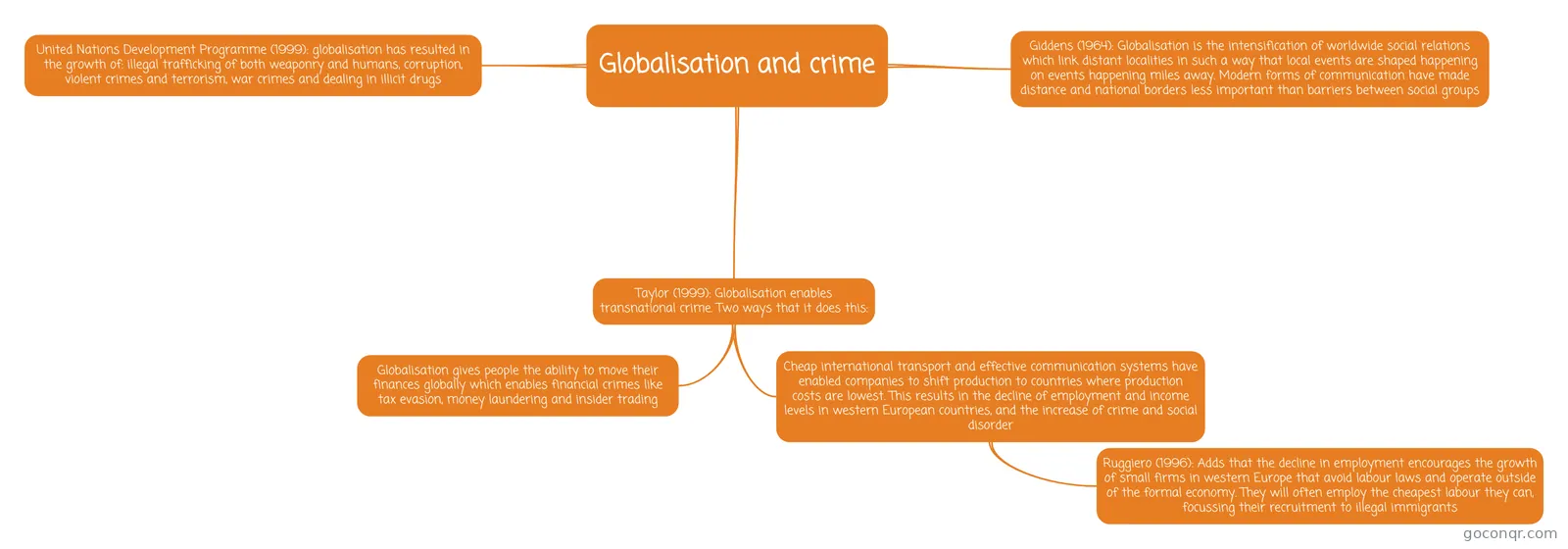
Mind map: globalisation and crime
Contenido del mapa
Globalisation and crime
Giddens (1964): Globalisation is the intensification of worldwide social relations which link distant localities in such a way that local events are shaped happening on events happening miles away. Modern forms of communication have made distance and national borders less important than barriers between social groups
United Nations Development Programme (1999): globalisation has resulted in the growth of: illegal trafficking of both weaponry and humans, corruption, violent crimes and terrorism, war crimes and dealing in illicit drugs
Taylor (1999): Globalisation enables transnational crime. Two ways that it does this:
- Globalisation gives people the ability to move their finances globally which enables financial crimes like tax evasion, money laundering and insider trading
- Cheap international transport and effective communication systems have enabled companies to shift production to countries where production costs are lowest. This results in the decline of employment and income levels in western European countries, and the increase of crime and social disorder
- Ruggiero (1996): Adds that the decline in employment encourages the growth of small firms in western Europe that avoid labour laws and operate outside of the formal economy. They will often employ the cheapest labour they can, focussing their recruitment to illegal immigrants
Información
- Descripción
- Studies and information about the relationship between globalisation and crime
- Creado por
- charfitzjohn
- Visitas
- 104
- Etiquetas
- Valoración