
Mapa mental
CONTENT-BASED INSTRUCTION AND COOPERATIVE LANGUAGE LEARNING
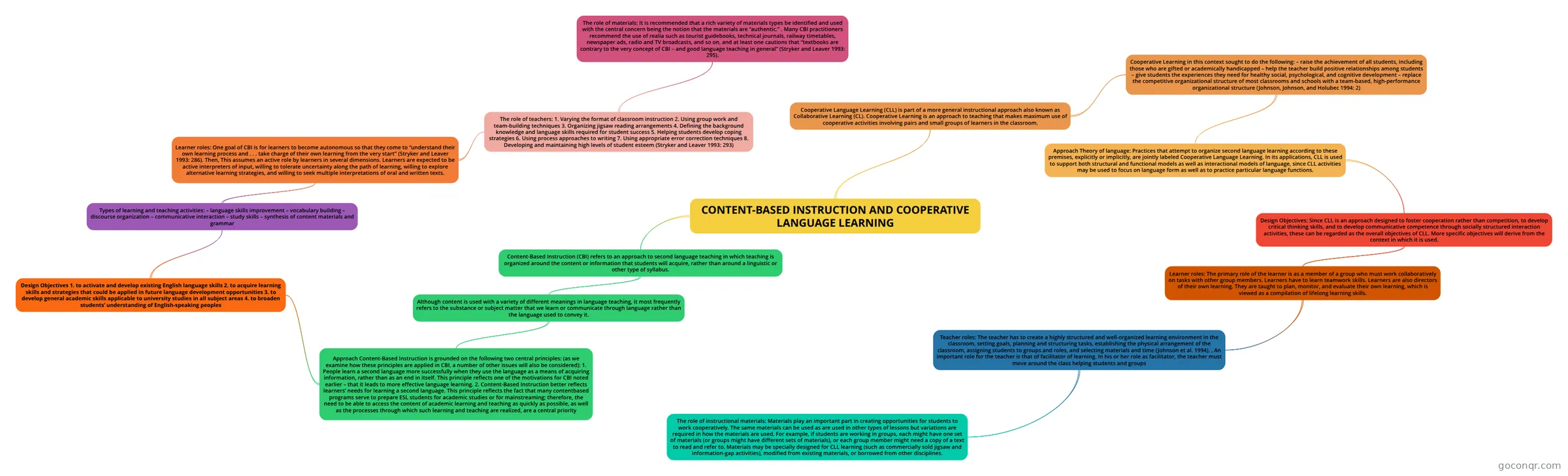
Mind map: Content-based instruction and cooperative language learning
Contenido del mapa
CONTENT-BASED INSTRUCTION AND COOPERATIVE LANGUAGE LEARNING
Content-Based Instruction (CBI) refers to an approach to second language teaching in which teaching is organized around the content or information that students will acquire, rather than around a linguistic or other type of syllabus.
- Although content is used with a variety of different meanings in language teaching, it most frequently refers to the substance or subject matter that we learn or communicate through language rather than the language used to convey it.
- Approach Content-Based Instruction is grounded on the following two central principles: (as we examine how these principles are applied in CBI, a number of other issues will also be considered): 1. People learn a second language more successfully when they use the language as a means of acquiring information, rather than as an end in itself. This principle reflects one of the motivations for CBI noted earlier – that it leads to more effective language learning. 2. Content-Based Instruction better reflects learners’ needs for learning a second language. This principle reflects the fact that many contentbased programs serve to prepare ESL students for academic studies or for mainstreaming; therefore, the need to be able to access the content of academic learning and teaching as quickly as possible, as well as the processes through which such learning and teaching are realized, are a central priority
- Design Objectives 1. to activate and develop existing English language skills 2. to acquire learning skills and strategies that could be applied in future language development opportunities 3. to develop general academic skills applicable to university studies in all subject areas 4. to broaden students’ understanding of English-speaking peoples
- Types of learning and teaching activities: – language skills improvement – vocabulary building – discourse organization – communicative interaction – study skills – synthesis of content materials and grammar
- Learner roles: One goal of CBI is for learners to become autonomous so that they come to “understand their own learning process and . . . take charge of their own learning from the very start” (Stryker and Leaver 1993: 286). Then, This assumes an active role by learners in several dimensions. Learners are expected to be active interpreters of input, willing to tolerate uncertainty along the path of learning, willing to explore alternative learning strategies, and willing to seek multiple interpretations of oral and written texts.
- The role of teachers: 1. Varying the format of classroom instruction 2. Using group work and team-building techniques 3. Organizing jigsaw reading arrangements 4. Defining the background knowledge and language skills required for student success 5. Helping students develop coping strategies 6. Using process approaches to writing 7. Using appropriate error correction techniques 8. Developing and maintaining high levels of student esteem (Stryker and Leaver 1993: 293)
- The role of materials: It is recommended that a rich variety of materials types be identified and used with the central concern being the notion that the materials are “authentic.” . Many CBI practitioners recommend the use of realia such as tourist guidebooks, technical journals, railway timetables, newspaper ads, radio and TV broadcasts, and so on, and at least one cautions that “textbooks are contrary to the very concept of CBI – and good language teaching in general” (Stryker and Leaver 1993: 295).
- The role of teachers: 1. Varying the format of classroom instruction 2. Using group work and team-building techniques 3. Organizing jigsaw reading arrangements 4. Defining the background knowledge and language skills required for student success 5. Helping students develop coping strategies 6. Using process approaches to writing 7. Using appropriate error correction techniques 8. Developing and maintaining high levels of student esteem (Stryker and Leaver 1993: 293)
- Learner roles: One goal of CBI is for learners to become autonomous so that they come to “understand their own learning process and . . . take charge of their own learning from the very start” (Stryker and Leaver 1993: 286). Then, This assumes an active role by learners in several dimensions. Learners are expected to be active interpreters of input, willing to tolerate uncertainty along the path of learning, willing to explore alternative learning strategies, and willing to seek multiple interpretations of oral and written texts.
- Types of learning and teaching activities: – language skills improvement – vocabulary building – discourse organization – communicative interaction – study skills – synthesis of content materials and grammar
- Design Objectives 1. to activate and develop existing English language skills 2. to acquire learning skills and strategies that could be applied in future language development opportunities 3. to develop general academic skills applicable to university studies in all subject areas 4. to broaden students’ understanding of English-speaking peoples
- Approach Content-Based Instruction is grounded on the following two central principles: (as we examine how these principles are applied in CBI, a number of other issues will also be considered): 1. People learn a second language more successfully when they use the language as a means of acquiring information, rather than as an end in itself. This principle reflects one of the motivations for CBI noted earlier – that it leads to more effective language learning. 2. Content-Based Instruction better reflects learners’ needs for learning a second language. This principle reflects the fact that many contentbased programs serve to prepare ESL students for academic studies or for mainstreaming; therefore, the need to be able to access the content of academic learning and teaching as quickly as possible, as well as the processes through which such learning and teaching are realized, are a central priority
- Although content is used with a variety of different meanings in language teaching, it most frequently refers to the substance or subject matter that we learn or communicate through language rather than the language used to convey it.
Cooperative Language Learning (CLL) is part of a more general instructional approach also known as Collaborative Learning (CL). Cooperative Learning is an approach to teaching that makes maximum use of cooperative activities involving pairs and small groups of learners in the classroom.
- Cooperative Learning in this context sought to do the following: – raise the achievement of all students, including those who are gifted or academically handicapped – help the teacher build positive relationships among students – give students the experiences they need for healthy social, psychological, and cognitive development – replace the competitive organizational structure of most classrooms and schools with a team-based, high-performance organizational structure (Johnson, Johnson, and Holubec 1994: 2)
- Approach Theory of language: Practices that attempt to organize second language learning according to these premises, explicitly or implicitly, are jointly labeled Cooperative Language Learning. In its applications, CLL is used to support both structural and functional models as well as interactional models of language, since CLL activities may be used to focus on language form as well as to practice particular language functions.
- Design Objectives: Since CLL is an approach designed to foster cooperation rather than competition, to develop critical thinking skills, and to develop communicative competence through socially structured interaction activities, these can be regarded as the overall objectives of CLL. More specific objectives will derive from the context in which it is used.
- Learner roles: The primary role of the learner is as a member of a group who must work collaboratively on tasks with other group members. Learners have to learn teamwork skills. Learners are also directors of their own learning. They are taught to plan, monitor, and evaluate their own learning, which is viewed as a compilation of lifelong learning skills.
- Teacher roles: The teacher has to create a highly structured and well-organized learning environment in the classroom, setting goals, planning and structuring tasks, establishing the physical arrangement of the classroom, assigning students to groups and roles, and selecting materials and time (Johnson et al. 1994). . An important role for the teacher is that of facilitator of learning. In his or her role as facilitator, the teacher must move around the class helping students and groups
- The role of instructional materials: Materials play an important part in creating opportunities for students to work cooperatively. The same materials can be used as are used in other types of lessons but variations are required in how the materials are used. For example, if students are working in groups, each might have one set of materials (or groups might have different sets of materials), or each group member might need a copy of a text to read and refer to. Materials may be specially designed for CLL learning (such as commercially sold jigsaw and information-gap activities), modified from existing materials, or borrowed from other disciplines.
- Teacher roles: The teacher has to create a highly structured and well-organized learning environment in the classroom, setting goals, planning and structuring tasks, establishing the physical arrangement of the classroom, assigning students to groups and roles, and selecting materials and time (Johnson et al. 1994). . An important role for the teacher is that of facilitator of learning. In his or her role as facilitator, the teacher must move around the class helping students and groups
- Learner roles: The primary role of the learner is as a member of a group who must work collaboratively on tasks with other group members. Learners have to learn teamwork skills. Learners are also directors of their own learning. They are taught to plan, monitor, and evaluate their own learning, which is viewed as a compilation of lifelong learning skills.
- Design Objectives: Since CLL is an approach designed to foster cooperation rather than competition, to develop critical thinking skills, and to develop communicative competence through socially structured interaction activities, these can be regarded as the overall objectives of CLL. More specific objectives will derive from the context in which it is used.
- Approach Theory of language: Practices that attempt to organize second language learning according to these premises, explicitly or implicitly, are jointly labeled Cooperative Language Learning. In its applications, CLL is used to support both structural and functional models as well as interactional models of language, since CLL activities may be used to focus on language form as well as to practice particular language functions.
- Cooperative Learning in this context sought to do the following: – raise the achievement of all students, including those who are gifted or academically handicapped – help the teacher build positive relationships among students – give students the experiences they need for healthy social, psychological, and cognitive development – replace the competitive organizational structure of most classrooms and schools with a team-based, high-performance organizational structure (Johnson, Johnson, and Holubec 1994: 2)
Información
- Descripción
- Mapa Mental sobre CONTENT-BASED INSTRUCTION AND COOPERATIVE LANGUAGE LEARNING, creado por Santiago Edixon Moreno Preciado el 03/05/2021.
- Creado por
- Santiago Edixon Moreno Preciado
- Visitas
- 1
- Valoración
Más sobre Content-Based Instruction and CLIL