
Mapa mental
All Blues - Miles Davis
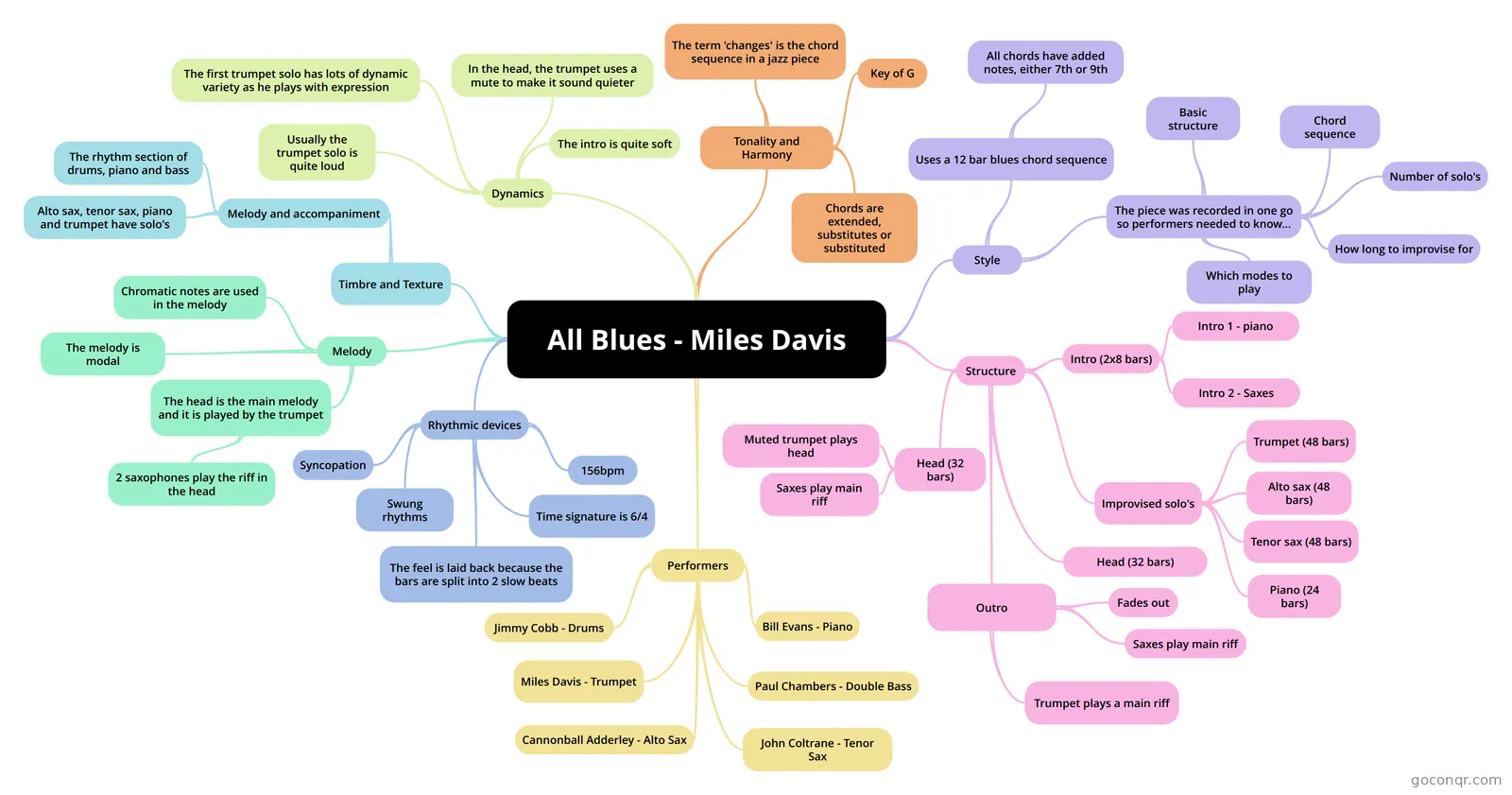
Mind map: All Blues - Miles Davis
Contenido del mapa
All Blues - Miles Davis
Rhythmic devices
- Swung rhythms
- Syncopation
- Time signature is 6/4
- 156bpm
- The feel is laid back because the bars are split into 2 slow beats
Performers
- Miles Davis - Trumpet
- Cannonball Adderley - Alto Sax
- John Coltrane - Tenor Sax
- Bill Evans - Piano
- Paul Chambers - Double Bass
- Jimmy Cobb - Drums
Melody
- The head is the main melody and it is played by the trumpet
- 2 saxophones play the riff in the head
- The melody is modal
- Chromatic notes are used in the melody
- The head is the main melody and it is played by the trumpet
Dynamics
- The intro is quite soft
- In the head, the trumpet uses a mute to make it sound quieter
- The first trumpet solo has lots of dynamic variety as he plays with expression
- Usually the trumpet solo is quite loud
Style
- Uses a 12 bar blues chord sequence
- All chords have added notes, either 7th or 9th
- The piece was recorded in one go so performers needed to know...
- Basic structure
- Chord sequence
- Number of solo's
- How long to improvise for
- Which modes to play
- Uses a 12 bar blues chord sequence
Timbre and Texture
- Melody and accompaniment
- The rhythm section of drums, piano and bass
- Alto sax, tenor sax, piano and trumpet have solo's
- Melody and accompaniment
Structure
- Intro (2x8 bars)
- Intro 1 - piano
- Intro 2 - Saxes
- Head (32 bars)
- Muted trumpet plays head
- Saxes play main riff
- Improvised solo's
- Trumpet (48 bars)
- Alto sax (48 bars)
- Piano (24 bars)
- Tenor sax (48 bars)
- Head (32 bars)
- Outro
- Fades out
- Saxes play main riff
- Trumpet plays a main riff
- Intro (2x8 bars)
Tonality and Harmony
- The term 'changes' is the chord sequence in a jazz piece
- Chords are extended, substitutes or substituted
- Key of G