
Mapa mental
Chapter 4 International Methods of Entry
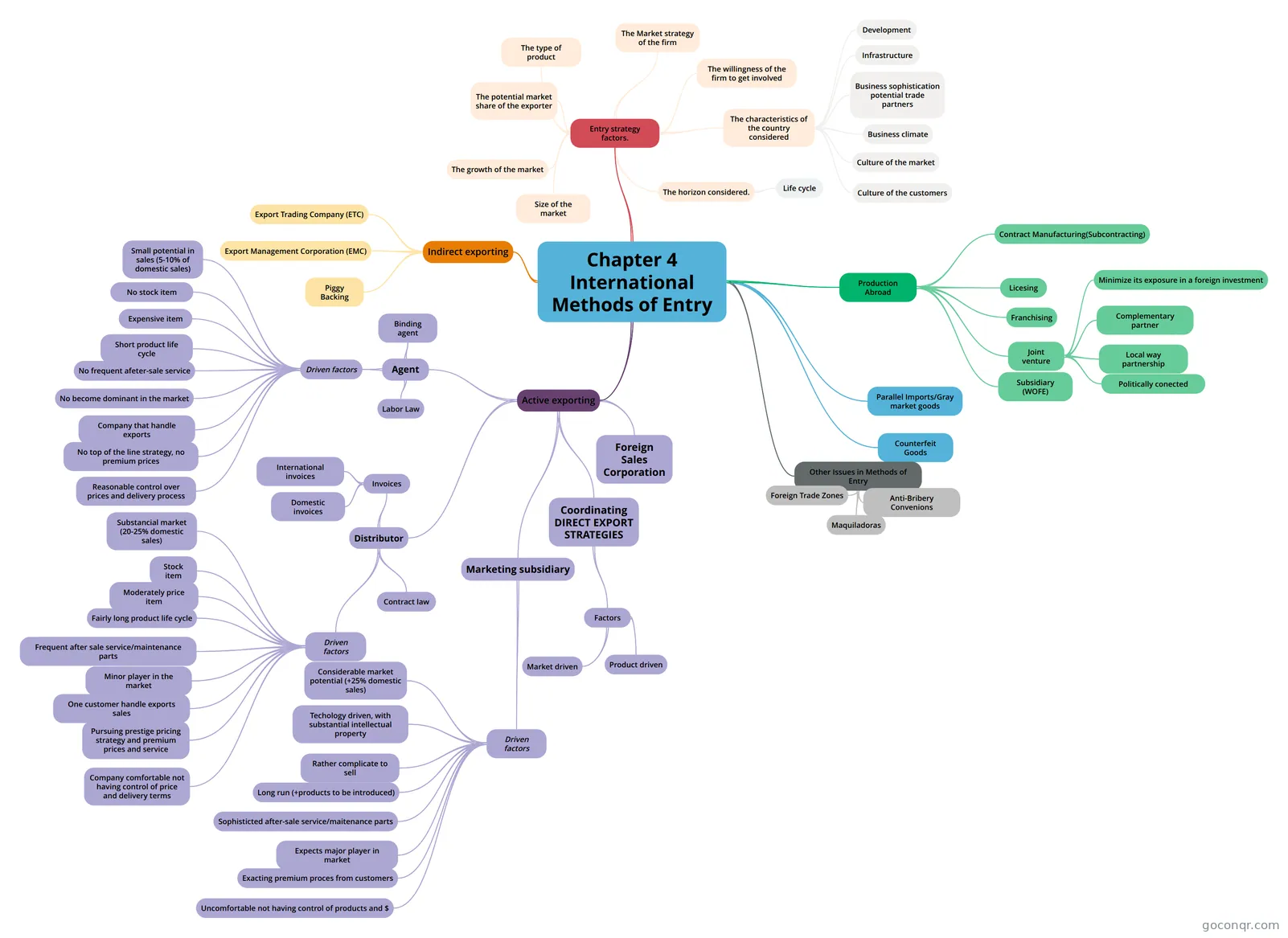
Mind map: International methods of entry
Contenido del mapa
Chapter 4 International Methods of Entry
Entry strategy factors.
- Size of the market
- The growth of the market
- The potential market share of the exporter
- Mayor or not mayor player
- The type of product
- -After sale service or parts
- The Market strategy of the firm
- The willingness of the firm to get involved
- The characteristics of the country considered
- Development
- Infrastructure
- Business sophistication potential trade partners
- Business climate
- Culture of the market
- Culture of the customers
- The horizon considered.
- Life cycle
Indirect exporting
- Export Trading Company (ETC)
- Intermediary... A company that purchases goods in one country for the purpose of reselling them in another country at a profit. Specialized in one geographical area or one product line. -Great for novice exporter. -Offices abroad.
- Export Management Corporation (EMC)
- Company that puts suppliers in touch with potential buyers and earns a commisssion if sale is completed. -Located in the exporting country -Small firms (-15 employees). -No(rarely) offices abroad -Contacts and potential importers and send people to promote the exporting. -Kind of Agent (the overseas representative of a manufacturer) Novice exporters
- Piggy Backing
- When a manufacturer goeas overseas and asks its suppliers to continue doing business abroad with him, the suppliers are said to be piggy backing on that customer efforts.
- Export Trading Company (ETC)
Active exporting
- Agent
- The overseas representative of a manufacturer. The agent represents the manufacturer in sales negotiations. ->Uses terms of sale (price delivery and discounts). >Sales brochure and proces list, products characteristic, anlysis of competitors products, information on sales and service philosophy, sales support in the form of samples, catologs, trade advertising and financial support. ->After the sale, the agent finishes with the job. And he gets paid unil the exporter has been paid by the importer.
- Binding agent
- Agent who is allowed to make decisions that are binding on the principal. The prinicipal must abide by whatever statements the agent has made, and negociate terms of trade.
- Driven factors
- -Long term relationship
- Small potential in sales (5-10% of domestic sales)
- No stock item
- Specifically designed for that market
- Expensive item
- Machinery
- Short product life cycle
- No frequent afeter-sale service
- No become dominant in the market
- Company that handle exports
- No top of the line strategy, no premium prices
- Reasonable control over prices and delivery process
- Labor Law
- Compesation to the agent based on the law, overruling terms of contract.
- Distributor
- Overseas company that purchases a manufacturer´s products with the goal of reseling them at profit. ->Inventory-After sale service-Complementary parts. +Responsability (Inventory risk, no sold items, Advertising, trade show attendance..) +Benefits: Setting prices, negotiating terms. ->Long term partner
- Invoices
- International invoices
- Domestic invoices
- Driven factors
- Substancial market (20-25% domestic sales)
- Stock item
- Moderately price item
- Fairly long product life cycle
- Frequent after sale service/maintenance parts
- Minor player in the market
- One customer handle exports sales
- Pursuing prestige pricing strategy and premium prices and service
- Company comfortable not having control of price and delivery terms
- Contract law
- Set of laws thet gobern relationships established by contracts between two parties.
- Marketing subsidiary
- An overseas firm owned by an exporter that is responsible for selling the exportes products in a foreign market All are domestic sales +Costs: Rented building, inventory built and employees (less variable-cost).
- Driven factors
- Considerable market potential (+25% domestic sales)
- Techology driven, with substantial intellectual property
- Rather complicate to sell
- Long run (+products to be introduced)
- Sophisticted after-sale service/maitenance parts
- Expects major player in market
- Exacting premium proces from customers
- Uncomfortable not having control of products and $
- Coordinating DIRECT EXPORT STRATEGIES
- Factors
- Consider changing from one entry strategy.
- Market driven
- Different strategies in each country (Agent, Distributor, EMC, etc.)} -Difficult in coordinating prices and after sale service. -Parallel imports looms. -Greatest profits can be extracted
- Product driven
- Same strategy in different countries (always agents) -Simplify management of its exports. -Unified front to its customers. -Prices and bounds coordinated. -After sale policies policies controlled. -Poor match with the market. -Stablish sales subsidiary in small markets.
- Factors
- Foreign Sales Corporation
- A subsidiary, created for tax-reduction purposes only, that handles an exporter´s overseas sales.
- Agent
Production Abroad
- Contract Manufacturing(Subcontracting)
- An arregement between two companies where one maufactorers for the other. Not a method for entry. +Barriers +Tariffs and quotas
- Licesing
- An arrangement between two companies where one uses the other´s intellectual property (secret or know how) in exchange of royalty (fee paid to use IP)
- Franchising
- An arrangement between two companies where one licenses an array of related intellectial property items (business model). ->Trademarks ->Copyrights ->Patents ->Know-how ->training ->methods of operation ->Substancial amount of piggy-backing
- Joint venture
- An overseas company that is jointly owned by two or more companies (share costs of venture.
- Minimize its exposure in a foreign investment
- Complementary partner
- Local way partnership
- Politically conected
- Subsidiary (WOFE)
- Company owned entirely by another company (Wholly-owned foreign enterprise). -Total control of investment and take the risk for this venture (no share). -Beneficial for host countries (creates jobs). -Manage a company in a foreign country without a very good understanding of local customs and regulations.
- Contract Manufacturing(Subcontracting)
Parallel Imports/Gray market goods
- Goods purchased in one country by unauthorized inetermediaries and sold to unautorized retailers in another country.
Counterfeit Goods
- Goods manufactured to look like original products, but whose manufacturing was not approved by the brand owners. -Lower quality and price
Other Issues in Methods of Entry
- Foreign Trade Zones
- Ana area that is physically within the borders of a country but that is considered outside of its borders for customs purposes.
- Maquiladoras
- A plant located in Mexico that have the same status as a foreign trade zone located both in ther US and Mexico. -Import goods from us, transform in Mexico and re-export to the US
- Anti-Bribery Convenions
- 2013 OECD convention that requires countries to penaize companies engaging in bribery.
- Foreign Trade Zones