
Mapa mental
Part 2 - Ch 7: Social Structure and Anomie
Contenido del mapa
Part 2 - Ch 7: Social Structure and Anomie
How social structures exert a definite pressure upon certain persons in the society to engage in nonconforming rather than conforming conduct
PATTERNS OF CULTURAL GOALS AND INSTITUTIONAL NORMS
- Several elements of social & cultural structures but 2 are most important:
- #1 - Cultural goals/objectives
- Held out as legitimate objectives for all or diversely located society members
- goals, purposes and interests defined by culture
- Integrated and roughly ordered in hierarchy of value
- Make up an aspirational reference - "worth striving for"
- Some are related to man's biological drives but are not determined by them
- Make up an aspirational reference - "worth striving for"
- Integrated and roughly ordered in hierarchy of value
- goals, purposes and interests defined by culture
- Held out as legitimate objectives for all or diversely located society members
- #2 - Cultural regulations (controls attainment of cultural goals)
- defines, regulates and controls the acceptable modes of reaching out for cultural goals
- Coupled with cultural goals
- rooted in the mores or institutions of allowable procedures for moving toward goals/objectives
- force, fraud and power are rules out of permitted conduct
- rooted in the mores or institutions of allowable procedures for moving toward goals/objectives
- Coupled with cultural goals
- defines, regulates and controls the acceptable modes of reaching out for cultural goals
- #1 - Cultural goals/objectives
- Focusing on societies who strongly emphasize specific goals w/o a corresponding emphasis on institutional procedures
- All societies have norms governing conduct but vary in the degree with which they are integrated with cultural goals and objectives
- differential emphases upon goals and institutionals procedures
- The procedure most effective, legitimate or not, becomes the most preferred regardless of the cultural regulations
- If this continues, it causes society to become unstable and anomie (normlessness) develops
- Not limited to competitive sports
- EXAMPLES:
- "Winning the game" rather than "winning under the rules of the game"
- football star secretly slugged
- wrestler incapacitates his opponent through illicit techniques
- athletic students subsidized by university alumni
- accumulated wealth regardless if accumulates legally or illegally
- Money is high on the hierarchy of value in America
- No stopping point, always a desire to have/make more
- Monetary success is conveniently indefinite and relative
- Monetary success entrenched in American culture/the American Dream
- THE AMERICAN DREAM
- The American Dream bombarded on citizens by Prestigeful reps, family, schools, employers, the work place, parents
- Americans try to attain the Dream even when faced with repeated frustrations
- The Dream is a lofty goal
- One must not quit, must not cease striving, must not lessen his goals
- "not failure, but low aim, is crime"
- Contemporary American culture continues to be characterized by a heavy emphasis on wealth as a basic symbol of success, w/o a corresponding emphasis on the legitimate avenues on which to march toward this goal
- "not failure, but low aim, is crime"
- One must not quit, must not cease striving, must not lessen his goals
- The Dream is a lofty goal
- Americans try to attain the Dream even when faced with repeated frustrations
- Dream culture enjoins the acceptance of 3 cultural axioms
- #1 - all should strive for the same lofty goals because these are open to all
- #2 - present seeming failure is but a way station to ultimate success
- #3 - genuine failure consists only in the lessening or withdrawal of ambition
- PSYCHOLOGICAL PARAPHRASE: #1 - a symbolic secondary reinforcement of incentive
- #2 - curbing the threatened extinction of a response through an associated stimulus
- #3 - genuine failure consists only in the lessening or withdrawal of ambition
- SOCIOLOGICAL PARAPHRASE: #1 - the deflection of criticism of the social structure onto one's self among those so situated in the society that they do not have full and equal access to oppotunity
- #2 - the preservation of a structure of social power by having individuals in the lower social strata identify themselves, no with their compeers, but with those at the top (whom they will ultimately join)
- #3 - providing pressures for conformity with the cultural dictates of unslackened ambition by the threat of less than full membership in the society for those who rail to conform
- #2 - the preservation of a structure of social power by having individuals in the lower social strata identify themselves, no with their compeers, but with those at the top (whom they will ultimately join)
- #2 - curbing the threatened extinction of a response through an associated stimulus
- #2 - present seeming failure is but a way station to ultimate success
- #1 - all should strive for the same lofty goals because these are open to all
- The American Dream bombarded on citizens by Prestigeful reps, family, schools, employers, the work place, parents
- THE AMERICAN DREAM
- Monetary success entrenched in American culture/the American Dream
- Monetary success is conveniently indefinite and relative
- No stopping point, always a desire to have/make more
- Money is high on the hierarchy of value in America
- accumulated wealth regardless if accumulates legally or illegally
- athletic students subsidized by university alumni
- wrestler incapacitates his opponent through illicit techniques
- football star secretly slugged
- "Winning the game" rather than "winning under the rules of the game"
- EXAMPLES:
- Not limited to competitive sports
- If this continues, it causes society to become unstable and anomie (normlessness) develops
- All societies have norms governing conduct but vary in the degree with which they are integrated with cultural goals and objectives
- Several elements of social & cultural structures but 2 are most important:
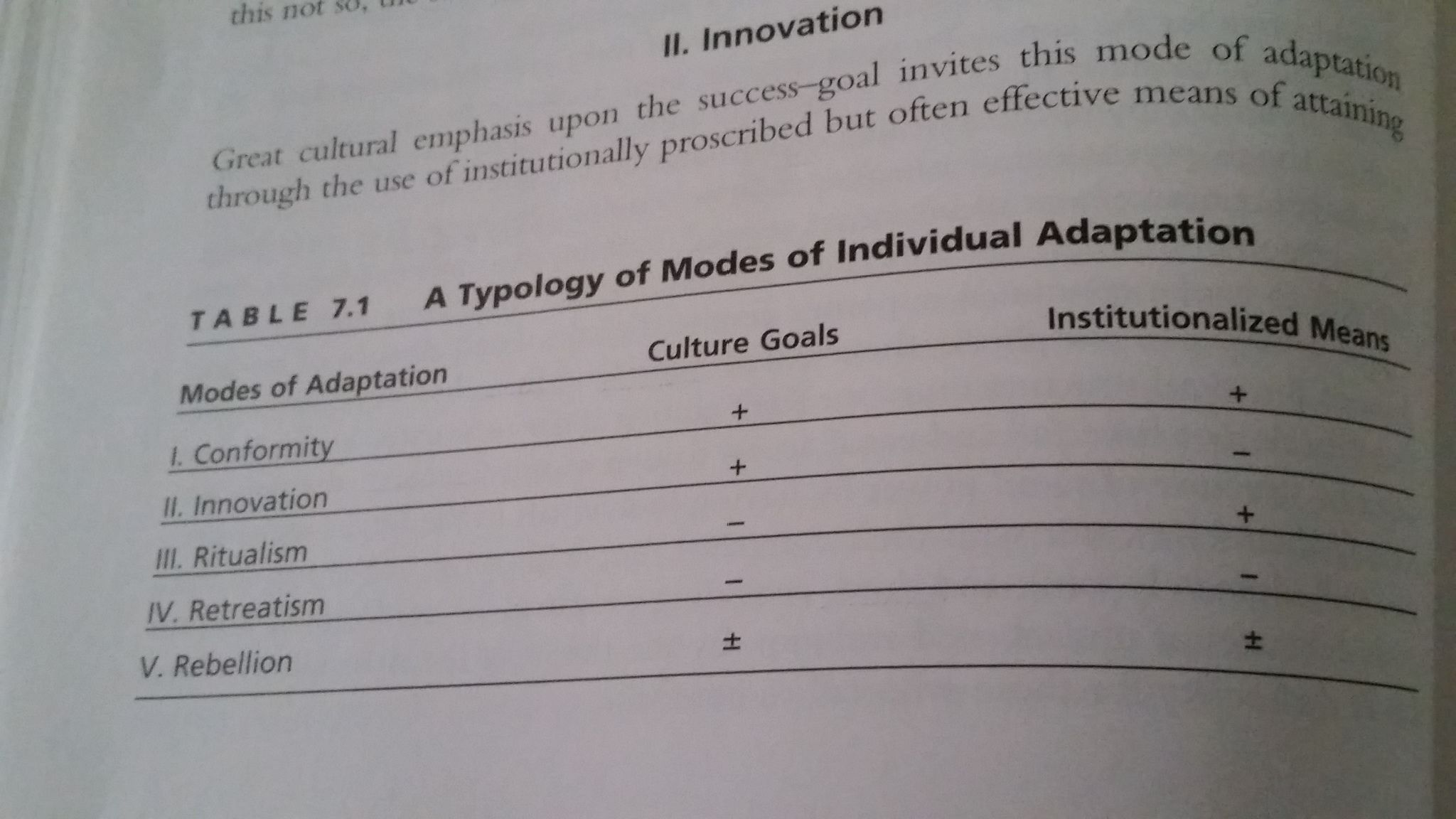
TYPES OF INDIVIDUAL ADAPTATION
- #1 - Conformity
- most common and widely diffused. W/o it, stability and continuity of society couldn't be maintained
- #2 - Innovation
- this response occurs when the individual has assimilated the cultural emphasis upon the goal w/o equally internalizing the institutional norms governing ways and means for its attainment
- #3 - Ritualism
- involves the abandoning or scaling down of the lofty cultural goals of great pecuniary success and rapid social mobility to the point where one's aspirations can be satisfied
- rejects cultural obligation, continues to abide compulsively to institutional norms
- social ritualist lower their ambitions/aspirations permanently
- #4 - Retreatism
- the rejection of cultural goals and institutional means
- the least common adaptation
- in the society but not of it
- adaptive activities of psychotics, autist, pariahs, outcasts, vagrants, vagabonds, tramps, chronic drunkards & drug addicts
- escape mechanisms allow individuals to drop out of competitive order & escape from the requirements of society
- internalized prohibitions
- #5 - Rebellion
- bringing in a new social structure
- alienation from reigning goals and standards
- #1 - Conformity
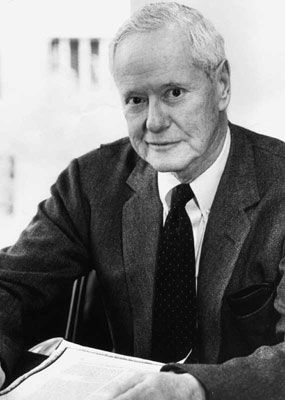
Robert K Merton
as long as supporting sentiments are distributed throughout the entire range of activities and are not confined to the final results of "success", the choice of means will remain largely within the ambit of institutional control
outdoing one's competitors produces a strain toward anomie and deviant behavior
when the cultural emphasis shifts from the satisfactions deriving from competition itself to almost exclusive concern with the outcome, the resultant stress makes for the breakdown of the regulatory structure
Imágenes y archivos del mapa
Información
- Descripción
- Ch 7: Social Structure and Anomie
- Creado por
- missylew69
- Visitas
- 189
- Etiquetas
- Valoración