
Mapa mental
Contrasting Teaching approaches
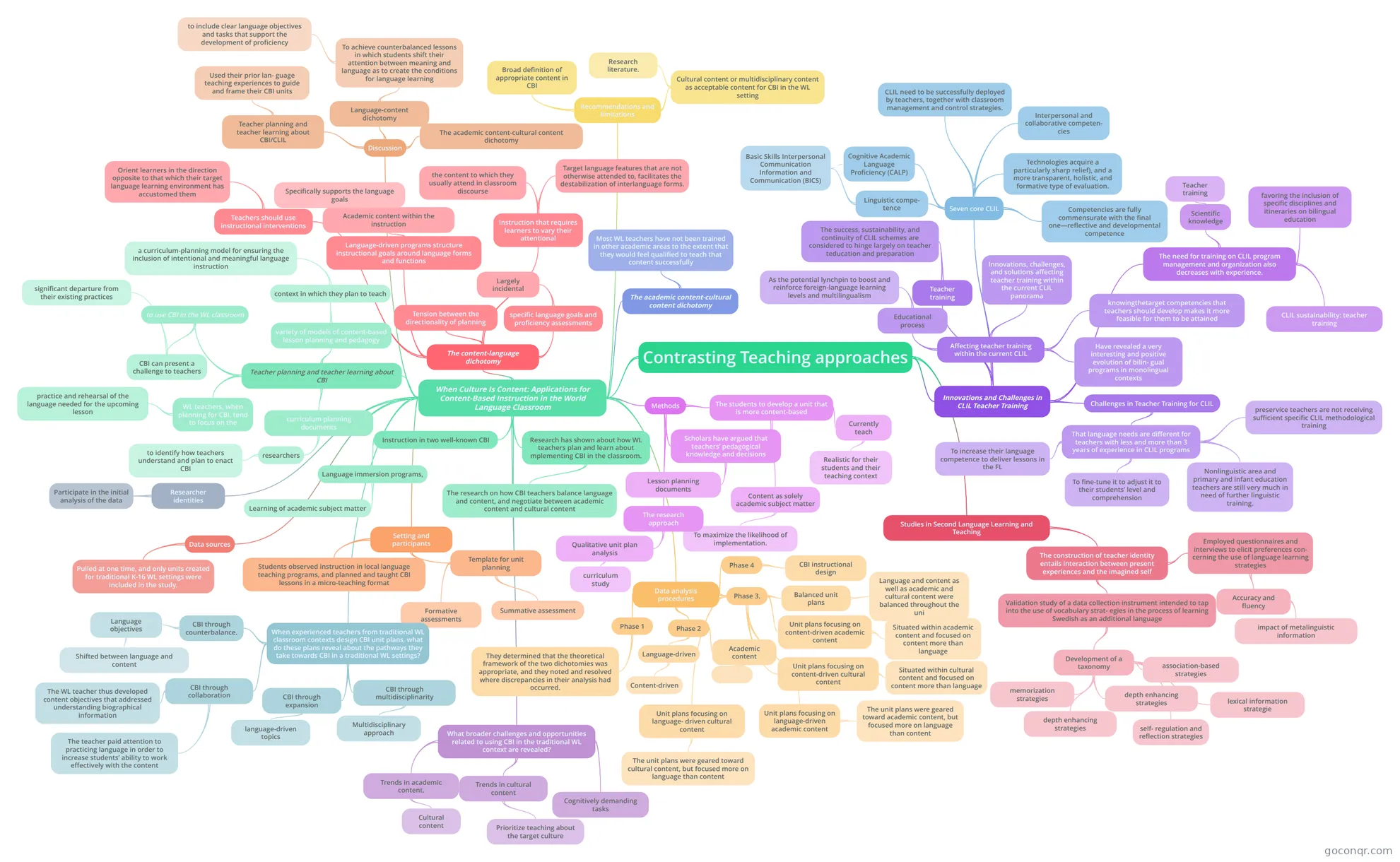
Mind map: Contrasting teaching approaches
Contenido del mapa
Contrasting Teaching approaches
When Culture Is Content: Applications for Content-Based Instruction in the World Language Classroom
- Instruction in two well-known CBI
- Language immersion programs,
- Learning of academic subject matter
- Language immersion programs,
- Research has shown about how WL teachers plan and learn about mplementing CBI in the classroom.
- The research on how CBI teachers balance language and content, and negotiate between academic content and cultural content
- Teacher planning and teacher learning about CBI
- WL teachers, when planning for CBI, tend to focus on the
- practice and rehearsal of the language needed for the upcoming lesson
- to use CBI in the WL classroom
- CBI can present a challenge to teachers
- significant departure from their existing practices
- CBI can present a challenge to teachers
- variety of models of content-based lesson planning and pedagogy
- context in which they plan to teach
- a curriculum-planning model for ensuring the inclusion of intentional and meaningful language instruction
- context in which they plan to teach
- curriculum planning documents
- researchers
- to identify how teachers understand and plan to enact CBI
- researchers
- WL teachers, when planning for CBI, tend to focus on the
- The content-language dichotomy
- Tension between the directionality of planning
- specific language goals and proficiency assessments
- Largely incidental
- Language-driven programs structure instructional goals around language forms and functions
- Academic content within the instruction
- Specifically supports the language goals
- Academic content within the instruction
- Teachers should use instructional interventions
- Orient learners in the direction opposite to that which their target language learning environment has accustomed them
- Instruction that requires learners to vary their attentional
- the content to which they usually attend in classroom discourse
- Target language features that are not otherwise attended to, facilitates the destabilization of interlanguage forms.
- The academic content-cultural content dichotomy
- Most WL teachers have not been trained in other academic areas to the extent that they would feel qualified to teach that content successfully
- Methods
- Scholars have argued that teachers’ pedagogical knowledge and decisions
- Lesson planning documents
- The students to develop a unit that is more content-based
- Currently teach
- Realistic for their students and their teaching context
- Content as solely academic subject matter
- To maximize the likelihood of implementation.
- Currently teach
- The research approach
- Qualitative unit plan analysis
- curriculum study
- Qualitative unit plan analysis
- Scholars have argued that teachers’ pedagogical knowledge and decisions
- Setting and participants
- Students observed instruction in local language teaching programs, and planned and taught CBI lessons in a micro-teaching format
- Template for unit planning
- Formative assessments
- Summative assessment
- Researcher identities
- Participate in the initial analysis of the data
- Data sources
- Pulled at one time, and only units created for traditional K-16 WL settings were included in the study.
- Data analysis procedures
- Phase 1
- They determined that the theoretical framework of the two dichotomies was appropriate, and they noted and resolved where discrepancies in their analysis had occurred.
- Phase 2
- Language-driven
- Content-driven
- Academic content
- Language-driven
- Phase 3.
- Balanced unit plans
- Language and content as well as academic and cultural content were balanced throughout the uni
- Unit plans focusing on content-driven academic content
- Situated within academic content and focused on content more than language
- Unit plans focusing on content-driven cultural content
- Situated within cultural content and focused on content more than language
- Unit plans focusing on language-driven academic content
- The unit plans were geared toward academic content, but focused more on language than content
- Unit plans focusing on language- driven cultural content
- The unit plans were geared toward cultural content, but focused more on language than content
- Balanced unit plans
- Phase 4
- CBI instructional design
- Phase 1
- When experienced teachers from traditional WL classroom contexts design CBI unit plans, what do these plans reveal about the pathways they take towards CBI in a traditional WL settings?
- CBI through counterbalance.
- Language objectives
- Shifted between language and content
- Language objectives
- CBI through collaboration
- The WL teacher thus developed content objectives that addressed understanding biographical information
- The teacher paid attention to practicing language in order to increase students’ ability to work effectively with the content
- CBI through expansion
- language-driven topics
- CBI through multidisciplinarity
- Multidisciplinary approach
- CBI through counterbalance.
- What broader challenges and opportunities related to using CBI in the traditional WL context are revealed?
- Trends in academic content.
- Cultural content
- Trends in cultural content
- Prioritize teaching about the target culture
- Cognitively demanding tasks
- Trends in academic content.
- Discussion
- Teacher planning and teacher learning about CBI/CLIL
- Used their prior lan- guage teaching experiences to guide and frame their CBI units
- Language-content dichotomy
- To achieve counterbalanced lessons in which students shift their attention between meaning and language as to create the conditions for language learning
- to include clear language objectives and tasks that support the development of proficiency
- To achieve counterbalanced lessons in which students shift their attention between meaning and language as to create the conditions for language learning
- The academic content-cultural content dichotomy
- Teacher planning and teacher learning about CBI/CLIL
- Recommendations and limitations
- Broad definition of appropriate content in CBI
- Cultural content or multidisciplinary content as acceptable content for CBI in the WL setting
- Research literature.
- Instruction in two well-known CBI
Innovations and Challenges in CLIL Teacher Training
- Affecting teacher training within the current CLIL
- Educational process
- As the potential lynchpin to boost and reinforce foreign-language learning levels and multilingualism
- Innovations, challenges, and solutions affecting teacher training within the current CLIL panorama
- knowingthetarget competencies that teachers should develop makes it more feasible for them to be attained
- Have revealed a very interesting and positive evolution of bilin- gual programs in monolingual contexts
- Educational process
- Teacher training
- The success, sustainability, and continuity of CLIL schemes are considered to hinge largely on teacher teducation and preparation
- Seven core CLIL
- Linguistic compe- tence
- Basic Skills Interpersonal Communication Information and Communication (BICS)
- Cognitive Academic Language Proficiency (CALP)
- Technologies acquire a particularly sharp relief), and a more transparent, holistic, and formative type of evaluation.
- CLIL need to be successfully deployed by teachers, together with classroom management and control strategies.
- Interpersonal and collaborative competen- cies
- Competencies are fully commensurate with the final one—reflective and developmental competence
- Linguistic compe- tence
- Challenges in Teacher Training for CLIL
- That language needs are different for teachers with less and more than 3 years of experience in CLIL programs
- To increase their language competence to deliver lessons in the FL
- To fine-tune it to adjust it to their students’ level and comprehension
- Nonlinguistic area and primary and infant education teachers are still very much in need of further linguistic training.
- preservice teachers are not receiving sufficient specific CLIL methodological training
- That language needs are different for teachers with less and more than 3 years of experience in CLIL programs
- The need for training on CLIL program management and organization also decreases with experience.
- Scientific knowledge
- Teacher training
- favoring the inclusion of specific disciplines and itineraries on bilingual education
- CLIL sustainability: teacher training
- Scientific knowledge
- Affecting teacher training within the current CLIL
Studies in Second Language Learning and Teaching
- The construction of teacher identity entails interaction between present experiences and the imagined self
- Validation study of a data collection instrument intended to tap into the use of vocabulary strat- egies in the process of learning Swedish as an additional language
- Development of a taxonomy
- memorization strategies
- depth enhancing strategies
- association-based strategies
- depth enhancing strategies
- self- regulation and reflection strategies
- lexical information strategie
- Development of a taxonomy
- Employed questionnaires and interviews to elicit preferences con- cerning the use of language learning strategies
- Accuracy and fluency
- impact of metalinguistic information
- Accuracy and fluency
- Validation study of a data collection instrument intended to tap into the use of vocabulary strat- egies in the process of learning Swedish as an additional language
- The construction of teacher identity entails interaction between present experiences and the imagined self
Información
- Descripción
- Mapa Mental sobre Contrasting Teaching approaches, creado por anderson zaraza el 13/07/2023.
- Creado por
- anderson zaraza
- Visitas
- 9
- Valoración
Más sobre Content-Based Instruction and CLIL