
Mapa mental
Division & Differentiation in Human Cells
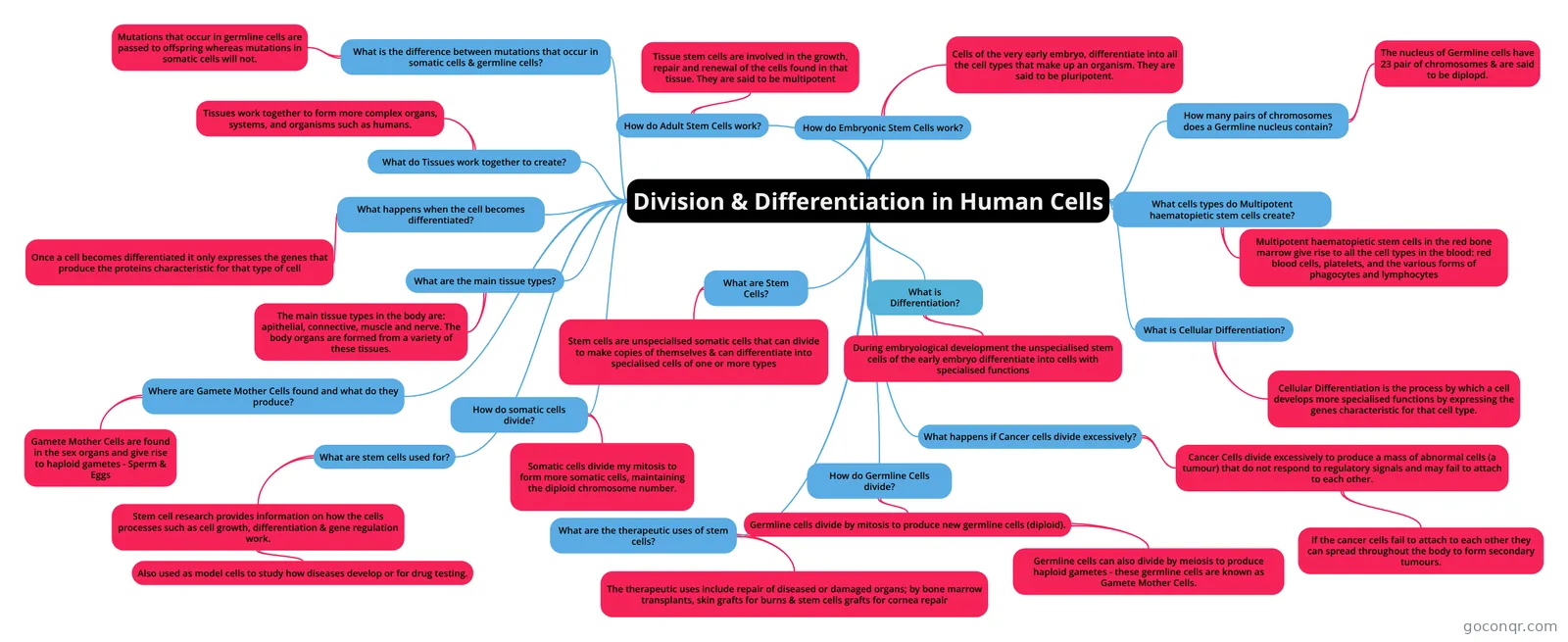
Mind map: Division and differentiation in human cells
Contenido del mapa
Division & Differentiation in Human Cells
What is Differentiation?
- During embryological development the unspecialised stem cells of the early embryo differentiate into cells with specialised functions
What are Stem Cells?
- Stem cells are unspecialised somatic cells that can divide to make copies of themselves & can differentiate into specialised cells of one or more types
How do Embryonic Stem Cells work?
- Cells of the very early embryo, differentiate into all the cell types that make up an organism. They are said to be pluripotent.
How do Adult Stem Cells work?
- Tissue stem cells are involved in the growth, repair and renewal of the cells found in that tissue. They are said to be multipotent
What are the main tissue types?
- The main tissue types in the body are: apithelial, connective, muscle and nerve. The body organs are formed from a variety of these tissues.
What cells types do Multipotent haematopietic stem cells create?
- Multipotent haematopietic stem cells in the red bone marrow give rise to all the cell types in the blood: red blood cells, platelets, and the various forms of phagocytes and lymphocytes
What do Tissues work together to create?
- Tissues work together to form more complex organs, systems, and organisms such as humans.
How do somatic cells divide?
- Somatic cells divide my mitosis to form more somatic cells, maintaining the diploid chromosome number.
What is Cellular Differentiation?
- Cellular Differentiation is the process by which a cell develops more specialised functions by expressing the genes characteristic for that cell type.
What happens when the cell becomes differentiated?
- Once a cell becomes differentiated it only expresses the genes that produce the proteins characteristic for that type of cell
How many pairs of chromosomes does a Germline nucleus contain?
- The nucleus of Germline cells have 23 pair of chromosomes & are said to be diplopd.
How do Germline Cells divide?
- Germline cells divide by mitosis to produce new germline cells (diploid).
- Germline cells can also divide by meiosis to produce haploid gametes - these germline cells are known as Gamete Mother Cells.
- Germline cells divide by mitosis to produce new germline cells (diploid).
Where are Gamete Mother Cells found and what do they produce?
- Gamete Mother Cells are found in the sex organs and give rise to haploid gametes - Sperm & Eggs
What is the difference between mutations that occur in somatic cells & germline cells?
- Mutations that occur in germline cells are passed to offspring whereas mutations in somatic cells will not.
What are stem cells used for?
- Stem cell research provides information on how the cells processes such as cell growth, differentiation & gene regulation work.
- Also used as model cells to study how diseases develop or for drug testing.
- Stem cell research provides information on how the cells processes such as cell growth, differentiation & gene regulation work.
What are the therapeutic uses of stem cells?
- The therapeutic uses include repair of diseased or damaged organs; by bone marrow transplants, skin grafts for burns & stem cells grafts for cornea repair
What happens if Cancer cells divide excessively?
- Cancer Cells divide excessively to produce a mass of abnormal cells (a tumour) that do not respond to regulatory signals and may fail to attach to each other.
- If the cancer cells fail to attach to each other they can spread throughout the body to form secondary tumours.
- Cancer Cells divide excessively to produce a mass of abnormal cells (a tumour) that do not respond to regulatory signals and may fail to attach to each other.
Información
- Descripción
- Mind map of 'what you should know' and 'learning intentions'
- Creado por
- Megan Falconer
- Visitas
- 95
- Etiquetas
- Valoración