
Mapa mental
Development
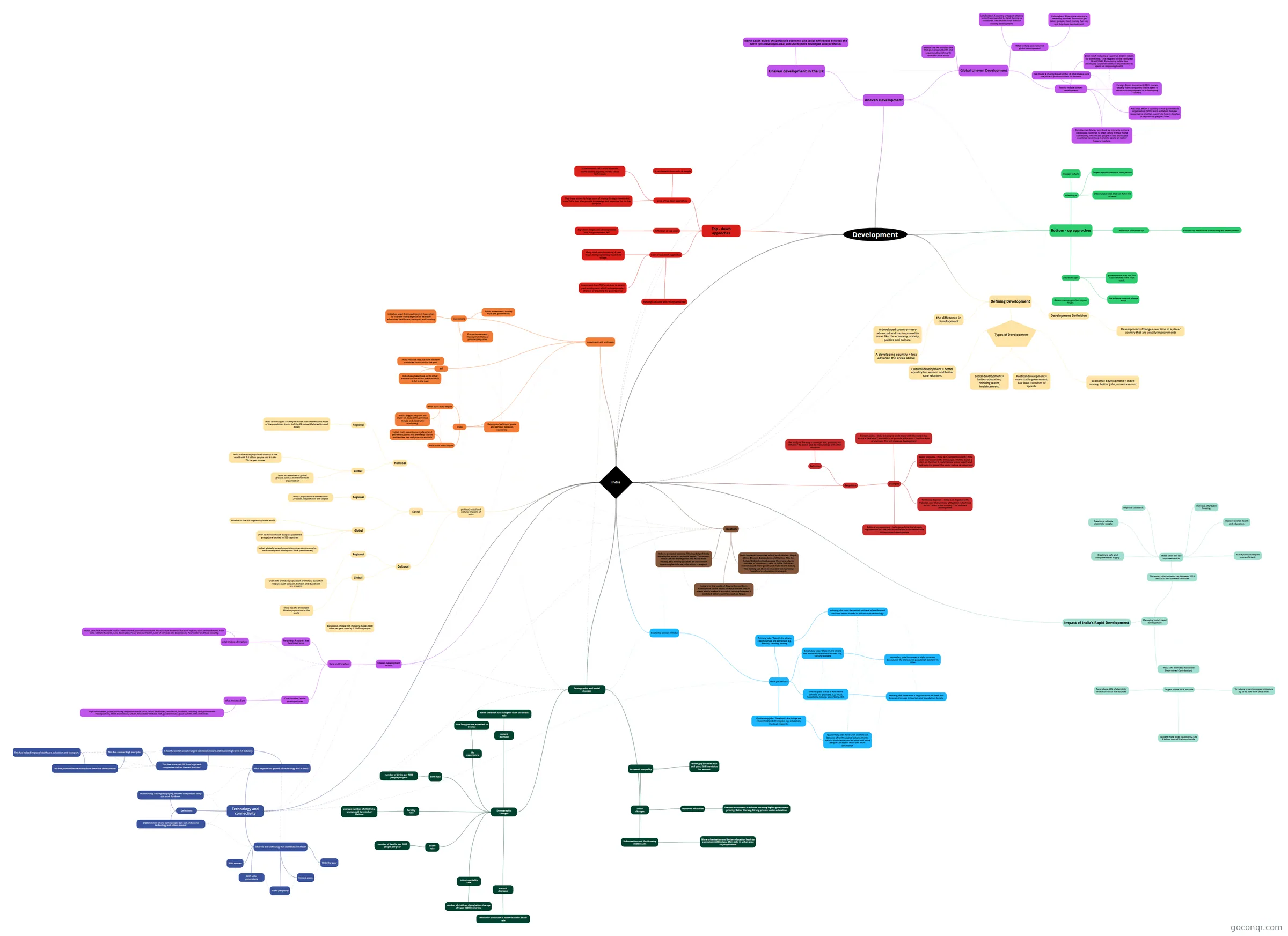
Mind map: Development
Contenido del mapa
Development
Bottom - up approches
- Deffinition of bottom-up
- Bottom–up: small scale community led developments.
- disadvantages
- governments may not like it as it makes them look weak
- Governments can often rely on NGOs
- the scheme may not always work
- advantages
- cheaper to fund
- Targets specific needs of local people
- creates local jobs that can fund the scheme
- Deffinition of bottom-up
Top - down approches
- pros of top-down approches
- They have access to large sums of money through investment from TNC’s that also provide knowledge and expertise for further projects.
- Governments/TNC’s Have access to world-leading experts and the latest technology
- It can benefit thousands of people
- deffinition of top-down
- Top–down: large scale developments that are government led.
- Cons of top-down approches
- Many local people may e.g. A new major dam project may flood their village.
- Investment from TNC’s can lead to poorly paid employment which reduces peoples chances of breaking the poverty cycle
- Funding can come with ‘strings attached’
- pros of top-down approches
Defining Development
- Development Definition
- Development = Changes over time in a place/ country that are usually improvements
- the difference in development
- A developed country = very advanced and has improved in areas like the economy, society, politics and culture.
- A developing country = less advance the areas above
- Types of Development
- Social development = better education, drinking water, healthcare etc.
- Economic development = more money, better jobs, more taxes etc
- Cultural development = better equality for women and better race relations
- Political development = more stable government. Fair laws. Freedom of speech.
- Development Definition
Uneven Development
- Uneven development in the UK
- North-South divide: the perceived economic and social differences between the north (less developed area) and south (more developed area) of the UK.
- Global Uneven Development
- Brandt line: An invisible line that goes around Earth and separates the rich north from the poor south
- What factors cause uneven global development?
- Landlocked: A country or region which is entirely surrounded by land, having no coastlines. This makes trade difficult slowing development.
- Colonialism: Where one country is owned by another. Resources get taken (people, food, money, fuel etc) and this slows development.
- how to reduce uneven development
- Fair-trade: A charity based in the UK that makes sure the price of products is fair for farmers.
- Debt relief: reducing a country’s debt in return for something. This happens in the rainforest (Brazil/USA). By reducing debts, less developed countries will have more money to spend on improving health.
- Aid: help. When a country or non-government organisation (NGO) such as Oxfam donates resources to another country to help it develop or improve its people’s lives.
- Remittances: Money sent back by migrants in more developed countries to their family in their home community. This means people in less developed countries have more money to spend on better houses, food etc.
- Foreign Direct Investment (FDI): money usually from companies that is spent o services or employment in a developing country.
- Uneven development in the UK
India
- location
- India is a coastal country. This has helped India develop because it can trade easier. This means India can sell more goods and make more money. This money can then be invested in improving healthcare, education, transport.
- India is in the south of Aisa in the northern hemisphere to the south of India lies the Indian ocean which makes it a coastal country however it borders 6 other countries such as Nepal.
- India borders 6 countries which are Pakistan, Nepal, China, Bhutan, Bangladesh and Burma. This has helped India develop because there are a large number of consumers near to India. India can therefore sell more goods and make more money. This money can then be invested in improving healthcare, education, transport.
- political, social and cultural impacts of india
- Political
- Regional
- India is the largest country in Indian subcontinent and most of the population live in 6 of the 29 states (Maharashtra and Bihar)
- Global
- India is the most populated country in the world with 1.4 billion people and it is the 7th Largest in area
- India is a member of global groups, such as the World Trade Organisation
- Regional
- Cultural
- Regional
- Over 80% of India’s population are Hindu, but other religions such as Islam, Sikhism and Buddhism are present.
- Global
- India has the 3rd largest Muslim population in the world
- Bollywood- India’s film industry makes 1600 films per year seen by 2.7 billion people
- Regional
- Social
- Regional
- India’s population is divided over 29 states. Rajasthan is the largest
- Global
- India’s globally spread population generates income for its economy with money sent back (remittances)
- Mumbai is the 9th largest city in the world
- Over 20 million Indian diaspora (scattered groups) are located in 100 countries
- Regional
- Political
- Uneven development in Inda
- Core and Periphery
- Core: A richer, more developed area
- what makes a Core
- High investment, ports providing important trade route, more developed, fertile soil, business, industry and government headquarters, more businesses, urban, favourable climate, rich, good services, good comms links and trade.
- what makes a Core
- Periphery: A poorer, less developed area.
- what makes a Periphery
- Rural, Distance from trade routes. Remote with poor infrastructure. Produce raw materials for core regions, Lack of investment, Poor soils, Climate hazards, Less developed, Poor, Disease ridden, Lack of services and businesses, Poor water and food security.
- what makes a Periphery
- Core: A richer, more developed area
- Core and Periphery
- Economic sectors in India
- the 4 job sectors
- Primary jobs: ‘Take it’ Are where raw materials are extracted. e.g. Fishing, farming, mining
- primary jobs have decreased as there is less demand for farm labour thanks to advances in technology
- Secondary jobs: ‘Make it’ Are where raw materials are manufactured. e.g. factory workers
- secondary jobs have seen a slight increase because of the increase in population desnsity in cities
- Tertiary jobs: ‘Serve it’ Are where services are provided. e.g. retail, hospitality, leisure, advertising, ICT.
- tertiary jobs have seen a large increase as there has been an increase in tourism and population density
- Quaternary jobs: ‘Develop it’ Are things are researched and developed. e.g. education, medical, research.
- Quaternary jobs have seen an increase becuase of technological advancements such as the internet and so more and more people can access more and more infomation
- Primary jobs: ‘Take it’ Are where raw materials are extracted. e.g. Fishing, farming, mining
- the 4 job sectors
- Demographic and social changes
- Soical changes
- Increased inequality
- Wider gap between rich and poor, Still low status for women
- Urbanisation and the Growing middle calls
- More urbanisation and better education leads to a growing middle class, More jobs in urban area so people move
- Improved education
- Greater investment in schools meaning higher government priority, Better literacy, Strong private sector education
- Increased inequality
- Demographic changes
- life expectancy
- How long you are expected to live for
- birth rate
- number of births per 1000 people per year
- fertility rate
- average number of children a women will have in her lifetime
- death rate
- number of deaths per 1000 people per year
- infant mortality rate
- number of children dying before the age of 5 per 1000 live births
- natural decrease
- When the birth rate is lower than the death rate
- natural increase
- When the Birth rate is higher than the death rate
- life expectancy
- Soical changes
- Geopolitics
- Definition
- the study of the way a country’s size, position, etc. influence its power and its relationships with other countries
- examples
- Foreign policy – India is trying to trade more with the west it has struck a deal with Canada for it to provide India with 3.2 million kilos of uranium. This will increase development
- Water disputes – India is in competition with China over river water in the Himalayas. If China builds a dam on the river it could reduce water supply and hydroelectric power this could reduce development
- Territorial disputes – India is in disputes with Pakistan over the territory of Kashmir, which has led to 3 wars in the country. This reduced development
- Political organisations – India joined the World trade organisation in 1994, which has helped to increase trade this increased development
- Definition
- investment, aid and trade
- Investment
- Public investment: money from the government
- india has used the investments it has gotten to improve many aspects for example education, healthcare, transport and housing
- Private investment: money from TNCs or private companies.
- aid
- India receives less aid from western countries than it did in the past
- India now gives more aid to other eastern countires like pakistan than it did in the past
- trade
- Buying and selling of goods and services between countries.
- What does india import
- India’s biggest imports are crude oil, coal, gems, precious metals and electronic machinery.
- What does india export
- India’s main exports are crude oil and petroleum, gems and jewellery, fabrics and textiles, tea and pharmaceuticals
- Investment
- Technology and connectivity
- what impacts has growth of technology had in India?
- it has the world’s second largest wireless network and its own high level ICT industry.
- This has attracted FDI from high tech companies such as Hewlett Packard.
- This has created high paid jobs.
- This has provided more money from taxes for development.
- This has helped improve healthcare, education and transport.
- This has provided more money from taxes for development.
- This has created high paid jobs.
- This has attracted FDI from high tech companies such as Hewlett Packard.
- it has the world’s second largest wireless network and its own high level ICT industry.
- Definitions
- Outsourcing: A company paying another company to carry out work for them.
- Digital divide: where some people can use and access technology and others cannot.
- where is the technology not distributed in India?
- With women
- With older generations
- In the periphery
- In rural areas
- With the poor
- what impacts has growth of technology had in India?
- Impact of India’s Rapid Development
- Managing India’s rapid development
- The smart cities mission ran between 2015 and 2020 and covered 100 cities
- These cities will see improvement in
- Creating a safe and adequate water supply.
- Creating a reliable electricity supply.
- Improve sanitation.
- Increase affordable housing.
- Improve overall health and education.
- Make public transport more efficient.
- These cities will see improvement in
- INDC (The Intended nationally Determined Contribution)
- Targets of the INDC include
- To reduce greenhouse gas emissions by 33 to 35% from 2005 level.
- To produce 40% of electricity from non–fossil fuel sources
- To plant more trees to absorb 2.5 to 3 billion tons of Carbon dioxide
- Targets of the INDC include
- The smart cities mission ran between 2015 and 2020 and covered 100 cities
- Managing India’s rapid development
- location
Información
- Descripción
- GCSE (Development) geography Mapa Mental sobre Development, creado por Kai Taylor el 23/01/2025.
- Creado por
- Kai Taylor
- Visitas
- 1
- Valoración