
Mapa mental
GCSE AQA Chemistry 2 Bonding
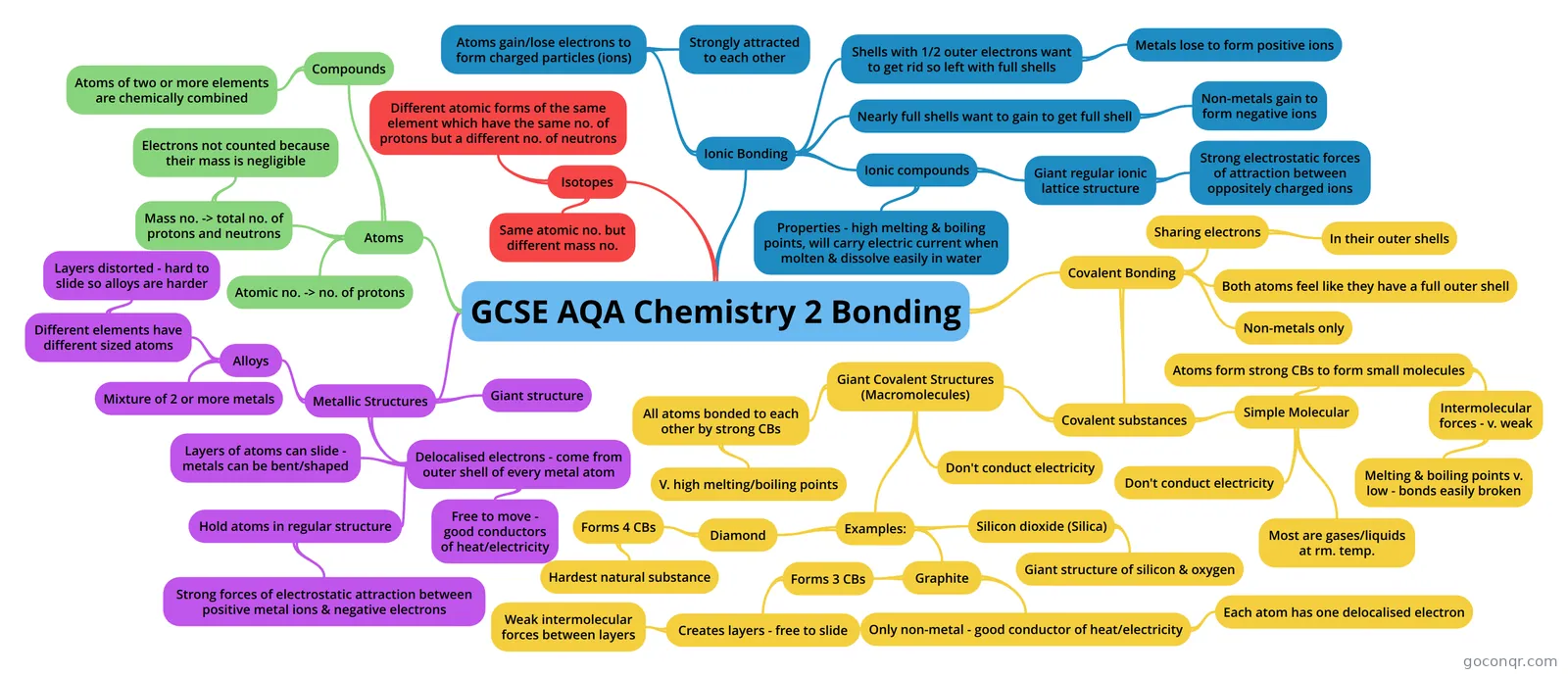
Mind map: GCSE AQA Chemistry 2 bonding
Contenido del mapa
GCSE AQA Chemistry 2 Bonding
Atoms
- Mass no. -> total no. of protons and neutrons
- Electrons not counted because their mass is negligible
- Atomic no. -> no. of protons
- Compounds
- Atoms of two or more elements are chemically combined
- Mass no. -> total no. of protons and neutrons
Isotopes
- Different atomic forms of the same element which have the same no. of protons but a different no. of neutrons
- Same atomic no. but different mass no.
Ionic Bonding
- Atoms gain/lose electrons to form charged particles (ions)
- Strongly attracted to each other
- Shells with 1/2 outer electrons want to get rid so left with full shells
- Metals lose to form positive ions
- Nearly full shells want to gain to get full shell
- Non-metals gain to form negative ions
- Ionic compounds
- Giant regular ionic lattice structure
- Strong electrostatic forces of attraction between oppositely charged ions
- Properties - high melting & boiling points, will carry electric current when molten & dissolve easily in water
- Giant regular ionic lattice structure
- Atoms gain/lose electrons to form charged particles (ions)
Covalent Bonding
- Sharing electrons
- In their outer shells
- Both atoms feel like they have a full outer shell
- Non-metals only
- Covalent substances
- Simple Molecular
- Atoms form strong CBs to form small molecules
- Intermolecular forces - v. weak
- Melting & boiling points v. low - bonds easily broken
- Intermolecular forces - v. weak
- Most are gases/liquids at rm. temp.
- Don't conduct electricity
- Atoms form strong CBs to form small molecules
- Giant Covalent Structures (Macromolecules)
- All atoms bonded to each other by strong CBs
- V. high melting/boiling points
- Don't conduct electricity
- Examples:
- Diamond
- Forms 4 CBs
- Hardest natural substance
- Forms 4 CBs
- Graphite
- Forms 3 CBs
- Creates layers - free to slide
- Weak intermolecular forces between layers
- Creates layers - free to slide
- Only non-metal - good conductor of heat/electricity
- Each atom has one delocalised electron
- Forms 3 CBs
- Silicon dioxide (Silica)
- Giant structure of silicon & oxygen
- Diamond
- All atoms bonded to each other by strong CBs
- Simple Molecular
- Sharing electrons
Metallic Structures
- Giant structure
- Delocalised electrons - come from outer shell of every metal atom
- Free to move - good conductors of heat/electricity
- Hold atoms in regular structure
- Strong forces of electrostatic attraction between positive metal ions & negative electrons
- Layers of atoms can slide - metals can be bent/shaped
- Alloys
- Mixture of 2 or more metals
- Different elements have different sized atoms
- Layers distorted - hard to slide so alloys are harder
Información
- Descripción
- Mind map showing information about bonding including ionic bonding, covalent bonding and metallic bonding.
- Creado por
- Lilac Potato
- Visitas
- 238
- Etiquetas
- Valoración