
Mapa mental
Approaches to treating Pain
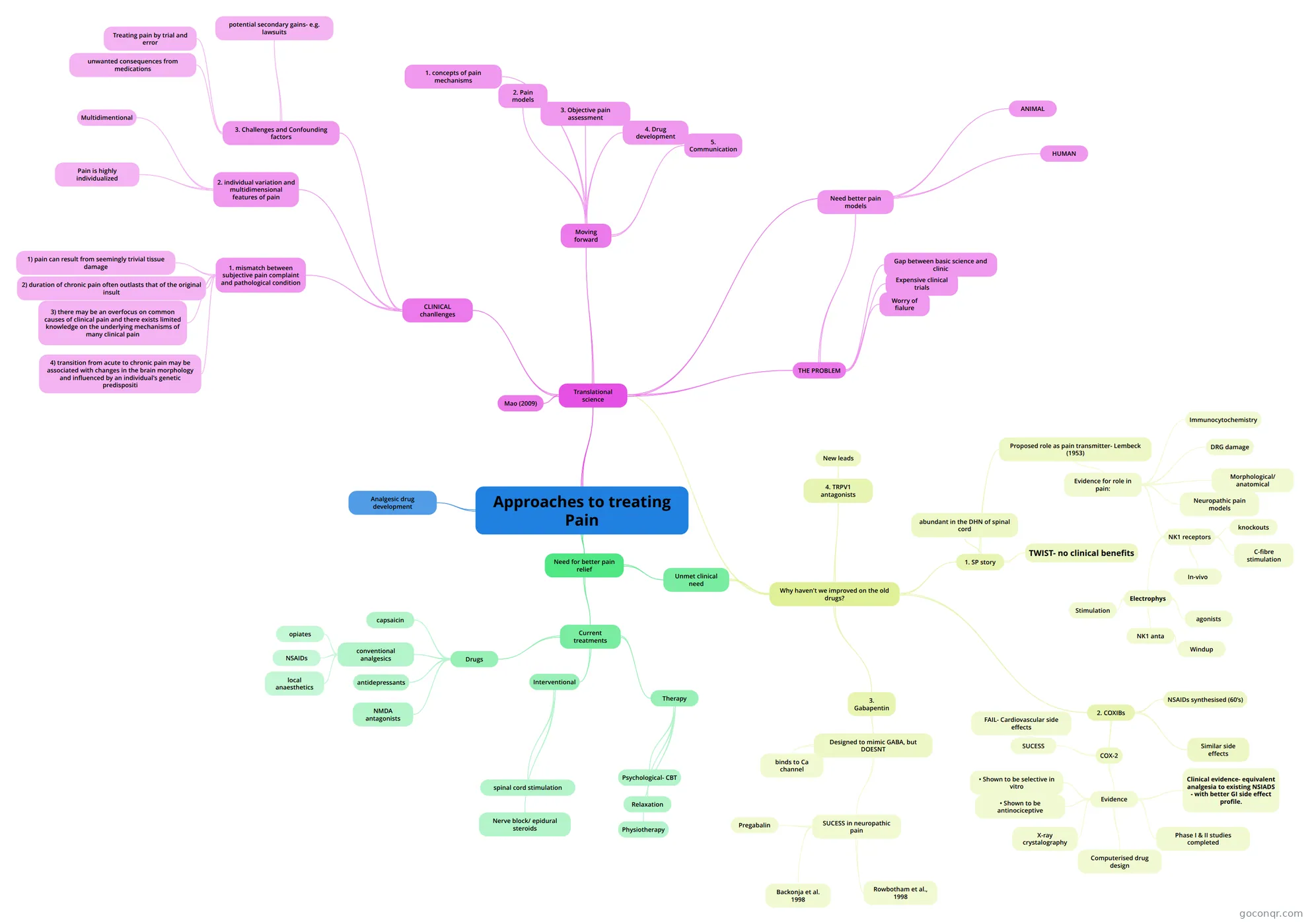
Mind map: Approaches to treating pain
Contenido del mapa
Approaches to treating Pain
Need for better pain relief
- Current treatments
- Drugs
- conventional analgesics
- opiates
- NSAIDs
- asprin
- local anaesthetics
- antidepressants
- capsaicin
- NMDA antagonists
- ketamine, cannabanoids
- conventional analgesics
- Interventional
- Nerve block/ epidural steroids
- spinal cord stimulation
- Therapy
- Psychological- CBT
- Physiotherapy
- Relaxation
- Drugs
- Unmet clinical need
- Why haven't we improved on the old drugs?
- 1. SP story
- abundant in the DHN of spinal cord
- in the primary afferents
- Proposed role as pain transmitter- Lembeck (1953)
- Evidence for role in pain:
- Immunocytochemistry
- showed high levels of SP in Lamina I-III
- DRG damage
- Spinal SP levels drop when dorsal roots sectioned
- Morphological/ anatomical
- Present in small dorsal root ganglion cell bodies – (6-20% of all DRG cells) • Estimated to be in 50% of all C-fibre neurones (nociceptors)
- NK1 receptors
- NK1 Receptor distribution matches SP inputs • Activation of NK1 receptors excites dorsal horn cells involved in nociceptive processing
- knockouts
- NK1 knock out mouse – Acute nociception relatively normal – Altered response to inflammation and wind up
- Electrophys
- NK1 anta
- – NK1 antagonists block slow EPSPs in dorsal horn neurones
- Windup
- Following inflammation of hindpaw NK1 antagonists attenuate wind up
- Stimulation
- Activation of NK1 receptors excites dorsal horn cells involved in nociceptive processing
- agonists
- – NK1 agonists evoke slow depolarisation
- NK1 anta
- C-fibre stimulation
- • Repeated application of c-fibre stimulus causes potentiation >>• Some evidence for a role for NK1 receptors in this process.
- In-vivo
- NK1 antagonists shown to be anti-nociceptive in vivo – Hot plate – Tail flick – Formalin injection
- Neuropathic pain models
- Immunocytochemistry
- Evidence for role in pain:
- TWIST- no clinical benefits
- No clinical benefit demonstrated – Migrane – Osteoarthritis – Post-herpetic neuralgia • Possible benefit in dental extraction model
- abundant in the DHN of spinal cord
- 2. COXIBs
- • Aspirin is the prototype NSAID
- Attempts to produce safer NSAIDs had focused on targeting downstream of COX with limited success
- NSAIDs synthesised (60’s)
- – Intended to be safer versions of aspirin – reversible COX inhibition – diclofenac, ibuprofen, ketorolac
- Similar side effects
- GI toxicity/Asthma/Renal failure – Limits use of drugs for many patients
- COX-2
- An inducible COX discovered in monocytes (1990) – Different from previously known COX • Shown to be inducible in a variety of organs – associated with inflammation, pain, swelling
- Evidence
- X-ray crystalography
- X-ray crystalography showed differences in COX pocket
- Computerised drug design
- allowed development of COX-2 selectives
- • Shown to be selective in vitro
- • Shown to be antinociceptive
- Phase I & II studies completed
- Clinical evidence- equivalent analgesia to existing NSIADS - with better GI side effect profile.
- X-ray crystalography
- SUCESS
- Effective drugs – Limited GI side effects – Good analgesic profile • Used preferentially to existing NSAIDs – Arthritis – Peri-operative – Back pain • Rapid uptake by doctors • Lots of money – Total market for COX-2 estimated at $20bn.
- FAIL- Cardiovascular side effects
- • An excess of cardiovascular events with rofecoxib – Thrombotic events - MIs/CVAs – 2-5 fold increase in events – Predictable side-effect of COX-2 antagonists
- 3. Gabapentin
- lipid soluble to cross the blood brain barrier
- Designed to mimic GABA, but DOESNT
- Does not mimic GABA! – But it is an anticonvulsant, with a good side effect profile – Launched as a second line adjunctive anticonvulsant
- SUCESS in neuropathic pain
- Backonja et al. 1998
- large study- n=165
- Rowbotham et al., 1998
- n=229
- Pregabalin
- Now being replaced by Pregabalin – “me too” drug with better pharmacokinetics.
- Backonja et al. 1998
- binds to Ca channel
- Found to bind to a calcium channel subunit (a2d) (Gee et al. 1996) – Proposed that this decreases transmitter release • Hence anticonvulsant/analgesic action
- 4. TRPV1 antagonists
- New leads
- 1. SP story
- Why haven't we improved on the old drugs?
- Current treatments
Analgesic drug development
Translational science
- PAIN MODELS
- ANIMAL
- HUMAN
- THE PROBLEM
- Gap between basic science and clinic
- Expensive clinical trials
- Worry of fialure
- Need better pain models
- CLINICAL chanllenges
- 1. mismatch between subjective pain complaint and pathological condition
- n the clinical setting, an individual's self-reporting of pain often does not correlate well with the severity of pathological condition because:
- 1) pain can result from seemingly trivial tissue damage
- 2) duration of chronic pain often outlasts that of the original insult
- 3) there may be an overfocus on common causes of clinical pain and there exists limited knowledge on the underlying mechanisms of many clinical pain
- 4) transition from acute to chronic pain may be associated with changes in the brain morphology and influenced by an individual's genetic predispositi
- 2. individual variation and multidimensional features of pain
- To date, no single clinical tool captures all dimensions of pain objectively, causing undertreatment of pain in some cases and inappropriate treatment in others.
- Pain is highly individualized
- with respect to the intensity, quality, and clinical comorbidity such as depression and posttraumatic stress disorder
- Multidimentional
- sensory discriminative, cognitive, autonomic and affective responses, and has gender and cultural differences
- 3. Challenges and Confounding factors
- Treating pain by trial and error
- unwanted consequences from medications
- addiction to medications
- potential secondary gains- e.g. lawsuits
- 1. mismatch between subjective pain complaint and pathological condition
- Mao (2009)
- Translational Pain Research: Achievements and Challenges
- Moving forward
- Translational pain research needs to involve the following areas.
- 1. concepts of pain mechanisms
- Current theories or concepts of pain mechanisms need to be critically reviewed and analyzed to provide a new roadmap of contemporary pain research. Preclinical research should move beyond studying the mechanisms of nociception to include investigations into the brain processing of pain perception and its related motor, autonomic, and psychological responses. For instance, it would be of significance to compare the similarities and differences in the cellular process between the spinal cord and various brain regions in response to peripheral nociceptive input.
- 2. Pain models
- Differences and similarities between animal and human experimental pain models and their relationship with clinical pain conditions should be compared and the limitations of these models are appropriately recognized. Experimental pain models, particularly preclinical models, are the foundation of pain research. Their relevance to clinical pain should be constantly revisited.
- 3. Objective pain assessment
- Limitations of preclinical and clinical pain-assessment tools have been well recognized. As such, developing innovative, objective pain-assessment and monitoring tools should be a top priority of translational pain research.
- 4. Drug development
- Current strategies of new drug development need to be evaluated and perhaps overhauled. Specific consideration should be given to understand the limitation of pharmacological interventions targeting similar cellular and intracellular mechanisms that may or may not be specific to the processing of nociception and pain.
- 5. Communication
- Dialogues between researchers and clinical practitioners must be strengthened as an important part of translational pain research. Some of these issues will be further discussed later in this article.
- Translational pain research requires constructive dialogues among basic scientists, pain practitioners, pharmaceutical chemists, and patients as well as collaborations among various clinical disciplines
- PAIN MODELS
Información
- Descripción
- Neuroscience of Pain Mapa Mental sobre Approaches to treating Pain, creado por Cher Bachar el 27/04/2013.
- Creado por
- Cher Bachar
- Visitas
- 78
- Etiquetas
- Valoración