
Mapa mental
Positive Classroom Management
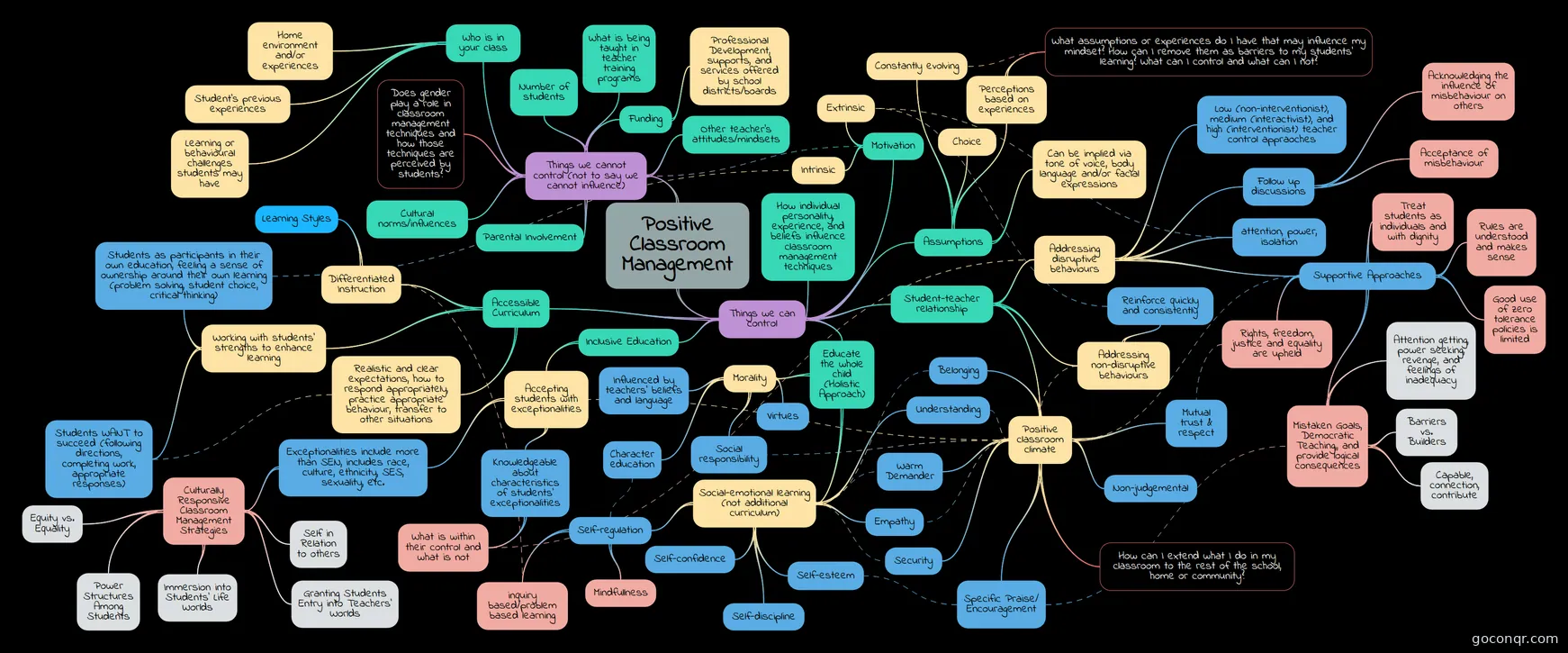
Mind map: Positive classroom management
Contenido del mapa
Positive Classroom Management
Things we can control
- Accessible Curriculum
- Realistic and clear expectations, how to respond appropriately, practice appropriate behaviour, transfer to other situations
- Working with students' strengths to enhance learning
- Beaty-O’Ferrall, Green, & Hanna (2010); Demirdag (2015)
- Students WANT to succeed (following directions, completing work, appropriate responses)
- Students as participants in their own education, feeling a sense of ownership around their own learning (problem solving, student choice, critical thinking)
- Differentiated Instruction
- Learning Styles
- Student-teacher relationship
- Positive classroom climate
- Warm Demander
- Everston & Weinstein (2006)
- How can I extend what I do in my classroom to the rest of the school, home or community?
- Belonging
- Security
- Mutual trust & respect
- Non-judgemental
- Specific Praise/ Encouragement
- Briere, Simonsen, Sugai & Myers (2015; Manning & Bucher (2013)
- Warm Demander
- Addressing disruptive behaviours
- Supportive Approaches
- Manning & Bucher (2013)
- Mistaken Goals, Democratic Teaching,, and provide logical consequences
- Manning & Bucher (2013)
- Attention getting, power seeking, revenge, and feelings of inadequacy
- Capable, connection, contribute
- Barriers vs. Builders
- Rights, freedom, justice and equality are upheld
- Treat students as individuals and with dignity
- Rules are understood and makes sense
- Good use of zero tolerance policies is limited
- attention, power, isolation
- Manning & Bucher (2013)
- Low (non-interventionist), medium (interactivist), and high (interventionist) teacher control appraoches
- Sahin (2015)
- Follow up discussions
- Romi, Lewis, & Salkovsky (2015)
- Acceptance of misbehaviour
- Acknowledging the influence of misbehaviour on others
- Supportive Approaches
- Addressing non-disruptive behaviours
- Reinforce quickly and consistently
- Goldstein & Brooks (2007)
- Reinforce quickly and consistently
- Positive classroom climate
- Educate the whole child (Holistic Approach)
- Social-emotional learning (not additional curriculum)
- Goldstein & Brooks (2007)
- Self-regulation
- Alderman & MacDonald (2015)
- inquiry based/problem based learning
- Mindfullness
- Gaines (2016)
- Empathy
- Understanding
- Self-confidence
- Self-discipline
- Self-esteem
- Demirdag (2015)
- Morality
- Fallona & Richardson (2006)
- Character education
- Influenced by teachers' beliefs and language
- Virtues
- Social responsibility
- Social-emotional learning (not additional curriculum)
- Assumptions
- Brooks & Goldstein (2007)
- Perceptions based on experiences
- What assumptions or experiences do I have that may influence my mindset? How can I remove them as barriers to my students' learning? What can I control and what can I not?
- Choice
- Constantly evolving
- Can be implied via tone of voice, body language and/or facial expressions
- Motivation
- Intrinsic
- Extrinsic
- How individual personality, experience, and beliefs influence classroom management techniques
- Briesch, Briesch & Chafouleas (2015)
- Inclusive Education
- Accepting students with exceptionalities
- Manning & Bucher (2013)
- Knowledgeable about characteristics of students' exceptionalities
- What is within their control and what is not
- Exceptionalities include more than SEN, includes race, culture, ethnicity, SES, sexuality, etc.
- Culturally Responsive Classroom Management Strategies
- Metropolitan Center for Urban Education (2008)
- Equity vs. Equality
- Milner & Tenore (2010)
- Power Structures Among Students
- Milner & Tenore (2010)
- Immersion into Students' Life Worlds
- Milner & Tenore (2010)
- Self in Relation to others
- Milner & Tenore (2010)
- Granting Students Entry into Teachers' Worlds
- Milner & Tenore (2010)
- Culturally Responsive Classroom Management Strategies
- Accepting students with exceptionalities
- Accessible Curriculum
Things we cannot control (not to say we cannot influence)
- Other teacher's attitudes/mindsets
- Brooks & Goldstein (2007)
- Number of students
- Who is in your class
- Student's previous experiences
- Home environment and/or experiences
- Learning or behavioural challenges students may have
- Does gender play a role in classroom management techniques and how those techniques are perceived by students?
- Cultural norms/influences
- Parental Involvement
- What is being taught in teacher training programs
- Funding
- Professional Development, supports, and services offered by school districts/boards
- Other teacher's attitudes/mindsets
Información
- Descripción
- Concept map for GRADEDUC 9483 - Positive Classroom Management
- Creado por
- Nicole Wadden Garland
- Visitas
- 61
- Etiquetas
- Valoración