
Mapa mental
Cells, tissues and organs - key points
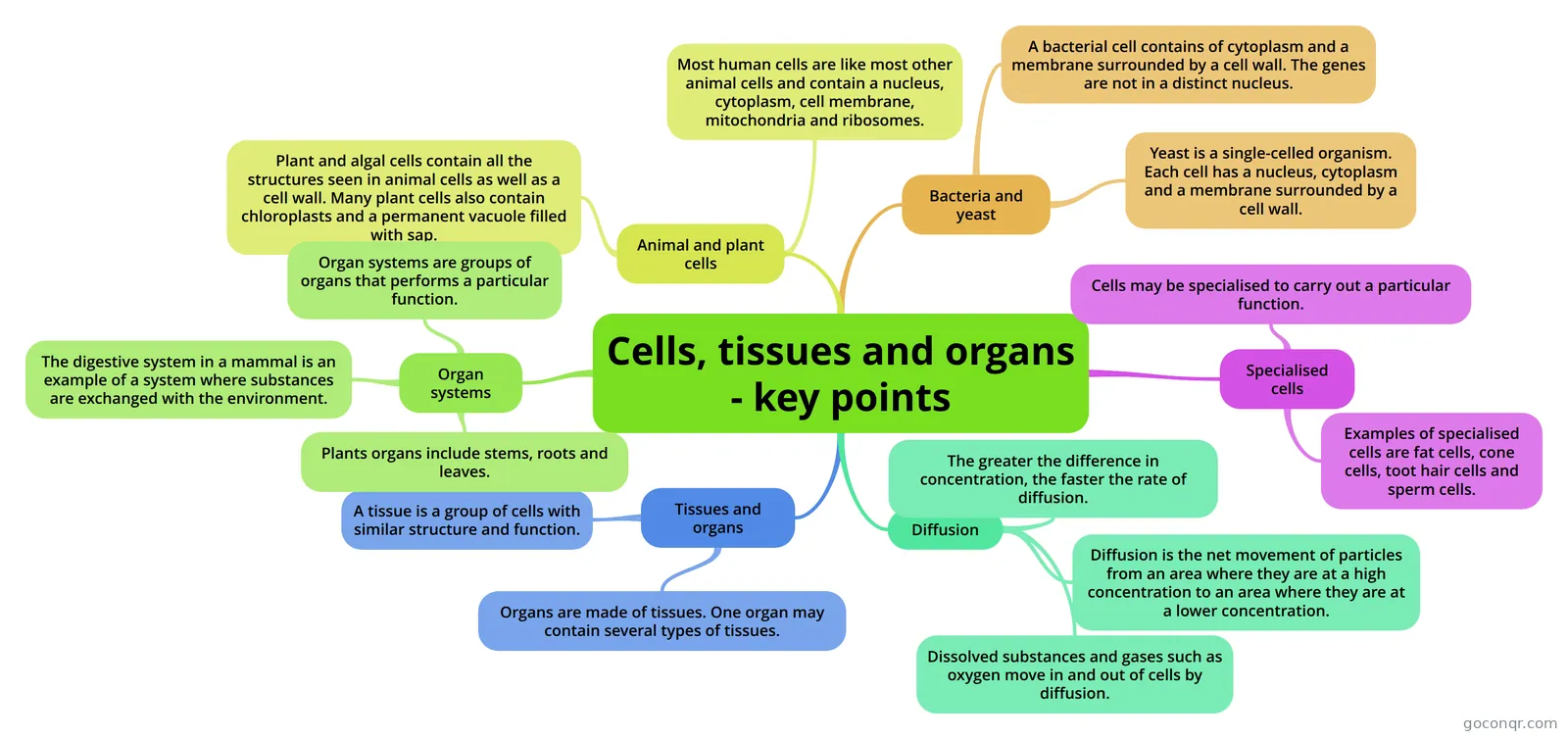
Mind map: cells, tissues and organs
Contenido del mapa
Cells, tissues and organs - key points
Animal and plant cells
- Most human cells are like most other animal cells and contain a nucleus, cytoplasm, cell membrane, mitochondria and ribosomes.
- Plant and algal cells contain all the structures seen in animal cells as well as a cell wall. Many plant cells also contain chloroplasts and a permanent vacuole filled with sap.
Diffusion
- The greater the difference in concentration, the faster the rate of diffusion.
- Diffusion is the net movement of particles from an area where they are at a high concentration to an area where they are at a lower concentration.
- Dissolved substances and gases such as oxygen move in and out of cells by diffusion.
Tissues and organs
- A tissue is a group of cells with similar structure and function.
- Organs are made of tissues. One organ may contain several types of tissues.
Specialised cells
- Cells may be specialised to carry out a particular function.
- Examples of specialised cells are fat cells, cone cells, toot hair cells and sperm cells.
Organ systems
- Organ systems are groups of organs that performs a particular function.
- Plants organs include stems, roots and leaves.
- The digestive system in a mammal is an example of a system where substances are exchanged with the environment.
Bacteria and yeast
- A bacterial cell contains of cytoplasm and a membrane surrounded by a cell wall. The genes are not in a distinct nucleus.
- Yeast is a single-celled organism. Each cell has a nucleus, cytoplasm and a membrane surrounded by a cell wall.
Información
- Descripción
- GCSE (Cells, tissues and organs) Biology Mapa Mental sobre Cells, tissues and organs - key points, creado por 01west el 20/03/2014.
- Creado por
- 01west
- Visitas
- 91
- Etiquetas
- Valoración