
Mapa mental
Evolution
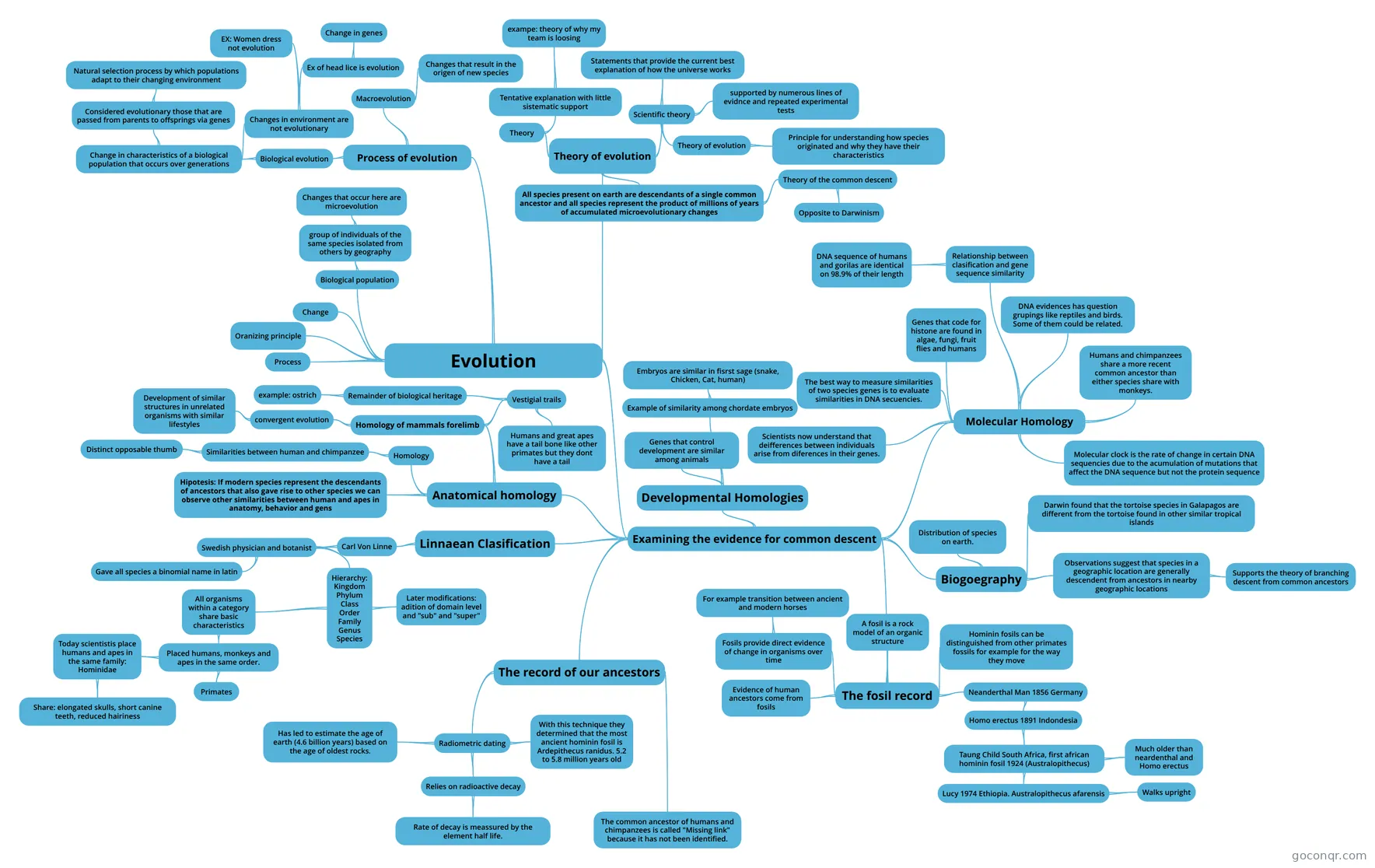
Mind map: Evolution
Contenido del mapa
Evolution
Process
Oranizing principle
Change
Process of evolution
- Biological evolution
- Change in characteristics of a biological population that occurs over generations
- Considered evolutionary those that are passed from parents to offsprings via genes
- Natural selection process by which populations adapt to their changing environment
- Changes in environment are not evolutionary
- EX: Women dress not evolution
- Ex of head lice is evolution
- Change in genes
- Considered evolutionary those that are passed from parents to offsprings via genes
- Change in characteristics of a biological population that occurs over generations
- Macroevolution
- Changes that result in the origen of new species
- Biological evolution
Biological population
- group of individuals of the same species isolated from others by geography
- Changes that occur here are microevolution
- group of individuals of the same species isolated from others by geography
Theory of evolution
- Theory
- Tentative explanation with little sistematic support
- exampe: theory of why my team is loosing
- Tentative explanation with little sistematic support
- Scientific theory
- Statements that provide the current best explanation of how the universe works
- supported by numerous lines of evidnce and repeated experimental tests
- Theory of evolution
- Principle for understanding how species originated and why they have their characteristics
- All species present on earth are descendants of a single common ancestor and all species represent the product of millions of years of accumulated microevolutionary changes
- Theory of the common descent
- Opposite to Darwinism
- Theory of the common descent
- Theory
Examining the evidence for common descent
- Linnaean Clasification
- Carl Von Linne
- Swedish physician and botanist
- Gave all species a binomial name in latin
- Hierarchy: Kingdom Phylum Class Order Family Genus Species
- Later modifications: adition of domain level and "sub" and "super"
- All organisms within a category share basic characteristics
- Placed humans, monkeys and apes in the same order.
- Primates
- Today scientistis place humans and apes in the same family: Hominidae
- Share: elongated skulls, short canine teeth, reduced hairiness
- Placed humans, monkeys and apes in the same order.
- Swedish physician and botanist
- Carl Von Linne
- Anatomical homology
- Hipotesis: If modern species represent the descendants of ancestors that also gave rise to other species we can observe other similarities between human and apes in anatomy, behavior and gens
- Homology
- Similarities between human and chimpanzee
- Distinct opposable thumb
- Similarities between human and chimpanzee
- Homology of mammals forelimb
- convergent evolution
- Development of similar structures in unrelated organisms with similar lifestyles
- Vestigial trails
- Humans and great apes have a tail bone like other primates but they dont have a tail
- Remainder of biological heritage
- example: ostrich
- convergent evolution
- Developmental Homologies
- Genes that control development are similar among animals
- Example of similarity among chordate embryos
- Embryos are similar in fisrst sage (snake, Chicken, Cat, human)
- Molecular Homology
- Scientists now understand that deifferences between individuals arise from diferences in their genes.
- The best way to measure similarities of two species genes is to evaluate similarities in DNA secuencies.
- Genes that code for histone are found in algae, fungi, fruit flies and humans
- Relationship between clasification and gene sequence similarity
- DNA sequence of humans and gorilas are identical on 98.9% of their length
- DNA evidences has question grupings like reptiles and birds. Some of them could be related.
- Humans and chimpanzees share a more recent common ancestor than either species share with monkeys.
- Molecular clock is the rate of change in certain DNA sequencies due to the acumulation of mutations that affect the DNA sequence but not the protein sequence
- Biogoegraphy
- Distribution of species on earth.
- Darwin found that the tortoise species in Galapagos are different from the tortoise found in other similar tropical islands
- Observations suggest that species in a geographic location are generally descendent from ancestors in nearby geographic locations
- Supports the theory of branching descent from common ancestors
- The fosil record
- Evidence of human ancestors come from fosils
- Fosils provide direct evidence of change in organisms over time
- For example transition between ancient and modern horses
- A fosil is a rock model of an organic structure
- Hominin fosils can be distinguished from other primates fossils for example for the way they move
- Neanderthal Man 1856 Germany
- Homo erectus 1891 Indondesia
- Taung Child South Africa, first african hominin fosil 1924 (Australopithecus)
- Much older than neardenthal and Homo erectus
- Lucy 1974 Ethiopia. Australopithecus afarensis
- Walks upright
- Taung Child South Africa, first african hominin fosil 1924 (Australopithecus)
- Homo erectus 1891 Indondesia
- The record of our ancestors
- Radiometric dating
- Has led to estimate the age of earth (4.6 billion years) based on the age of oldest rocks.
- Relies on radioactive decay
- Rate of decay is meassured by the element half life.
- With this technique they determined that the most ancient hominin fosil is Ardepithecus ranidus. 5.2 to 5.8 million years old
- The common ancestor of humans and chimpanzees is called "Missing link" because it has not been identified.
- Radiometric dating
- Linnaean Clasification
Información
- Descripción
- Mapa Mental sobre Evolution, creado por Gabriela Pardo el 14/11/2016.
- Creado por
- Gabriela Pardo
- Visitas
- 0
- Valoración