
Mapa mental
Ecology
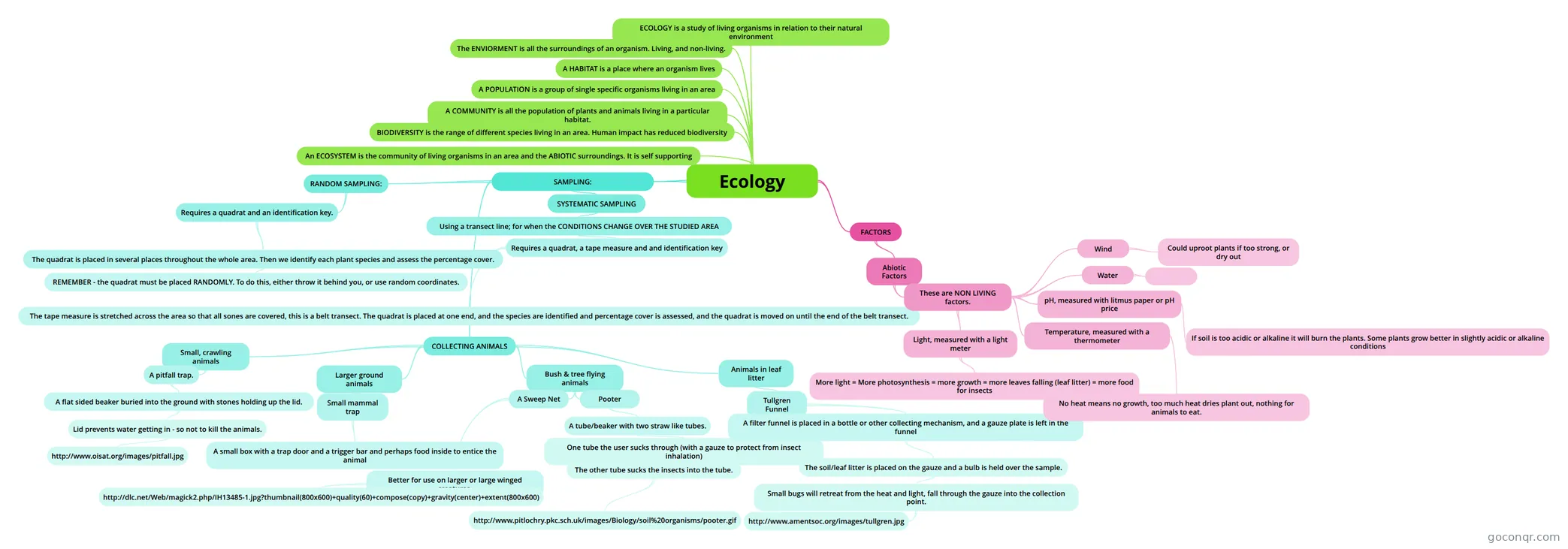
Mind map: ecology
Contenido del mapa
Ecology
ECOLOGY is a study of living organisms in relation to their natural environment
The ENVIORMENT is all the surroundings of an organism. Living, and non-living.
A HABITAT is a place where an organism lives
A POPULATION is a group of single specific organisms living in an area
A COMMUNITY is all the population of plants and animals living in a particular habitat.
BIODIVERSITY is the range of different species living in an area. Human impact has reduced biodiversity
An ECOSYSTEM is the community of living organisms in an area and the ABIOTIC surroundings. It is self supporting
SAMPLING:
- RANDOM SAMPLING:
- Requires a quadrat and an identification key.
- The quadrat is placed in several places throughout the whole area. Then we identify each plant species and assess the percentage cover.
- REMEMBER - the quadrat must be placed RANDOMLY. To do this, either throw it behind you, or use random coordinates.
- The quadrat is placed in several places throughout the whole area. Then we identify each plant species and assess the percentage cover.
- Requires a quadrat and an identification key.
- SYSTEMATIC SAMPLING
- Using a transect line; for when the CONDITIONS CHANGE OVER THE STUDIED AREA
- Requires a quadrat, a tape measure and and identification key
- The tape measure is stretched across the area so that all sones are covered, this is a belt transect. The quadrat is placed at one end, and the species are identified and percentage cover is assessed, and the quadrat is moved on until the end of the belt transect.
- Requires a quadrat, a tape measure and and identification key
- Using a transect line; for when the CONDITIONS CHANGE OVER THE STUDIED AREA
- COLLECTING ANIMALS
- Small, crawling animals
- A pitfall trap.
- A flat sided beaker buried into the ground with stones holding up the lid.
- Lid prevents water getting in - so not to kill the animals.
- http://www.oisat.org/images/pitfall.jpg
- Lid prevents water getting in - so not to kill the animals.
- A flat sided beaker buried into the ground with stones holding up the lid.
- A pitfall trap.
- Larger ground animals
- Small mammal trap
- A small box with a trap door and a trigger bar and perhaps food inside to entice the animal
- Small mammal trap
- Bush & tree flying animals
- A Sweep Net
- Better for use on larger or large winged creatures.
- http://dlc.net/Web/magick2.php/IH13485-1.jpg?thumbnail(800x600)+quality(60)+compose(copy)+gravity(center)+extent(800x600)
- Better for use on larger or large winged creatures.
- Pooter
- A tube/beaker with two straw like tubes.
- One tube the user sucks through (with a gauze to protect from insect inhalation)
- The other tube sucks the insects into the tube.
- http://www.pitlochry.pkc.sch.uk/images/Biology/soil%20organisms/pooter.gif
- The other tube sucks the insects into the tube.
- One tube the user sucks through (with a gauze to protect from insect inhalation)
- A tube/beaker with two straw like tubes.
- A Sweep Net
- Animals in leaf litter
- Tullgren Funnel
- A filter funnel is placed in a bottle or other collecting mechanism, and a gauze plate is left in the funnel
- The soil/leaf litter is placed on the gauze and a bulb is held over the sample.
- Small bugs will retreat from the heat and light, fall through the gauze into the collection point.
- http://www.amentsoc.org/images/tullgren.jpg
- Small bugs will retreat from the heat and light, fall through the gauze into the collection point.
- The soil/leaf litter is placed on the gauze and a bulb is held over the sample.
- A filter funnel is placed in a bottle or other collecting mechanism, and a gauze plate is left in the funnel
- Tullgren Funnel
- Small, crawling animals
- RANDOM SAMPLING:
FACTORS
- Abiotic Factors
- These are NON LIVING factors.
- Light, measured with a light meter
- More light = More photosynthesis = more growth = more leaves falling (leaf litter) = more food for insects
- Temperature, measured with a thermometer
- No heat means no growth, too much heat dries plant out, nothing for animals to eat.
- pH, measured with litmus paper or pH price
- If soil is too acidic or alkaline it will burn the plants. Some plants grow better in slightly acidic or alkaline conditions
- Wind
- Could uproot plants if too strong, or dry out
- Water
- Light, measured with a light meter
- These are NON LIVING factors.
- Abiotic Factors
Información
- Descripción
- GCSE Biology Mapa Mental sobre Ecology, creado por Aoife O'Connor el 04/05/2013.
- Creado por
- Aoife O'Connor
- Visitas
- 141
- Etiquetas
- Valoración