
Mapa mental
1.3.2 Networks (cont again)
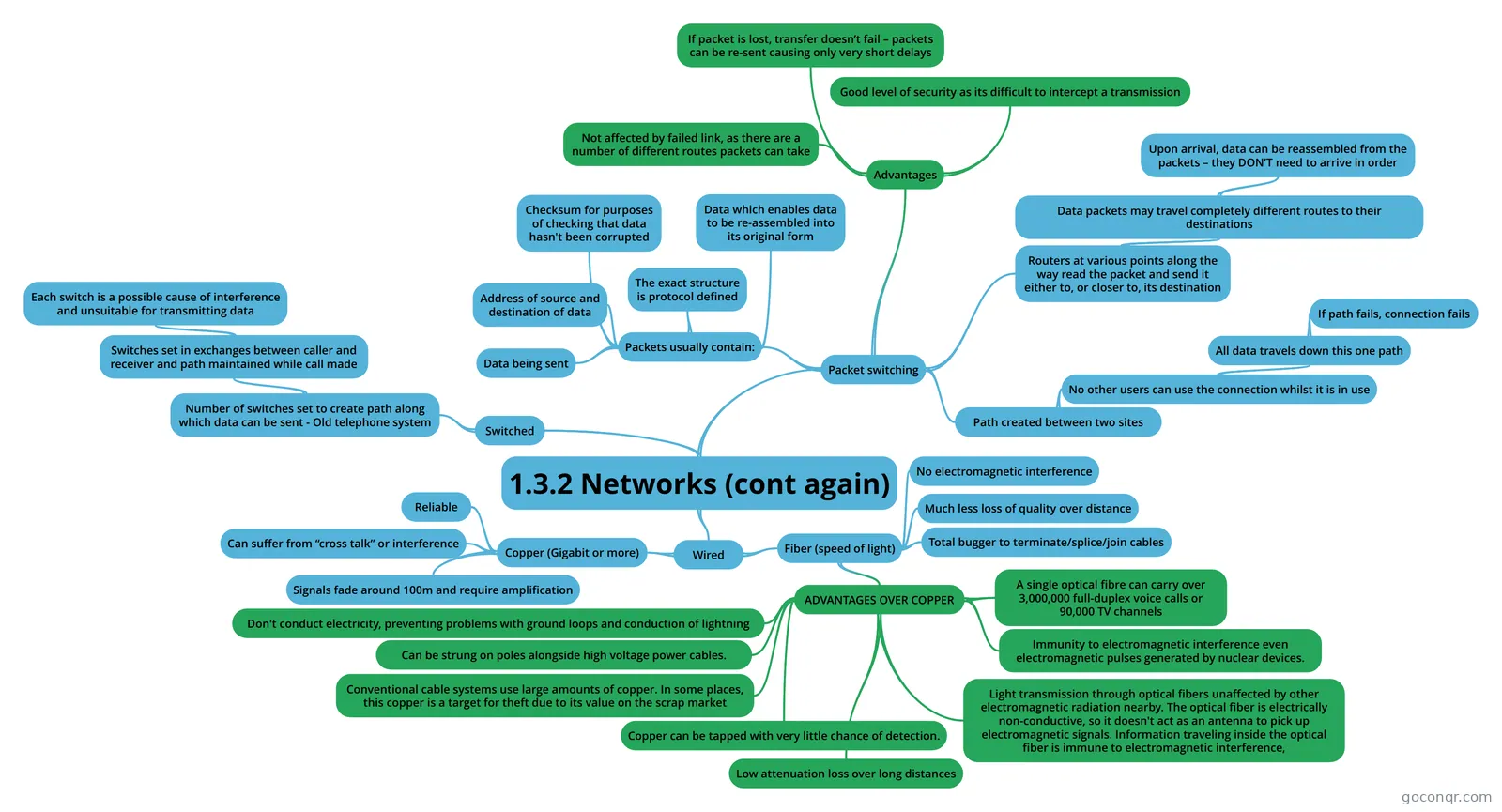
Mind map: Networks wired switched packet switching
Contenido del mapa
1.3.2 Networks (cont again)
Wired
- Copper (Gigabit or more)
- Reliable
- Can suffer from “cross talk” or interference
- Signals fade around 100m and require amplification
- Fiber (speed of light)
- No electromagnetic interference
- Much less loss of quality over distance
- Total bugger to terminate/splice/join cables
- ADVANTAGES OVER COPPER
- A single optical fibre can carry over 3,000,000 full-duplex voice calls or 90,000 TV channels
- Immunity to electromagnetic interference even electromagnetic pulses generated by nuclear devices.
- Light transmission through optical fibers unaffected by other electromagnetic radiation nearby. The optical fiber is electrically non-conductive, so it doesn't act as an antenna to pick up electromagnetic signals. Information traveling inside the optical fiber is immune to electromagnetic interference,
- Low attenuation loss over long distances
- Don't conduct electricity, preventing problems with ground loops and conduction of lightning
- Can be strung on poles alongside high voltage power cables.
- Conventional cable systems use large amounts of copper. In some places, this copper is a target for theft due to its value on the scrap market
- Copper can be tapped with very little chance of detection.
- Copper (Gigabit or more)
Switched
- Number of switches set to create path along which data can be sent - Old telephone system
- Switches set in exchanges between caller and receiver and path maintained while call made
- Each switch is a possible cause of interference and unsuitable for transmitting data
- Switches set in exchanges between caller and receiver and path maintained while call made
- Number of switches set to create path along which data can be sent - Old telephone system
Packet switching
- Path created between two sites
- No other users can use the connection whilst it is in use
- All data travels down this one path
- If path fails, connection fails
- All data travels down this one path
- No other users can use the connection whilst it is in use
- Packets usually contain:
- Data being sent
- Address of source and destination of data
- Checksum for purposes of checking that data hasn't been corrupted
- Data which enables data to be re-assembled into its original form
- The exact structure is protocol defined
- Routers at various points along the way read the packet and send it either to, or closer to, its destination
- Data packets may travel completely different routes to their destinations
- Upon arrival, data can be reassembled from the packets – they DON’T need to arrive in order
- Data packets may travel completely different routes to their destinations
- Advantages
- Not affected by failed link, as there are a number of different routes packets can take
- If packet is lost, transfer doesn’t fail – packets can be re-sent causing only very short delays
- Good level of security as its difficult to intercept a transmission
- Path created between two sites
Información
- Descripción
- A level (1.3.2 Networks) Computing Mapa Mental sobre 1.3.2 Networks (cont again), creado por Alexandra Russell el 30/11/2016.
- Creado por
- Alexandra Russell
- Visitas
- 3
- Valoración