
Mapa mental
Systems and Models
Contenido del mapa
Systems and Models
1.1.1 Outline the concept and characteristics of systems
- System: assemblage of parts, working together, forming a functioning whole
- Non-living system: bicycle
- Living system: The cell
- The biosphere= lithosphere + ecosphere + hydrosphere + atmosphere
1.1.2 Apply the systems concept on a range of scales
- Drop of water
- Pete's pond, Botswana
- The atlantic ocean
- The earth
1.13 Define the terms open system, closed system and isolated systems
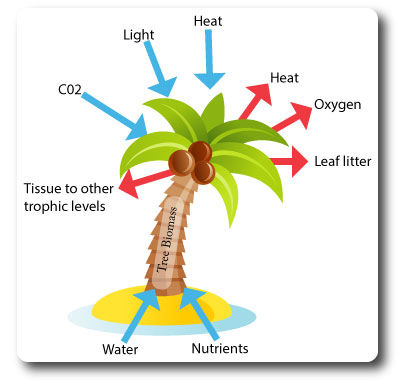
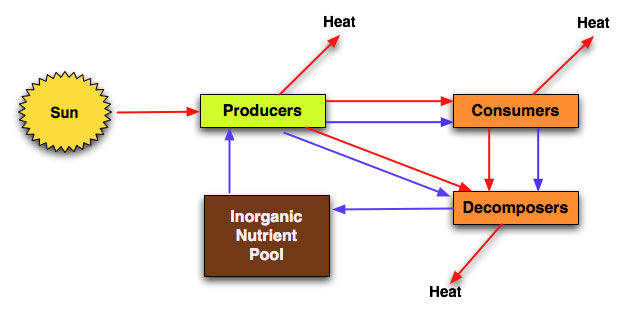
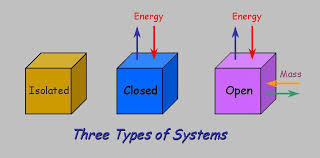
- Open system: exchange matter (blue) and energy (red) with its surroundings (most systems are open)
- Forest
- Closed system: exchanges energy but not matter with the environment
- Earth and Biosphere 2
- Isolated system: does not exchange matter or energy with its surroundings
- The universe
- Open system: exchange matter (blue) and energy (red) with its surroundings (most systems are open)
1.1.4 Describe how the first and second law of thermodynamics are relevant to environmental systems
- First law: Energy is neither created nor destroyed
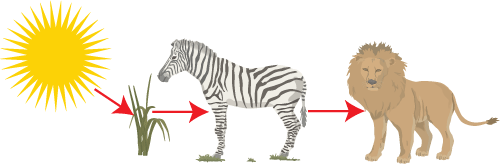
- Solar energy (sun) >stored chemical energy (plants-glucose)> food for the herbivore (zebra)>food for the carnivore (lion)
- Second law: The entropy of any isolated system is not in in equilibrium and increases spontanousely over time
- Entropy: A measure of the amount of disorder, chaos or randomness, in a system; the grgreater the disorder, the greater the level of entropy.
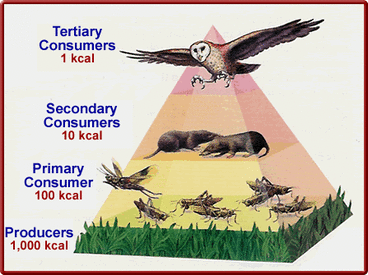
- Energy conversions are never 100%, some energy is always lost to the environment as heat.
- At each stage of the food chain most of the energy is lost in heat.
- First law: Energy is neither created nor destroyed
1.1.5 Explain the nature of equilibria
- Equilibrium: A state of balance among the components of a system
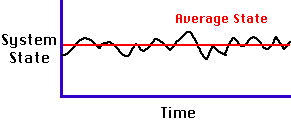
- Steady-state equilibrium: Condition in an open system where there are no changes over the long term, but there may be some oscillations in the very short term.
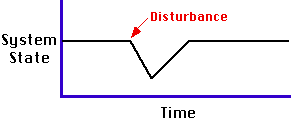
- Stable equilibrium: Condition of a system which there is a tendency for it to return to a previous equilibrium condition following a disturbance rather than adopting a new one.
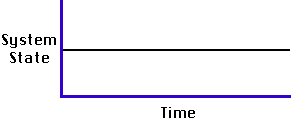
- Static equilibrium: No change. Condition to which natural systems can be compared to.
1.1.6 Define and explain the principles of positive feedback and negative feedback
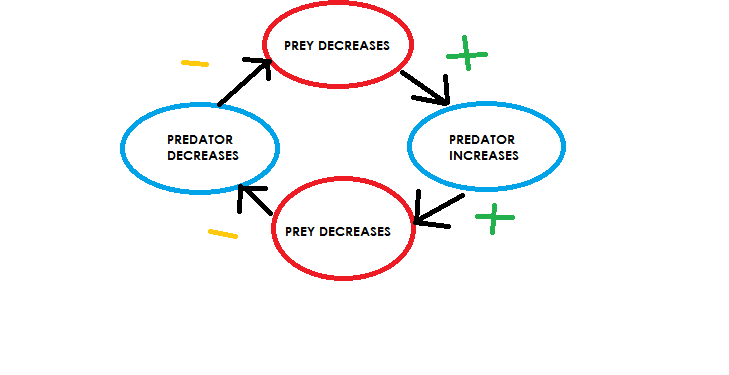
- Negative feedback: Feedback that tends to damp down, neutralise or counteract any deviation from an equilibrium and promotes stability. eg, predator-prey relationship
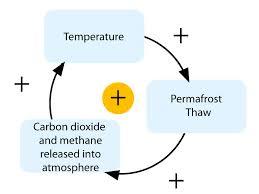
- Positive feedback: Feedback that amplifies or increases change; it leads to exponential deviation from an equilibrium. eg. Temperature>permafrost thaw> CO2 and Methane
1.1.7 Describe transfer and transformation processes
- Transfer: Flow through a system and involves a change in location
- Transformation: Interaction within a system which leads in the formation of a new product/ involves a change of state.
1.1.8 Distinguish between flows and storages in relation to systems
- Flow: Inputs and outputs of energy and matter (arrows) Storages: Where energy and matter can be stored. (stock-boxes)
1.1.10 Evaluate the strengths and limitations of models
- Strengths: 1. Simplify complex methods 2. Predictions about the future can be made following theory 3. Variables can be changed to examine effects 4. Available to both scientists and public
- Weaknesses: 1. They may be inaccurate 2. They rely of the expertise of those making them 3. Interpretations may vary 4. Vest interests may manipulate them 5. Models are as good as the data that goes in them 6. Different models can show different effects using the same data
1.1.9: Construct and analyse quantitative models involving flows and storages in a system
- Blow arrows: flows of matter Red arrows: flows of energy Boxes and circles: storages
Imágenes y archivos del mapa
Información
- Descripción
- International Baccalaureate (TOPIC 1) ESS Mapa Mental sobre Systems and Models , creado por ntokozoyende el 07/04/2014.
- Creado por
- ntokozoyende
- Visitas
- 222
- Etiquetas
- Valoración