
Mapa mental
Population
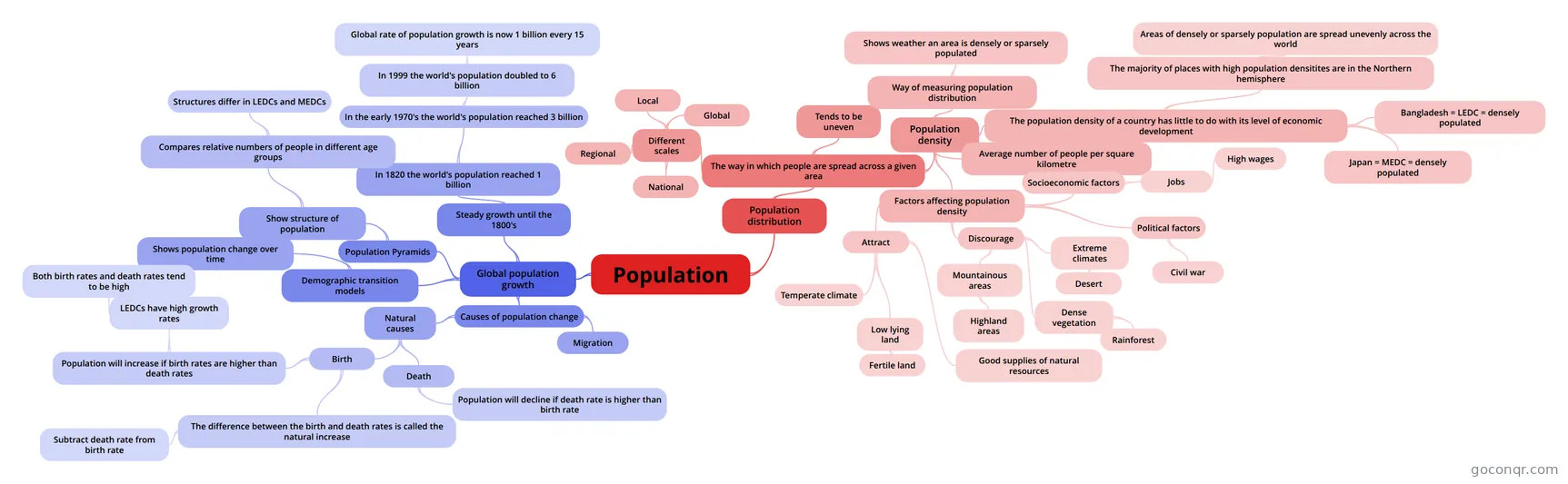
Mind map: Population
Contenido del mapa
Population
Population distribution
- The way in which people are spread across a given area
- Different scales
- Local
- Regional
- National
- Global
- Tends to be uneven
- Population density
- Average number of people per square kilometre
- Way of measuring population distribution
- Shows weather an area is densely or sparsely populated
- The population density of a country has little to do with its level of economic development
- Bangladesh = LEDC = densely populated
- Japan = MEDC = densely populated
- The majority of places with high population densitites are in the Northern hemisphere
- Areas of densely or sparsely population are spread unevenly across the world
- Factors affecting population density
- Attract
- Temperate climate
- Low lying land
- Fertile land
- Good supplies of natural resources
- Discourage
- Extreme climates
- Desert
- Mountainous areas
- Highland areas
- Dense vegetation
- Rainforest
- Extreme climates
- Socioeconomic factors
- Jobs
- High wages
- Jobs
- Political factors
- Civil war
- Attract
- Different scales
- The way in which people are spread across a given area
Global population growth
- Steady growth until the 1800's
- In 1820 the world's population reached 1 billion
- In the early 1970's the world's population reached 3 billion
- In 1999 the world's population doubled to 6 billion
- Global rate of population growth is now 1 billion every 15 years
- In 1999 the world's population doubled to 6 billion
- In the early 1970's the world's population reached 3 billion
- In 1820 the world's population reached 1 billion
- Population Pyramids
- Show structure of population
- Compares relative numbers of people in different age groups
- Structures differ in LEDCs and MEDCs
- Compares relative numbers of people in different age groups
- Show structure of population
- Demographic transition models
- Shows population change over time
- Causes of population change
- Natural causes
- Death
- Population will decline if death rate is higher than birth rate
- Birth
- The difference between the birth and death rates is called the natural increase
- Subtract death rate from birth rate
- Population will increase if birth rates are higher than death rates
- LEDCs have high growth rates
- Both birth rates and death rates tend to be high
- LEDCs have high growth rates
- The difference between the birth and death rates is called the natural increase
- Death
- Migration
- Natural causes
- Steady growth until the 1800's
Información
- Descripción
- GCSE (Population) Geography Mapa Mental sobre Population, creado por Keera el 27/04/2014.
- Creado por
- Keera
- Visitas
- 239
- Etiquetas
- Valoración