
Mapa mental
chapter 10
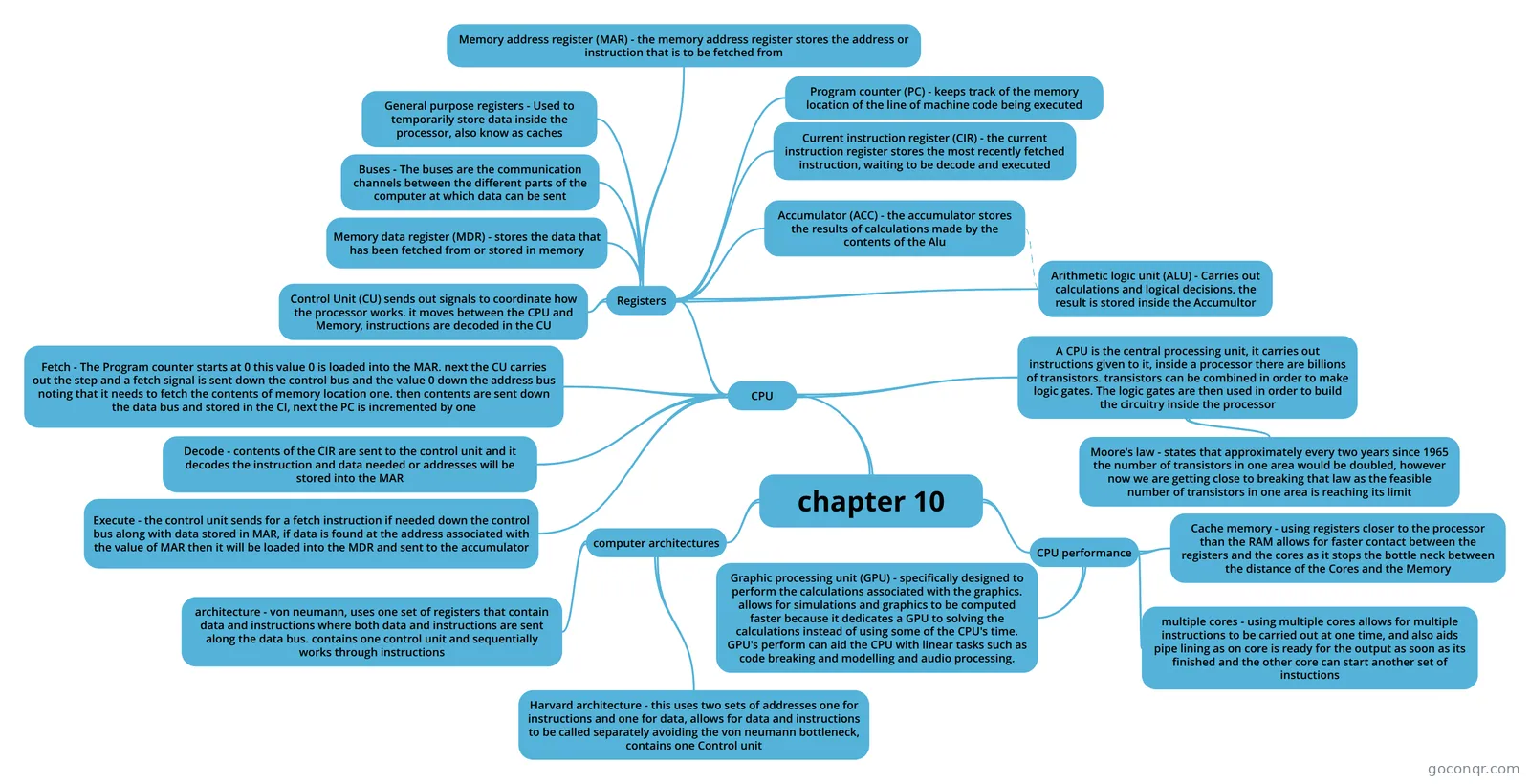
Mind map: CPU and computer architectures
Contenido del mapa
chapter 10
CPU
- A CPU is the central processing unit, it carries out instructions given to it, inside a processor there are billions of transistors. transistors can be combined in order to make logic gates. The logic gates are then used in order to build the circuitry inside the processor
- Moore's law - states that approximately every two years since 1965 the number of transistors in one area would be doubled, however now we are getting close to breaking that law as the feasible number of transistors in one area is reaching its limit
- Registers
- Program counter (PC) - keeps track of the memory location of the line of machine code being executed
- Memory data register (MDR) - stores the data that has been fetched from or stored in memory
- Current instruction register (CIR) - the current instruction register stores the most recently fetched instruction, waiting to be decode and executed
- Accumulator (ACC) - the accumulator stores the results of calculations made by the contents of the Alu
- General purpose registers - Used to temporarily store data inside the processor, also know as caches
- Buses - The buses are the communication channels between the different parts of the computer at which data can be sent
- Arithmetic logic unit (ALU) - Carries out calculations and logical decisions, the result is stored inside the Accumultor
- Control Unit (CU) sends out signals to coordinate how the processor works. it moves between the CPU and Memory, instructions are decoded in the CU
- Memory address register (MAR) - the memory address register stores the address or instruction that is to be fetched from
- Fetch - The Program counter starts at 0 this value 0 is loaded into the MAR. next the CU carries out the step and a fetch signal is sent down the control bus and the value 0 down the address bus noting that it needs to fetch the contents of memory location one. then contents are sent down the data bus and stored in the CI, next the PC is incremented by one
- Decode - contents of the CIR are sent to the control unit and it decodes the instruction and data needed or addresses will be stored into the MAR
- Execute - the control unit sends for a fetch instruction if needed down the control bus along with data stored in MAR, if data is found at the address associated with the value of MAR then it will be loaded into the MDR and sent to the accumulator
- A CPU is the central processing unit, it carries out instructions given to it, inside a processor there are billions of transistors. transistors can be combined in order to make logic gates. The logic gates are then used in order to build the circuitry inside the processor
CPU performance
- Cache memory - using registers closer to the processor than the RAM allows for faster contact between the registers and the cores as it stops the bottle neck between the distance of the Cores and the Memory
- multiple cores - using multiple cores allows for multiple instructions to be carried out at one time, and also aids pipe lining as on core is ready for the output as soon as its finished and the other core can start another set of instuctions
- Graphic processing unit (GPU) - specifically designed to perform the calculations associated with the graphics. allows for simulations and graphics to be computed faster because it dedicates a GPU to solving the calculations instead of using some of the CPU's time. GPU's perform can aid the CPU with linear tasks such as code breaking and modelling and audio processing.
computer architectures
- architecture - von neumann, uses one set of registers that contain data and instructions where both data and instructions are sent along the data bus. contains one control unit and sequentially works through instructions
- Harvard architecture - this uses two sets of addresses one for instructions and one for data, allows for data and instructions to be called separately avoiding the von neumann bottleneck, contains one Control unit
Información
- Descripción
- Mapa Mental sobre chapter 10, creado por dylan johnson el 17/03/2017.
- Creado por
- dylan johnson
- Visitas
- 5
- Valoración