
Mapa mental
Gender & Achievement: Girls
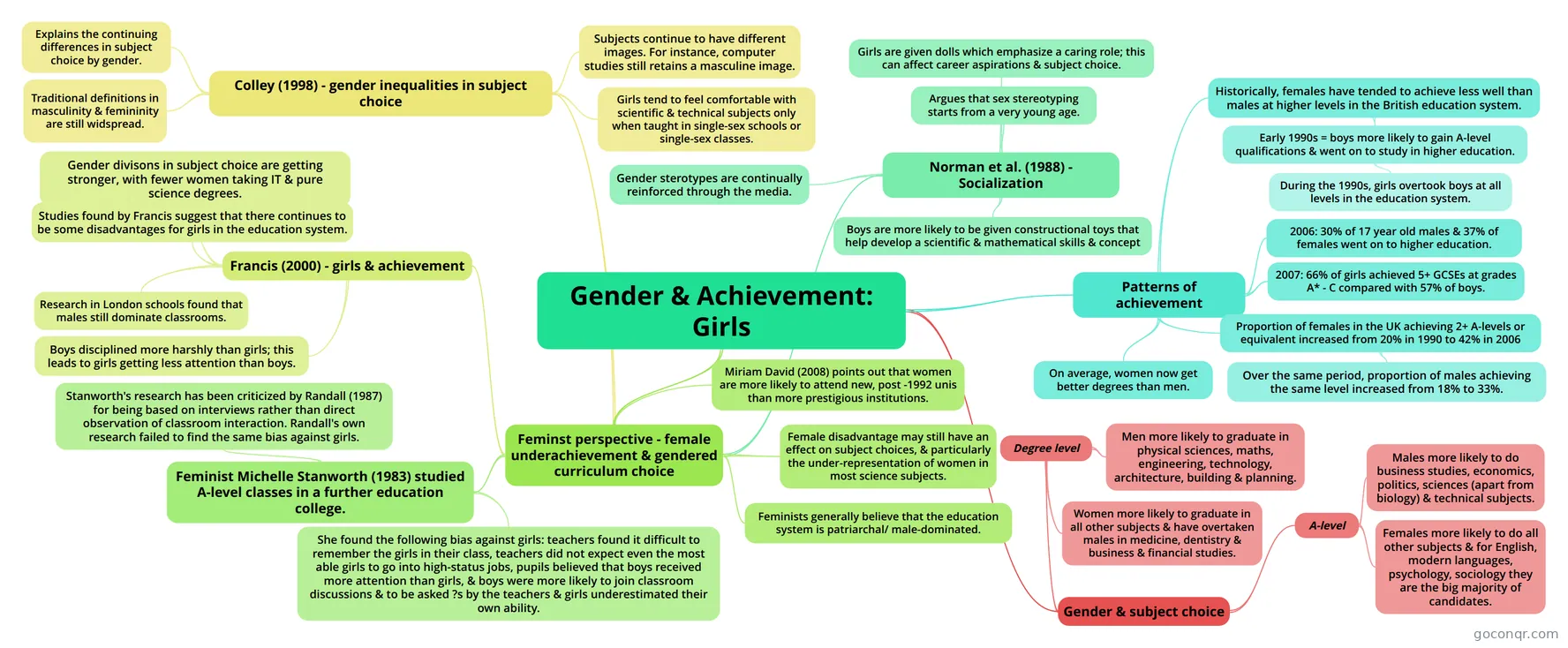
Mind map: Gender and achievement girls
Contenido del mapa
Gender & Achievement: Girls
Patterns of achievement
- Historically, females have tended to achieve less well than males at higher levels in the British education system.
- Early 1990s = boys more likely to gain A-level qualifications & went on to study in higher education.
- During the 1990s, girls overtook boys at all levels in the education system.
- Early 1990s = boys more likely to gain A-level qualifications & went on to study in higher education.
- 2007: 66% of girls achieved 5+ GCSEs at grades A* - C compared with 57% of boys.
- Proportion of females in the UK achieving 2+ A-levels or equivalent increased from 20% in 1990 to 42% in 2006
- Over the same period, proportion of males achieving the same level increased from 18% to 33%.
- 2006: 30% of 17 year old males & 37% of females went on to higher education.
- On average, women now get better degrees than men.
- Historically, females have tended to achieve less well than males at higher levels in the British education system.
Gender & subject choice
- A-level
- Males more likely to do business studies, economics, politics, sciences (apart from biology) & technical subjects.
- Females more likely to do all other subjects & for English, modern languages, psychology, sociology they are the big majority of candidates.
- Degree level
- Men more likely to graduate in physical sciences, maths, engineering, technology, architecture, building & planning.
- Women more likely to graduate in all other subjects & have overtaken males in medicine, dentistry & business & financial studies.
- A-level
Feminst perspective - female underachievement & gendered curriculum choice
- Feminists generally believe that the education system is patriarchal/ male-dominated.
- Miriam David (2008) points out that women are more likely to attend new, post -1992 unis than more prestigious institutions.
- Female disadvantage may still have an effect on subject choices, & particularly the under-representation of women in most science subjects.
- Feminist Michelle Stanworth (1983) studied A-level classes in a further education college.
- She found the following bias against girls: teachers found it difficult to remember the girls in their class, teachers did not expect even the most able girls to go into high-status jobs, pupils believed that boys received more attention than girls, & boys were more likely to join classroom discussions & to be asked ?s by the teachers & girls underestimated their own ability.
- Stanworth's research has been criticized by Randall (1987) for being based on interviews rather than direct observation of classroom interaction. Randall's own research failed to find the same bias against girls.
- Francis (2000) - girls & achievement
- Studies found by Francis suggest that there continues to be some disadvantages for girls in the education system.
- Research in London schools found that males still dominate classrooms.
- Boys disciplined more harshly than girls; this leads to girls getting less attention than boys.
- Gender divisons in subject choice are getting stronger, with fewer women taking IT & pure science degrees.
- Colley (1998) - gender inequalities in subject choice
- Explains the continuing differences in subject choice by gender.
- Traditional definitions in masculinity & femininity are still widspread.
- Subjects continue to have different images. For instance, computer studies still retains a masculine image.
- Girls tend to feel comfortable with scientific & technical subjects only when taught in single-sex schools or single-sex classes.
- Norman et al. (1988) - Socialization
- Argues that sex stereotyping starts from a very young age.
- Girls are given dolls which emphasize a caring role; this can affect career aspirations & subject choice.
- Boys are more likely to be given constructional toys that help develop a scientific & mathematical skills & concept
- Gender sterotypes are continually reinforced through the media.
Información
- Descripción
- Sociology Mapa Mental sobre Gender & Achievement: Girls, creado por n.n.princess el 10/05/2013.
- Creado por
- n.n.princess
- Visitas
- 124
- Etiquetas
- Valoración