
Mapa mental
Epistemology
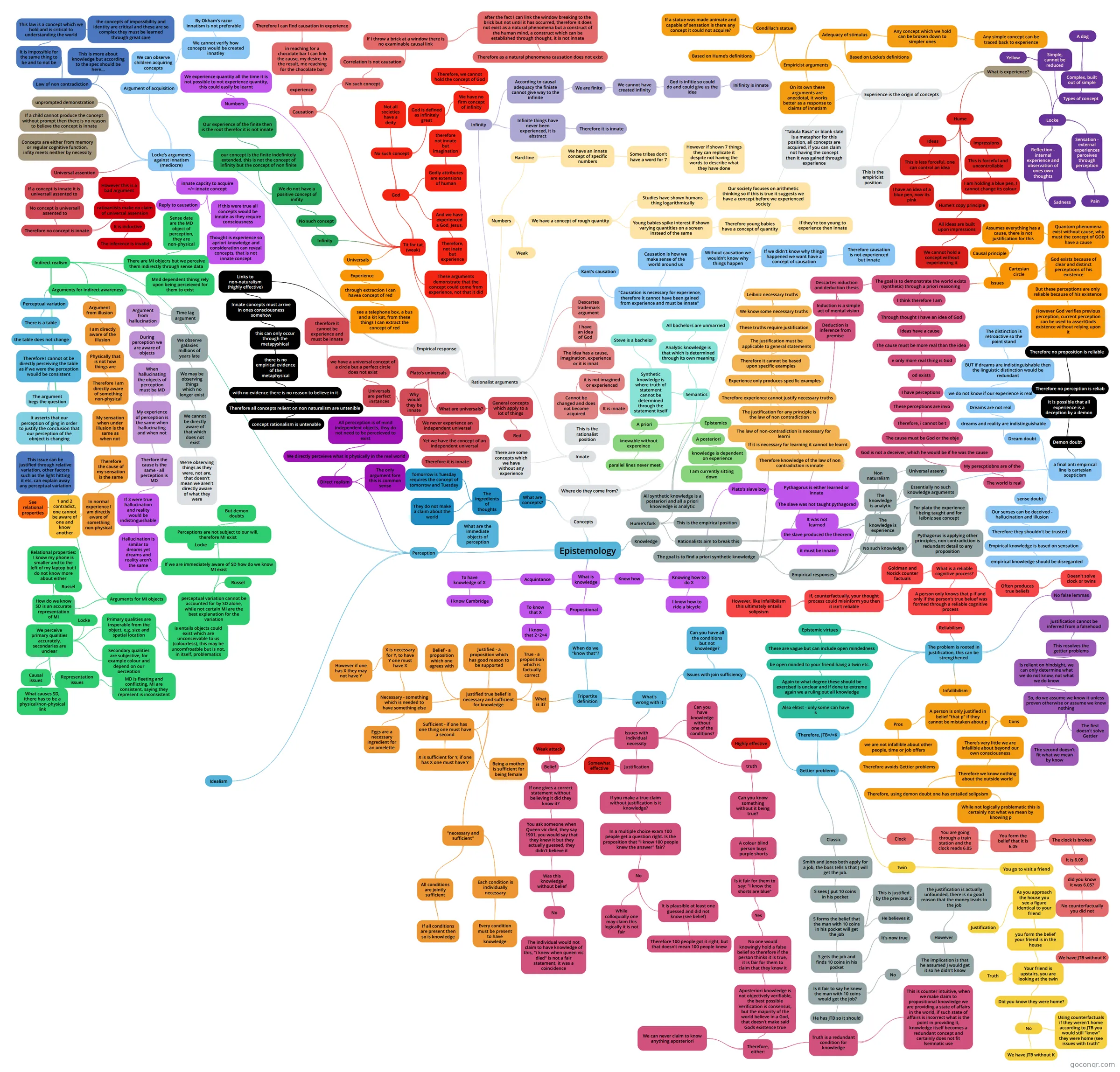
Mind map: Epistemology
Contenido del mapa
Epistemology
What is knowledge
- Propositional
- To know that X
- I know that 2+2=4
- When do we "know that"?
- Tripartite definition
- What is it?
- Justified true belief is necessary and sufficient for knowledge
- Justified - a proposition which has good reason to be supported
- True - a proposition which is factually correct
- Belief - a proposition which one agrees with
- Necessary - something which is needed to have something else
- X is necessary for Y, to have Y one must have X
- However if one has X they may not have Y
- Eggs are a necessary ingredient for an omelette
- X is necessary for Y, to have Y one must have X
- Sufficient - if one has one thing one must have a second
- X is sufficient for Y, if one has X one must have Y
- Being a mother is sufficient for being female
- "necessary and sufficient"
- Each condition is individually necessary
- Every condition must be present to have knowledge
- All conditions are jointly sufficient
- If all conditions are present then so is knowledge
- Each condition is individually necessary
- Justified true belief is necessary and sufficient for knowledge
- What's wrong with it
- Issues with individual necessity
- Belief
- If one gives a correct statement without believing it did they know it?
- You ask someone when Queen vic died, they say 1901, you would say that they knew it but they actually guessed, they didn't believe it
- Was this knowledge without belief
- No
- The individual would not claim to have knowledge of this, "i knew when queen vic died" is not a fair statement, it was a coincidence
- No
- Was this knowledge without belief
- You ask someone when Queen vic died, they say 1901, you would say that they knew it but they actually guessed, they didn't believe it
- Weak attack
- If one gives a correct statement without believing it did they know it?
- Justification
- If you make a true claim without justification is it knowledge?
- In a multiple choice exam 100 people get a question right. Is the proposition that "I know 100 people knew the answer" fair?
- No
- It is plausible at least one guessed and did not know (see belief)
- Therefore 100 people got it right, but that doesn't mean 100 people knew
- While colloquially one may claim this logically it is not fair
- It is plausible at least one guessed and did not know (see belief)
- No
- In a multiple choice exam 100 people get a question right. Is the proposition that "I know 100 people knew the answer" fair?
- Somewhat effective
- If you make a true claim without justification is it knowledge?
- truth
- Can you know something without it being true?
- A colour blind person buys purple shorts
- Is it fair for them to say: "I know the shorts are blue"
- Yes
- No one would knowingly hold a false belief so therefore if the person thinks it is true, it is fair for them to claim that they know it
- Aposteriori knowledge is not objectively verifiable, the best possible verification is consensus, but the majority of the world believe in a God, that doesn't make said Gods existence true
- Therefore, either:
- Truth is a redundant condition for knowledge
- This is counter intuitive, when we make claim to propositional knowledge we are providing a state of affairs in the world, if such state of affairs is incorrect what is the point in providing it, knowledge itself becomes a redundant concept and certainly does not fit lsemnatic use
- We can never claim to know anything aposteriori
- Truth is a redundant condition for knowledge
- Therefore, either:
- Aposteriori knowledge is not objectively verifiable, the best possible verification is consensus, but the majority of the world believe in a God, that doesn't make said Gods existence true
- No one would knowingly hold a false belief so therefore if the person thinks it is true, it is fair for them to claim that they know it
- Yes
- Is it fair for them to say: "I know the shorts are blue"
- A colour blind person buys purple shorts
- Highly effective
- Can you know something without it being true?
- Can you have knowledge without one of the conditions?
- Belief
- Issues with join sufficiency
- Can you have all the conditions but not knowledge?
- Gettier problems
- Classic
- Smith and Jones both apply for a job, the boss tells S that J will get the job.
- S sees J put 10 coins in his pocket
- S forms the belief that the man with 10 coins in his pocket will get the job
- This is justified by the previous 2
- He believes it
- S gets the job and finds 10 coins in his pocket
- It's now true
- Is it fair to say he knew the man with 10 coins would get the job?
- He has JTB so it should
- No
- The implication is that he assumed J would get it so he didn't know
- However
- The justification is actually unfounded, there is no good reason that the money leads to the job
- However
- The implication is that he assumed J would get it so he didn't know
- S forms the belief that the man with 10 coins in his pocket will get the job
- S sees J put 10 coins in his pocket
- Smith and Jones both apply for a job, the boss tells S that J will get the job.
- Twin
- You go to visit a friend
- As you approach the house you see a figure identical to your friend
- Justification
- you form the belief your friend is in the house
- Your friend is upstairs, you are looking at the twin
- Truth
- Did you know they were home?
- No
- We have JTB without K
- Using counterfactuals if they weren't home according to JTB you would still "know" they were home (see issues with truth"
- No
- Your friend is upstairs, you are looking at the twin
- As you approach the house you see a figure identical to your friend
- You go to visit a friend
- Clock
- You are going through a train station and the clock reads 6.05
- You form the belief that it is 6.05
- The clock is broken
- It is 6.05
- did you know it was 6.05?
- No counterfactually you did not
- We have JTB without K
- No counterfactually you did not
- did you know it was 6.05?
- It is 6.05
- The clock is broken
- You form the belief that it is 6.05
- You are going through a train station and the clock reads 6.05
- Therefore, JTB=/=K
- The problem is rooted in justification, this can be strengthened
- Infallibilism
- A person is only justified in belief "that p" if they cannot be mistaken about p
- Pros
- we are not infallible about other people, time or job offers
- Therefore avoids Gettier problems
- we are not infallible about other people, time or job offers
- Cons
- There's very little we are infallible about beyond our own consciousness
- Therefore we know nothing about the outside world
- Therefore, using demon doubt one has entailed solipsism
- While not logically problematic this is certainly not what we mean by knowing p
- Therefore, using demon doubt one has entailed solipsism
- Therefore we know nothing about the outside world
- There's very little we are infallible about beyond our own consciousness
- Pros
- A person is only justified in belief "that p" if they cannot be mistaken about p
- No false lemmas
- Justification cannot be inferred from a falsehood
- This resolves the gettier problems
- Is relient on hindsight, we can only determine what we do not know, not what we do know
- So, do we assume we know it unless proven otherwise or assume we know nothing
- The first doesn't solve Gettier
- The second doesn't fit what we mean by know
- So, do we assume we know it unless proven otherwise or assume we know nothing
- Is relient on hindsight, we can only determine what we do not know, not what we do know
- This resolves the gettier problems
- Justification cannot be inferred from a falsehood
- Epistemic virtues
- These are vague but can include open mindedness
- be open minded to your friend havig a twin etc.
- Again to what degree these should be exercised is unclear and if done to extreme again we a ruling out all knowledge
- Also elitist - only some can have k
- Again to what degree these should be exercised is unclear and if done to extreme again we a ruling out all knowledge
- be open minded to your friend havig a twin etc.
- These are vague but can include open mindedness
- Reliabilism
- A person only knows that p if and only if the person's true beluef was formed through a reliable cognitive process
- What is a reliable cognitive process?
- Often produces true beliefs
- Doesn't solve clock or twins
- Goldman and Nozick counter factuals
- if, counterfactually, your thought process could misinform you then it isn't reliable
- However, like Infallibilism this ultimately entails solipsism
- if, counterfactually, your thought process could misinform you then it isn't reliable
- Often produces true beliefs
- What is a reliable cognitive process?
- A person only knows that p if and only if the person's true beluef was formed through a reliable cognitive process
- Infallibilism
- The problem is rooted in justification, this can be strengthened
- Classic
- Issues with individual necessity
- What is it?
- Tripartite definition
- To know that X
- Know how
- Knowing how to do X
- I know how to ride a bicycle
- Knowing how to do X
- Acquintance
- To have knowledge of X
- I know Cambridge
- To have knowledge of X
- Propositional
Concepts
- What are concepts?
- The ingredients of thoughts
- They do not make a claim about the world
- Tomorrow is Tuesday requires the concept of tomorrow and Tuesday
- The ingredients of thoughts
- Where do they come from?
- Experience is the origin of concepts
- This is the empiricist position
- "Tabula Rasa" or blank slate is a metaphor for this position, all concepts are acquired, if you can claim not having the concept then it was gained through experience
- What is experience?
- Locke
- Sensation - external experiences perceives through perception
- Pain
- Reflection - internal experience and observation of ones own thoughts
- Sadness
- Types of concept
- Simple, cannot be reduced
- Yellow
- Complex, built out of simple
- A dog
- Simple, cannot be reduced
- Sensation - external experiences perceives through perception
- Hume
- Ideas
- This is less forceful, one can control an idea
- I have an idea of a blue pen, now its pink
- This is less forceful, one can control an idea
- Impressions
- This is forceful and uncontrollable
- I am holding a blue pen, I cannot change its colour
- This is forceful and uncontrollable
- Hume's copy principle
- All ideas are built upon impressions
- We cannot hold a concept without experiencing it
- All ideas are built upon impressions
- Ideas
- Locke
- Empiricist arguments
- Adequacy of stimulus
- Based on Locke's definitions
- Any concept which we hold can be broken down to simpler ones
- Any simple concept can be traced back to experience
- On its own these arguments are anecdotal, it works better as a response to claims of innatism
- Condillac's statue
- Based on Hume's definitions
- If a statue was made animate and capable of sensation is there any concept it could not acquire?
- Adequacy of stimulus
- Innate
- This is the rationalist position
- There are some concepts which we have without any experience
- Rationalist arguments
- Descartes trademark argument
- I have an idea of God
- The idea has a cause, imagination, experience or it is innat
- it is not imagined or experienced
- It is innate
- Cannot be changed and does not become acquired
- it is not imagined or experienced
- The idea has a cause, imagination, experience or it is innat
- I have an idea of God
- Plato's universals
- What are universals?
- General concepts which apply to a lot of things
- Red
- General concepts which apply to a lot of things
- Why would they be innate
- We never experience an independent universal
- Yet we have the concept of an independent universal
- Therefore it is innate
- Yet we have the concept of an independent universal
- Universals are perfect instances
- we have a universal concept of a circle but a perfect circle does not exist
- therefore it cannot be experience and must be innate
- we have a universal concept of a circle but a perfect circle does not exist
- We never experience an independent universal
- What are universals?
- Kant's causation
- "Causation is necessary for experience, therefore it cannot have been gained from experience and must be innate"
- Causation is how we make sense of the world around us
- Without causation we wouldn't know why things happen
- If we didn't know why things happened we want have a concept of causation
- Therefore causation is not experienced but innate
- If we didn't know why things happened we want have a concept of causation
- Without causation we wouldn't know why things happen
- Causation is how we make sense of the world around us
- "Causation is necessary for experience, therefore it cannot have been gained from experience and must be innate"
- Numbers
- Hard-line
- We have an innate concept of specific numbers
- Some tribes don't have a word for 7
- However if shown 7 things they can replicate it despite not having the words to describe what they have done
- Some tribes don't have a word for 7
- We have an innate concept of specific numbers
- Weak
- We have a concept of rough quantity
- Young babies spike interest if shown varying quantities on a screen instead of the same
- Therefore young babies have a concept of quantity
- If they're too young to experience then innate
- Therefore young babies have a concept of quantity
- Studies have shown humans thing logarithmically
- Our society focuses on arithmetic thinking so if this is true it suggests we have a concept before we experienced society
- Young babies spike interest if shown varying quantities on a screen instead of the same
- We have a concept of rough quantity
- Hard-line
- Infinity
- Infinite things have never been experienced, it is abstract
- Therefore it is innate
- According to causal adequacy the finiate cannot give way to the infinite
- We are finite
- We cannot have created infinity
- God is infitie so could do and could give us the idea
- Inifinity is innate
- God is infitie so could do and could give us the idea
- We cannot have created infinity
- We are finite
- Infinite things have never been experienced, it is abstract
- Empirical response
- Tit for tat (weak)
- These arguments demonstrate that the concept could come from experience, not that it did
- God
- Godly attributes are extensions of human
- therefore not innate but imagination
- And we have experienced a God, Jesus,
- Therefore, not inate but experience
- No such concept
- God is defined as infinitely great
- We have no firm concept of infinity
- Therefore, we cannot hold the concept of God
- We have no firm concept of infinity
- Not all societies have a deity
- God is defined as infinitely great
- Godly attributes are extensions of human
- Causation
- experience
- in reaching for a chocolate bar I can link the cause, my desire, to the result, me reaching for the chocolate bar
- Therefore I can find causation in experience
- in reaching for a chocolate bar I can link the cause, my desire, to the result, me reaching for the chocolate bar
- No such concept
- Correlation is not causation
- If I throw a brick at a window there is no examinable causal link
- after the fact I can link the window breaking to the brick but not until it has occurred, therefore it does not exist as a natural phenomena but a construct of the human mind, a construct which can be established through thought, it is not innate
- Therefore as a natural phenomena causation does not exist
- after the fact I can link the window breaking to the brick but not until it has occurred, therefore it does not exist as a natural phenomena but a construct of the human mind, a construct which can be established through thought, it is not innate
- If I throw a brick at a window there is no examinable causal link
- Correlation is not causation
- experience
- Numbers
- We experience quantity all the time it is not possible to not experience quantity, this could easily be learnt
- Infinity
- No such concept
- We do not have a positive concept of inifity
- our concept is the finite indefinitely extended, this is not the concept of infinity but the concept of non finite
- Our experience of the finite then is the root therefor it is not innate
- our concept is the finite indefinitely extended, this is not the concept of infinity but the concept of non finite
- We do not have a positive concept of inifity
- No such concept
- Universals
- Experience
- through extraction I can havea concept of red
- see a telephone box, a bus and a kit kat, from these things I can extract the concept of red
- through extraction I can havea concept of red
- Experience
- Locke's arguments against innatism (mediocre)
- Argument of acquisition
- We can observe children acquiring concepts
- We cannot verify how concepts would be created innatley
- By Okham's razor innatism is not preferable
- We cannot verify how concepts would be created innatley
- We can observe children acquiring concepts
- Law of non contradiction
- It is impossible for the same thing to be and to not be
- This law is a concept which we hold and is critical to understanding the world
- the concepts of impossibility and identity are critical and these are so complex they must be learned through great care
- This law is a concept which we hold and is critical to understanding the world
- This is more about knowledge but according to the spec should be here...
- It is impossible for the same thing to be and to not be
- unprompted demonstration
- If a child cannot produce the concept without prompt then there is no reason to believe the concept is innate
- Concepts are either from memory or regular cognitive function, infity meets neither by necessity
- If a child cannot produce the concept without prompt then there is no reason to believe the concept is innate
- innate capcity to acquire =/= innate concept
- Reply to causation
- if this were true all concepts would be innate as they require consciousness
- Thought is experience so apriori knowledge and consideration can reveal concepts, that is not innate concept
- Universal assention
- If a concept is innate it is universall assented to
- No concept is universall assented to
- Therefore no concept is innate
- However this is a bad argument
- ratioanlists make no claim of universal assension
- It is inductive
- The inference is invalid
- It is inductive
- ratioanlists make no claim of universal assension
- However this is a bad argument
- Therefore no concept is innate
- No concept is universall assented to
- If a concept is innate it is universall assented to
- Argument of acquisition
- Links to non-naturalism (highly effective)
- Innate concepts must arrive in ones consciousness somehow
- this can only occur through the metapyshical
- there is no empirical evidence of the metaphysical
- with no evidence there is no reason to believe in it
- Therefore all concepts relient on non naturalism are untenible
- concept rationalism is untenable
- Therefore all concepts relient on non naturalism are untenible
- with no evidence there is no reason to believe in it
- there is no empirical evidence of the metaphysical
- this can only occur through the metapyshical
- Innate concepts must arrive in ones consciousness somehow
- Tit for tat (weak)
- Descartes trademark argument
- Experience is the origin of concepts
- What are concepts?
Knowledge
- Hume's fork
- All synthetic knowledge is a posteriori and all a priori knowledge is analytic
- Semantics
- Analytic knowledge is that which is determined through its own meaning
- All bachelors are unmarried
- Synthetic knowledge is where truth of statement cannot be determined through the statement itself
- Steve is a bachelor
- Analytic knowledge is that which is determined through its own meaning
- Epistemics
- A priori
- knowable without expereince
- parallel lines never meet
- knowable without expereince
- A posteriori
- knowledge is dependent on experience
- I am currently sitting down
- knowledge is dependent on experience
- A priori
- Semantics
- This is the empirical position
- Rationalists aim to break this
- The goal is to find a priori synthetic knowledge
- Leibniz necessary truths
- We know some necessary truths
- These truths require justification
- The justification must be applicable to general statements
- Therefore it cannot be based upon specific examples
- Experience only produces specific examples
- Therefore experience cannot justify necessary truths
- The justification for any principle is the law of non contradiction
- The law of non-contradiction is necessary for learni
- If it is necessary for learning it cannot be learnt
- Therefore knowledge of the law of non contradiction is innate
- If it is necessary for learning it cannot be learnt
- The law of non-contradiction is necessary for learni
- The justification for any principle is the law of non contradiction
- Therefore experience cannot justify necessary truths
- Experience only produces specific examples
- Therefore it cannot be based upon specific examples
- The justification must be applicable to general statements
- These truths require justification
- We know some necessary truths
- Plato's slave boy
- Pythagorus is either learned or innate
- The slave was not taught pythagorad
- It was not learned
- the slave produced the theorem
- it must be innate
- the slave produced the theorem
- It was not learned
- The slave was not taught pythagorad
- Pythagorus is either learned or innate
- Empirical responses
- No such knowledge
- Pythagorus is applying other principles, non contradiction is redundant detail to any proposition
- The knowledge is experience
- For plato the experience i being taught and for leibniz see concept
- The knowledge is analytic
- Essentially no such knowledge arguments
- Non naturalism
- Universal assent
- No such knowledge
- Descartes induction and deduction thesis
- Induction is a simple act of mental vision
- Deduction is inference from premise
- The goal is to demonstrate the world exists (synthetic) through a priori reasoning
- I think therefore I am
- Through thought I have an idea of God
- Ideas have a cause
- The cause must be more real than the idea
- e only more real thing is God
- od exists
- I have perceptions
- These perceptions are invo
- Therefore, i cannot be t
- The cause must be God or the obje
- God is not a deceiver, which he would be if he was the cause
- My perecptiobns are of the
- The world is real
- My perecptiobns are of the
- God is not a deceiver, which he would be if he was the cause
- The cause must be God or the obje
- Therefore, i cannot be t
- These perceptions are invo
- I have perceptions
- od exists
- e only more real thing is God
- The cause must be more real than the idea
- Ideas have a cause
- Through thought I have an idea of God
- Issues
- Causal principle
- Assumes everything has a cause, there is not justification for this
- Quantom phenomena exist without cause, why must the concept of GOD have a cause
- Assumes everything has a cause, there is not justification for this
- Cartesian circle
- God exists because of clear and distinct perceptions of his existence
- But these perceptions are only reliable because of his existence
- However God verifies previous perception, current perception can be used to assertGods existence without relying upon it
- But these perceptions are only reliable because of his existence
- God exists because of clear and distinct perceptions of his existence
- Causal principle
- I think therefore I am
- Leibniz necessary truths
- a final anti empirical line is cartesian scepticism
- sense doubt
- Our senses can be deceived - hallucination and illusion
- Therefore they shouldn't be trusted
- Empirical knowledge is based on sensation
- empirical knowledge should be disregarded
- Empirical knowledge is based on sensation
- Therefore they shouldn't be trusted
- Our senses can be deceived - hallucination and illusion
- Dream doubt
- dreams and reality are indistinguishable
- Dreams are not real
- we do not know if our experience is real
- BUT if dreams are indistinguishable then the linguistic distinction would be redundant
- The distinction is retroactive so the point stand
- BUT if dreams are indistinguishable then the linguistic distinction would be redundant
- we do not know if our experience is real
- Dreams are not real
- dreams and reality are indistinguishable
- Demon doubt
- It is possible that all experience is a deception by a demon
- Therefore no perception is reliab
- Therefore no proposition is reliable
- Therefore no perception is reliab
- It is possible that all experience is a deception by a demon
- sense doubt
- The goal is to find a priori synthetic knowledge
- All synthetic knowledge is a posteriori and all a priori knowledge is analytic
- Hume's fork
Perception
- What are the immediate objects of perception
- Direct realism
- We directly perceieve what is physically in the real world
- All pereception is of mind independent objects, thsy do not need to be perceieved to exist
- The only argument fore this is common sense
- We directly perceieve what is physically in the real world
- Indirect realism
- There are MI objecrs but we perceive them indirectly through sense data
- Sense date are the MD object of perception, they are non-physical
- Mnd dependent thinsg rely upon being perceieved for them to exist
- Arguments for indirect awareness
- Perceptual variation
- There is a table
- the table does not change
- Therefore I cannot ot be directly perceiving the table as if we were the perception wouild be consistent
- The argument begs the question
- It asserts that our perception of ging in order to justify the conclusion that our perception of the obnject is changing
- This issue can be justified through relative variation, other factors such as the light hitting it etc. can explain away any perceptual variation
- The argument begs the question
- Therefore I cannot ot be directly perceiving the table as if we were the perception wouild be consistent
- the table does not change
- There is a table
- Argument from illusion
- I am directly aware of the illusion
- Physically that is not how things are
- Therefore I am directly aware of something non-physical
- My sensation when under illusion is the same as when not
- Therefore the cause of my sensation is the same
- In normal experience I am directly aware of something non-physical
- See relational properties
- 1 and 2 contradict, one cannot be aware of one and know another
- In normal experience I am directly aware of something non-physical
- Therefore the cause of my sensation is the same
- My sensation when under illusion is the same as when not
- Therefore I am directly aware of something non-physical
- Physically that is not how things are
- I am directly aware of the illusion
- Argument from hallucination
- During perception we are aware of objects
- When hallucinating the objects of perception must be MD
- My experience of perception is the same when hallucinating and when not
- Therfore the cause is the same - all perception is MD
- If 3 were true hallucination and reality would be indistinguishable
- Hallucination is similar to dreams yet dreams and reality aren't the same
- If 3 were true hallucination and reality would be indistinguishable
- Therfore the cause is the same - all perception is MD
- My experience of perception is the same when hallucinating and when not
- When hallucinating the objects of perception must be MD
- During perception we are aware of objects
- Time lag argument
- We observe galaxies millions of years late
- We may be observing things which no longer exist
- We cannot be directly aware of that which does not exist
- We're observing things as they were, not are, that doesn't mean we aren't directly aware of what they were
- We cannot be directly aware of that which does not exist
- We may be observing things which no longer exist
- We observe galaxies millions of years late
- Perceptual variation
- Arguments for MI objects
- If we are immediately aware of SD how do we know MI exist
- Perceptions are not subject to our will, therefore MI exist
- But demon doubts
- Locke
- perceptual variation cannot be accounted for by SD alone, while not certain MI are the best explanation for the variation
- Russel
- Perceptions are not subject to our will, therefore MI exist
- How do we know SD is an accurate representation of MI
- Relational properties: I know my phone is smaller and to the left of my laptop but I do not know more about either
- Russel
- We perceive primary qualities accurately, secondaries are unclear
- Locke
- Primary qualities are insperable from the object, e.g. size and spatial location
- is entails objects could exist which are unconceivable to us (colourless), this may be uncomfroatble but is not, in itself, problematics
- Secondary qualities are subjective, for example colour and depend on our perception
- Causal issues
- What causes SD, ithere has to be a physical/non-physical link
- Representation issues
- MD is fleeting and conflicting, MI are consistent, saying they represent is inconsistent
- Relational properties: I know my phone is smaller and to the left of my laptop but I do not know more about either
- If we are immediately aware of SD how do we know MI exist
- There are MI objecrs but we perceive them indirectly through sense data
- Idealism
Información
- Descripción
- A level (AS) Philosophy Mapa Mental sobre Epistemology, creado por John Doak el 28/03/2017.
- Creado por
- John Doak
- Visitas
- 3
- Historial
-
- Creado por John Doak · 7 mar 2017
- Copiado por John Doak · 28 mar 2017
- Valoración