
Mapa mental
WOMEN
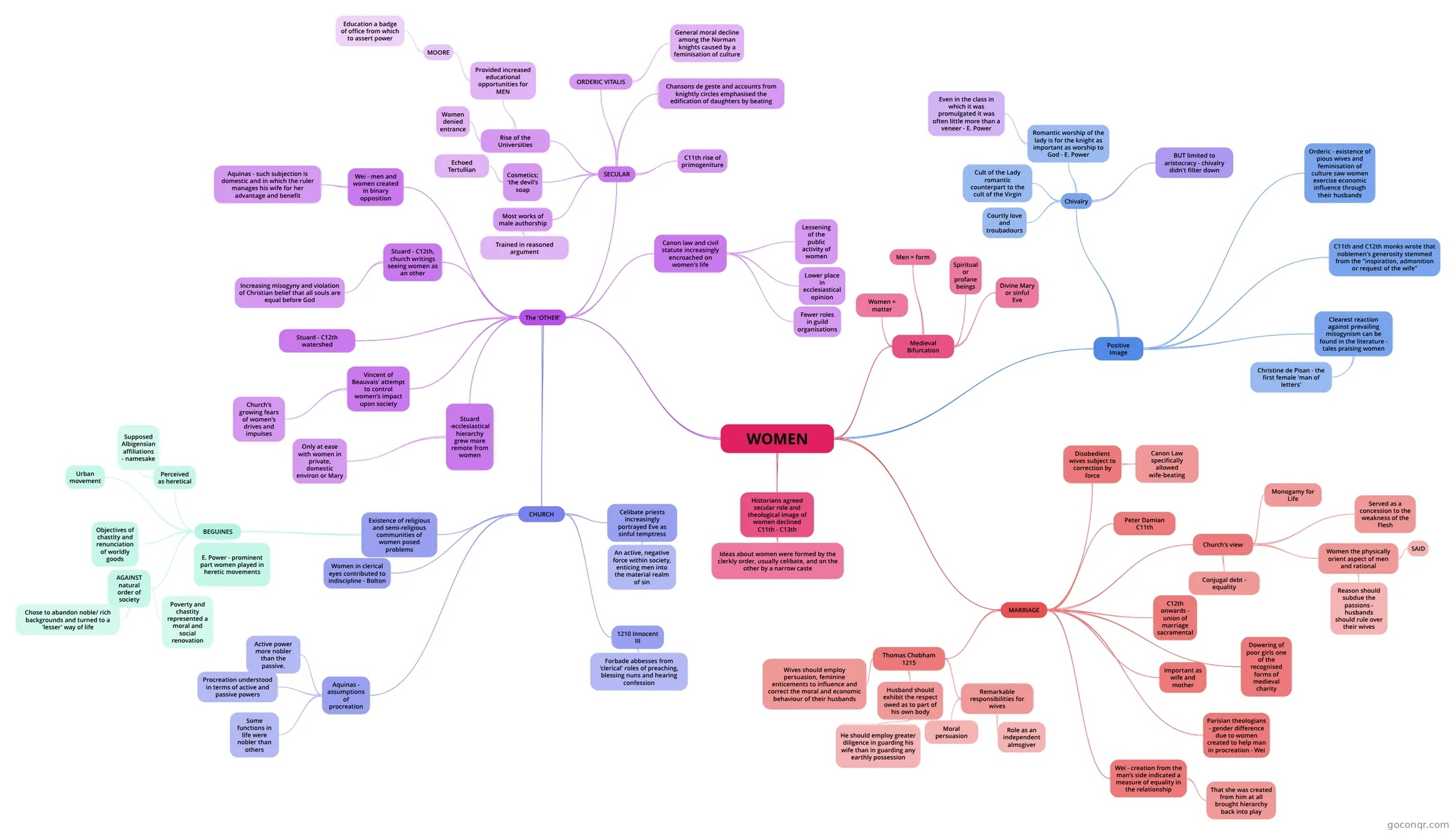
Mind map: Medieval women
Contenido del mapa
WOMEN
The 'OTHER'
- Stuard - C12th, church writings seeing women as an other
- Increasing misogyny and violation of Christian belief that all souls are equal before God
- Vincent of Beauvais' attempt to control women's impact upon society
- Church's growing fears of women's drives and impulses
- Stuard -ecclesiastical hierarchy grew more remote from women
- Encountered greater difficulty in comprehending women who participated in society
- Only at ease with women in private, domestic environ or Mary
- Canon law and civil statute increasingly encroached on women's life
- Lessening of the public activity of women
- Lower place in ecclesiastical opinion
- Fewer roles in guild organisations
- Stuard - C12th watershed
- Between the greater opportunity for women in early medieval times and the more confining circumstances of life in the later Middle Ages
- CHURCH
- Existence of religious and semi-religious communities of women posed problems
- BEGUINES
- Urban movement
- Perceived as heretical
- Made no polemical demands on clerics and did not stress to the same extent the merit of the priesthood
- Supposed Albigensian affiliations - namesake
- Objectives of chastity and renunciation of worldly goods
- AGAINST natural order of society
- Chose to abandon noble/ rich backgrounds and turned to a 'lesser' way of life
- Poverty and chastity represented a moral and social renovation
- A spiritual renewal through the adoption of a new lifestyle – the vita apostolica.
- E. Power - prominent part women played in heretic movements
- Manifestation of their discontent with their lot in the world.
- BEGUINES
- Women in clerical eyes contributed to indiscipline - Bolton
- Celibate priests increasingly portrayed Eve as sinful temptress
- Men who aspired to the spiritual life should avoid women altogether
- An active, negative force within society, enticing men into the material realm of sin
- Farmer
- 1210 Innocent III
- Forbade abbesses from 'clerical' roles of preaching, blessing nuns and hearing confession
- Aquinas - assumptions of procreation
- Procreation understood in terms of active and passive powers
- Man the active, woman the passive
- Some functions in life were nobler than others
- Specifically male functions of spirituality and the warrior caste
- Active power more nobler than the passive.
- Procreation understood in terms of active and passive powers
- Existence of religious and semi-religious communities of women posed problems
- SECULAR
- C11th rise of primogeniture
- Serving to protect the power and wealth of the nobility by consolidating landed property
- Dowries fell increasingly under the husband's control
- ORDERIC VITALIS
- General moral decline among the Norman knights caused by a feminisation of culture
- In men becoming more female, subverting the gender hierarchy, and therefore undertones of disorder - POWER
- General moral decline among the Norman knights caused by a feminisation of culture
- Chansons de geste and accounts from knightly circles emphasised the edification of daughters by beating
- Most works of male authorship
- Assumed prerogative of author to examine and judge womankind
- Trained in reasoned argument
- Aquinas' scholasticism
- Rise of the Universities
- Women denied entrance
- Provided increased educational opportunities for MEN
- MOORE
- Education a badge of office from which to assert power
- Knowledge of the weaker sex
- Education a badge of office from which to assert power
- MOORE
- Cosmetics; 'the devil's soap
- Echoed Tertullian
- "those women sin against God who annoint their faces with creams, stain cheeks with rouge or lengthen eyelashes with antimony"
- Polluting their face; God's creation and hence provoked clerical disgust
- Echoed Tertullian
- C11th rise of primogeniture
- Wei - men and women created in binary opposition
- Women naturally inferior to men and thus should be subject to men - POWER relationship
- Aquinas - such subjection is domestic and in which the ruler manages his wife for her advantage and benefit
- Stuard - C12th, church writings seeing women as an other
Medieval Bifurcation
- Spiritual or profane beings
- Divine Mary or sinful Eve
- Women = matter
- Chaotic and formless
- Women imperfect and incomplete version of man - opposite sex as the receiver and inferior instrument
- Men = form
- Life-giving principle
MARRIAGE
- Peter Damian C11th
- Hated all sexuality and barely allowed marriage to be a cover to sin
- C12th onwards - union of marriage sacramental
- Sexual union the essence of marriage
- Church's view
- Monogamy for Life
- Women the physically orient aspect of men and rational
- Reason should subdue the passions - husbands should rule over their wives
- SAID
- Served as a concession to the weakness of the Flesh
- Conjugal debt - equality
- Yet often used by theologians to depict the weakness of the female flesh - her passive role means she was perceived to instigate sex
- Thomas Chobham 1215
- Eccentric view - Farmer
- Wives should employ persuasion, feminine enticements to influence and correct the moral and economic behaviour of their husbands
- Women to be preachers to their husbands, because no priest is able to soften the heart of a man the way his wife can
- Wife's duty to prevent her husband from sinning
- Husband should exhibit the respect owed as to part of his own body
- Taken from Genesis - Eve made from Adam's rib - an equal
- He should employ greater diligence in guarding his wife than in guarding any earthly possession
- Remarkable responsibilities for wives
- Moral persuasion
- Role as an independent almsgiver
- Disobedient wives subject to correction by force
- Canon Law specifically allowed wife-beating
- Important as wife and mother
- Wielding practical authority in her sphere in the home and as her husband’s representative during his absence
- Dowering of poor girls one of the recognised forms of medieval charity
- Parisian theologians - gender difference due to women created to help man in procreation - Wei
- Wei - creation from the man’s side indicated a measure of equality in the relationship
- That she was created from him at all brought hierarchy back into play
- Peter Damian C11th
Historians agreed secular role and theological image of women declined C11th - C13th
- Farmer
- Ideas about women were formed by the clerkly order, usually celibate, and on the other by a narrow caste
- Nobles saw their women as ornamental assets, and subordinating them to the interests of the land - E. Power
Positive Image
- C11th and C12th monks wrote that noblemen's generosity stemmed from the "inspiration, admonition or request of the wife"
- Orderic - existence of pious wives and feminisation of culture saw women exercise economic influence through their husbands
- Chivalry
- Cult of the Lady romantic counterpart to the cult of the Virgin
- Romantic worship of the lady is for the knight as important as worship to God - E. Power
- Even in the class in which it was promulgated it was often little more than a veneer - E. Power
- BUT limited to aristocracy - chivalry didn't filter down
- Courtly love and troubadours
- New politeness principles in higher society - Great ladies the main beneficiaries and the main clientele of the literature and art inspired by courtly love.
- Clearest reaction against prevailing misogynism can be found in the literature - tales praising women
- Christine de Pisan - the first female 'man of letters'
- Poems she composed complaining of the fashionable habit of dispraising women and attacks particularly 'Le Roman de la Rose'
- Christine de Pisan - the first female 'man of letters'
Información
- Descripción
- Constructing the Other Mapa Mental sobre WOMEN, creado por tompoad el 12/05/2013.
- Creado por
- tompoad
- Visitas
- 41
- Etiquetas
- Valoración