
Mapa mental
RELIGION
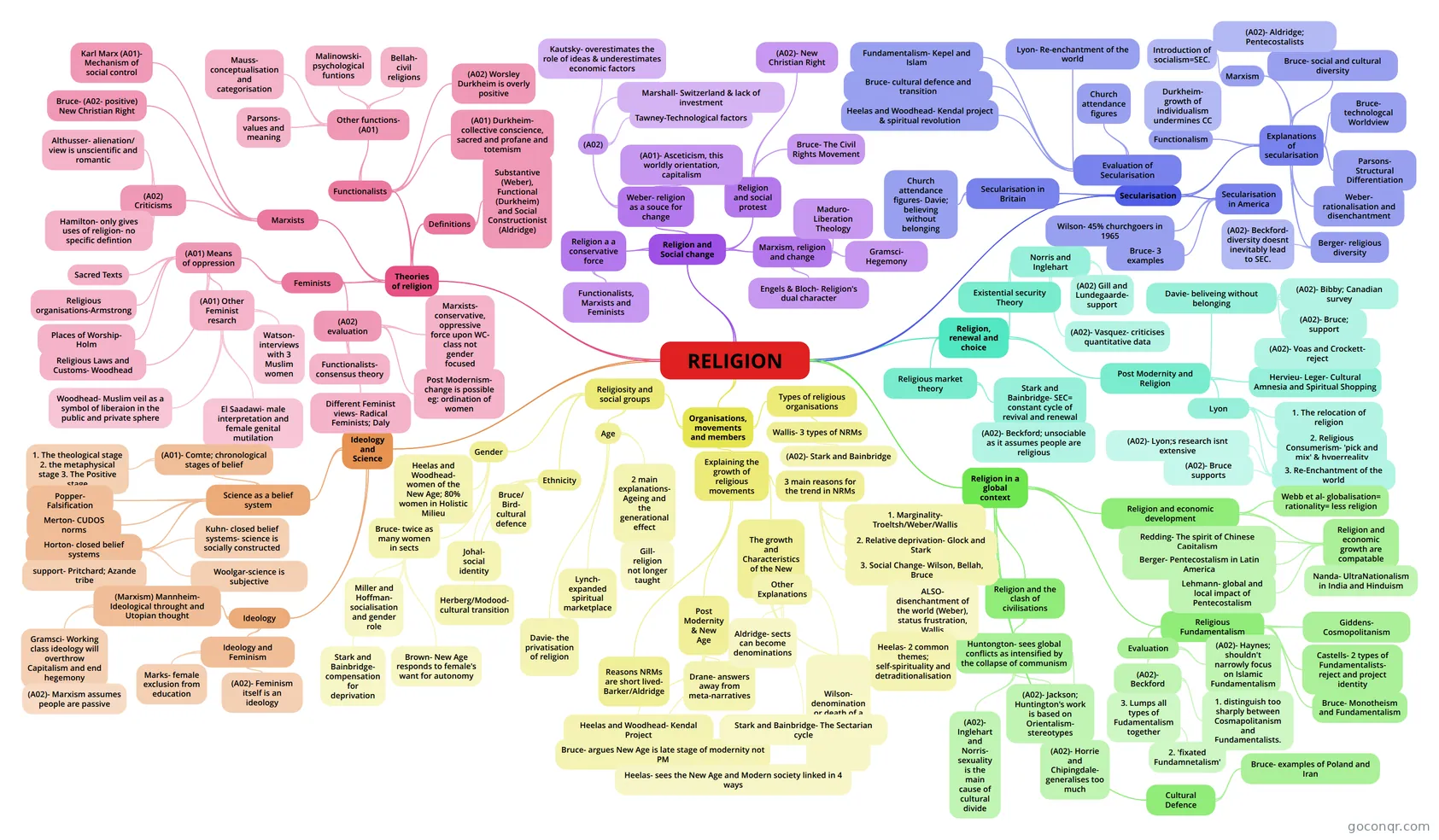
Mind map: religion sociology
Contenido del mapa
RELIGION
Religion in a global context
- Religion and economic development
- Webb et al- globalisation= rationality= less religion
- Religion and economic growth are compatable
- Nanda- UltraNationalism in India and Hinduism
- Redding- The spirit of Chinese Capitalism
- Berger- Pentecostalism in Latin America
- Lehmann- global and local impact of Pentecostalism
- Religious Fundamentalism
- Giddens- Cosmopolitanism
- Castells- 2 types of Fundamentalists- reject and project identity
- Bruce- Monotheism and Fundamentalism
- Evaluation
- (A02)- Haynes; shouldn't narrowly focus on Islamic Fundamentalism
- (A02)- Beckford
- 1. distinguish too sharply between Cosmapolitanism and Fundamentalists.
- 2. 'fixated Fundamnetalism'
- 3. Lumps all types of Fudamentalism together
- Cultural Defence
- Bruce- examples of Poland and Iran
- Religion and the clash of civilisations
- Huntongton- sees global conflicts as intensified by the collapse of communism
- (A02)- Jackson; Huntington's work is based on Orientalism- stereotypes
- (A02)- Horrie and Chipingdale- generalises too much
- (A02)- Inglehart and Norris- sexuality is the main cause of cultural divide
- Huntongton- sees global conflicts as intensified by the collapse of communism
- Religion and economic development
Theories of religion
- Definitions
- Substantive (Weber), Functional (Durkheim) and Social Constructionist (Aldridge)
- Functionalists
- (A01) Durkheim- collective conscience, sacred and profane and totemism
- (A02) Worsley Durkheim is overly positive
- Other functions- (A01)
- Parsons- values and meaning
- Mauss- conceptualisation and categorisation
- Malinowski- psychological funtions
- Bellah- civil religions
- Marxists
- Karl Marx (A01)- Mechanism of social control
- Bruce- (A02- positive) New Christian Right
- (A02) Criticisms
- Althusser- alienation/ view is unscientific and romantic
- Hamilton- only gives uses of religion- no specific defintion
- Feminists
- (A01) Means of oppression
- Religious organisations-Armstrong
- Sacred Texts
- Religious Laws and Customs- Woodhead
- Places of Worship- Holm
- (A01) Other Feminist resarch
- Woodhead- Muslim veil as a symbol of liberaion in the public and private sphere
- Watson- interviews with 3 Muslim women
- El Saadawi- male interpretation and female genital mutilation
- (A02) evaluation
- Marxists- conservative, oppressive force upon WC- class not gender focused
- Functionalists- consensus theory
- Different Feminist views- Radical Feminists; Daly
- Post Modernism- change is possible eg: ordination of women
- (A01) Means of oppression
- Definitions
Religion and Social change
- Religion a a conservative force
- Functionalists, Marxists and Feminists
- Weber- religion as a souce for change
- (A01)- Asceticism, this worldly orientation, capitalism
- (A02)
- Kautsky- overestimates the role of ideas & underestimates economic factors
- Tawney-Technological factors
- Marshall- Switzerland & lack of investment
- Religion and social protest
- Bruce- The Civil Rights Movement
- (A02)- New Christian Right
- Marxism, religion and change
- Maduro- Liberation Theology
- Engels & Bloch- Religion's dual character
- Gramsci- Hegemony
- Religion a a conservative force
Secularisation
- Secularisation in Britain
- Church attendance figures- Davie; believing without belonging
- Explanations of secularisation
- Functionalism
- Durkheim- growth of individualism undermines CC
- Marxism
- Introduction of socialism=SEC.
- Weber- rationalisation and disenchantment
- Parsons- Structural Differentiation
- Bruce- technologcal Worldview
- Bruce- social and cultural diversity
- (A02)- Aldridge; Pentecostalists
- Berger- religious diversity
- (A02)- Beckford- diversity doesnt inevitably lead to SEC.
- Functionalism
- Secularisation in America
- Wilson- 45% churchgoers in 1965
- Bruce- 3 examples
- Evaluation of Secularisation
- Church attendance figures
- Lyon- Re-enchantment of the world
- Bruce- cultural defence and transition
- Heelas and Woodhead- Kendal project & spiritual revolution
- Fundamentalism- Kepel and Islam
- Secularisation in Britain
Religion, renewal and choice
- Post Modernity and Religion
- Davie- beliveing without belonging
- (A02)- Bibby; Canadian survey
- (A02)- Voas and Crockett- reject
- (A02)- Bruce; support
- Hervieu- Leger- Cultural Amnesia and Spiritual Shopping
- Lyon
- 1. The relocation of religion
- 2. Religious Consumerism- 'pick and mix' & hyperreality
- 3. Re-Enchantment of the world
- (A02)- Lyon;s research isnt extensive
- (A02)- Bruce supports
- Davie- beliveing without belonging
- Existential security Theory
- Norris and Inglehart
- (A02) Gill and Lundegaarde- support
- (A02)- Vasquez- criticises quantitative data
- Norris and Inglehart
- Religious market theory
- Stark and Bainbridge- SEC= constant cycle of revival and renewal
- (A02)- Beckford; unsociable as it assumes people are religious
- Stark and Bainbridge- SEC= constant cycle of revival and renewal
- Post Modernity and Religion
Ideology and Science
- Science as a belief system
- (A01)- Comte; chronological stages of belief
- 1. The theological stage 2. the metaphysical stage 3. The Positive stage
- Popper- Falsification
- Merton- CUDOS norms
- Horton- closed belief systems
- support- Pritchard; Azande tribe
- Kuhn- closed belief systems- science is socially constructed
- Woolgar-science is subjective
- (A01)- Comte; chronological stages of belief
- Ideology
- (Marxism) Mannheim- Ideological throught and Utopian thought
- Gramsci- Working class ideology will overthrow Capitalism and end hegemony
- (A02)- Marxism assumes people are passive
- Gramsci- Working class ideology will overthrow Capitalism and end hegemony
- Ideology and Feminism
- Marks- female exclusion from education
- (A02)- Feminism itself is an ideology
- (Marxism) Mannheim- Ideological throught and Utopian thought
- Science as a belief system
Organisations, movements and members
- Types of religious organisations
- Wallis- 3 types of NRMs
- (A02)- Stark and Bainbridge
- Wallis- 3 types of NRMs
- Explaining the growth of religious movements
- 3 main reasons for the trend in NRMs
- 1. Marginality- Troeltsh/Weber/Wallis
- 2. Relative deprivation- Glock and Stark
- 3. Social Change- Wilson, Bellah, Bruce
- ALSO- disenchantment of the world (Weber), status frustration, Wallis
- Reasons NRMs are short lived- Barker/Aldridge
- Post Modernity & New Age
- Drane- answers away from meta-narratives
- Heelas and Woodhead- Kendal Project
- Bruce- argues New Age is late stage of modernity not PM
- Heelas- sees the New Age and Modern society linked in 4 ways
- The growth and Characteristics of the New Age
- Heelas- 2 common themes; self-spirituality and detraditionalisation
- Other Explanations
- Aldridge- sects can become denominations
- Wilson- denomination or death of a sect is not only option
- Stark and Bainbridge- The Sectarian cycle
- 3 main reasons for the trend in NRMs
- Religiosity and social groups
- Gender
- Bruce- twice as many women in sects
- Miller and Hoffman- socialisation and gender role
- Stark and Bainbridge- compensation for deprivation
- Brown- New Age responds to female's want for autonomy
- Heelas and Woodhead- women of the New Age; 80% women in Holistic Milieu
- Bruce- twice as many women in sects
- Ethnicity
- Bruce/ Bird- cultural defence
- Herberg/Modood- cultural transition
- Johal- social identity
- Age
- Lynch- expanded spiritual marketplace
- Davie- the privatisation of religion
- 2 main explanations- Ageing and the generational effect
- Gill- religion not longer taught
- Gender
- Types of religious organisations
Información
- Descripción
- Sociology Mapa Mental sobre RELIGION, creado por Laura Roche el 15/05/2013.
- Creado por
- Laura Roche
- Visitas
- 252
- Etiquetas
- Valoración