
Mapa mental
Text 28: Oliver Twist
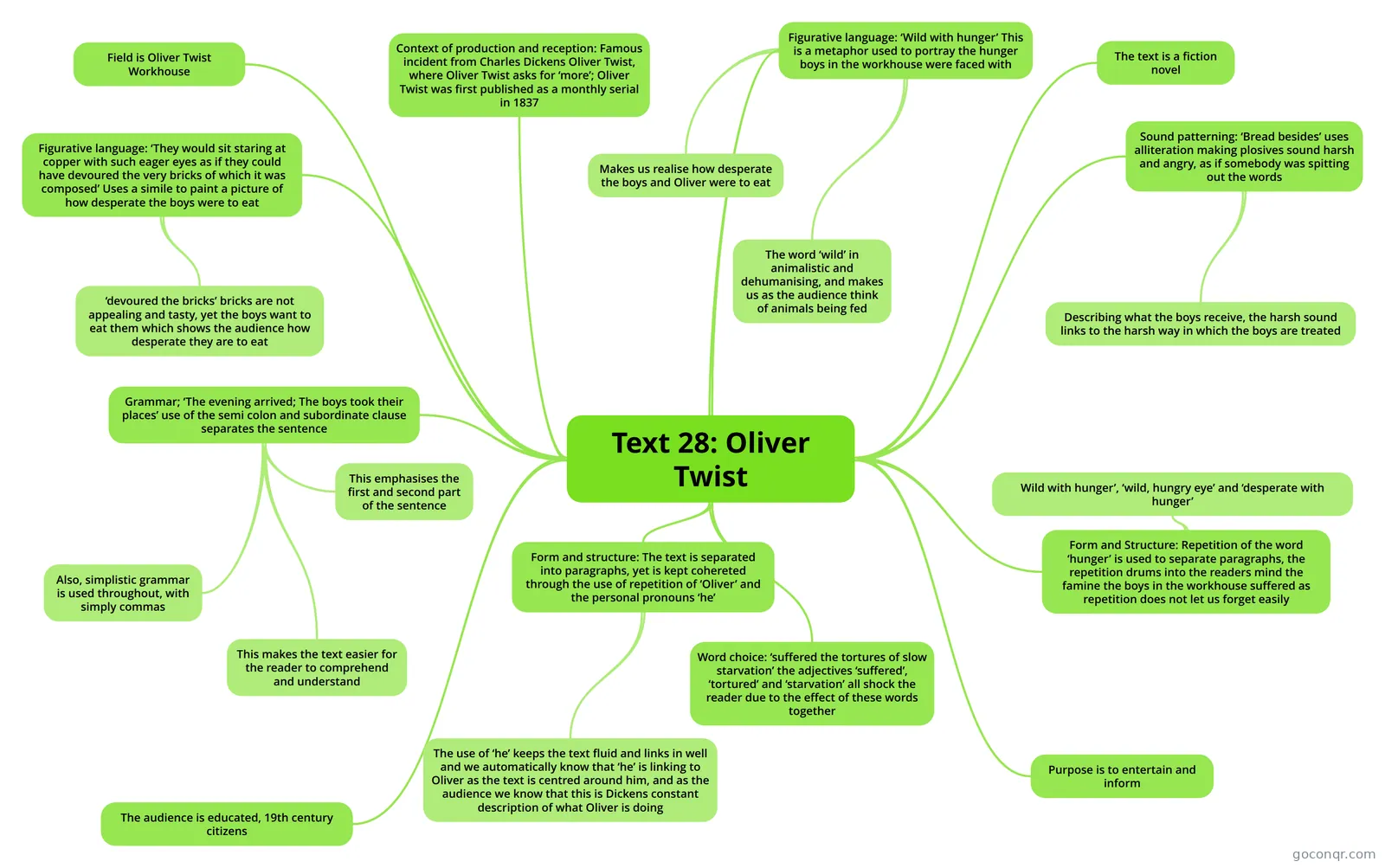
Mind map: Oliver Twist text analysis
Contenido del mapa
Text 28: Oliver Twist
Purpose is to entertain and inform
The audience is educated, 19th century citizens
Field is Oliver Twist Workhouse
The text is a fiction novel
Context of production and reception: Famous incident from Charles Dickens Oliver Twist, where Oliver Twist asks for ‘more’; Oliver Twist was first published as a monthly serial in 1837
Form and structure: The text is separated into paragraphs, yet is kept cohereted through the use of repetition of ‘Oliver’ and the personal pronouns ‘he’
- The use of ‘he’ keeps the text fluid and links in well and we automatically know that ‘he’ is linking to Oliver as the text is centred around him, and as the audience we know that this is Dickens constant description of what Oliver is doing
Form and Structure: Repetition of the word ‘hunger’ is used to separate paragraphs, the repetition drums into the readers mind the famine the boys in the workhouse suffered as repetition does not let us forget easily
- Wild with hunger’, ‘wild, hungry eye’ and ‘desperate with hunger’
Figurative language: ‘Wild with hunger’ This is a metaphor used to portray the hunger boys in the workhouse were faced with
- Makes us realise how desperate the boys and Oliver were to eat
- The word ‘wild’ in animalistic and dehumanising, and makes us as the audience think of animals being fed
Figurative language: ‘They would sit staring at copper with such eager eyes as if they could have devoured the very bricks of which it was composed’ Uses a simile to paint a picture of how desperate the boys were to eat
- ‘devoured the bricks’ bricks are not appealing and tasty, yet the boys want to eat them which shows the audience how desperate they are to eat
Sound patterning: ‘Bread besides’ uses alliteration making plosives sound harsh and angry, as if somebody was spitting out the words
- Describing what the boys receive, the harsh sound links to the harsh way in which the boys are treated
Word choice: ‘suffered the tortures of slow starvation’ the adjectives ‘suffered’, ‘tortured’ and ‘starvation’ all shock the reader due to the effect of these words together
Grammar; ‘The evening arrived; The boys took their places’ use of the semi colon and subordinate clause separates the sentence
- This emphasises the first and second part of the sentence
- Also, simplistic grammar is used throughout, with simply commas
- This makes the text easier for the reader to comprehend and understand
Información
- Descripción
- A-Levels (AS) English Literature and Language Mapa Mental sobre Text 28: Oliver Twist, creado por Luke Davies el 16/05/2013.
- Creado por
- Luke Davies
- Visitas
- 1.822
- Etiquetas
- Valoración