
Apuntes
Scientists & their Experiments
Contenido del apunte (9)
Página 1
J. J. Thomson >Cathode Rays >electron
English physicist from Cambridge
Constructed a partially glass tube and applied a high electrical voltage between 2 electrodes at either end of the tube. He found a beam of particles (called cathode rays) traveled from the negatively charged electrode (called cathode) to the positive charge (called anode).
Particles composing the cathode rays had these properties:
traveled in straight lines
independent of the material that they originate, cathode
carry a negative electrical charge
Cathode ray: a stream of electrons produced when a high electrical voltage is applied between two electrodes with a partially evacuated tube
Cathode ray tube: an evacuated tube containing charged plates to accelerate and view electron beams
Measured the 'charge-to-mass' ratio of the cathode ray particles by deflecting them with electric and magnetic fields by seeing the strengths at which the effect of the two fields cancel
Discovered the electron!
Página 2
Robert Milikan >Oil Drop
>Electron charge
American physicist in 1909
sprayed oil into fine droplets as an atomizer, they fell rough a small hole into the lower level. during the fall the drops gathered electrons, these electrons had been produced with the air let into the chamber with ionizing radiation. the lower part of the apparatus had a negatively charged electric field. by measuring the strength of the electric field required to stop the free fall of the drops, he figured out the masses/charge of the drops
Página 3
Henri Becquerel&Marie Curie
>radioactivity
discovered radioactivity
the element Curium was named after Curie for discovering it
Página 4
Ernest Rutherford >Gold Foil
disapproved Thomson's model of the atom
directed positively charged alpha particles at an ultrathin gold foil sheet to act as probes of the gold atom's structure
most particles passed directly through the foil, while some bounced back
>Nuclear Atom >Nuclear Theory
the results from his gold foil experiment lead Rutherford to create the model of the atom containing a dense nucleus and electron cloud
Majority of the atom's mass/all positive charge is in the nucleus
Most volume is empty space where electrons are dispersed
Amount of electrons and protons are equal
Página 5
James Chadwick >neutrons
In trying to account for the remaining mass in an atom after accounting for all its known parts, they discovered the neutron
Página 6
Dmitri Mendeleev> Periodic Law
Russian chemist
noticed similarities in the element's properties
listed them in order of increasing mass
predicted elements yet to be discovered
Página 7
Clemens Winkler>germanium
Página 8
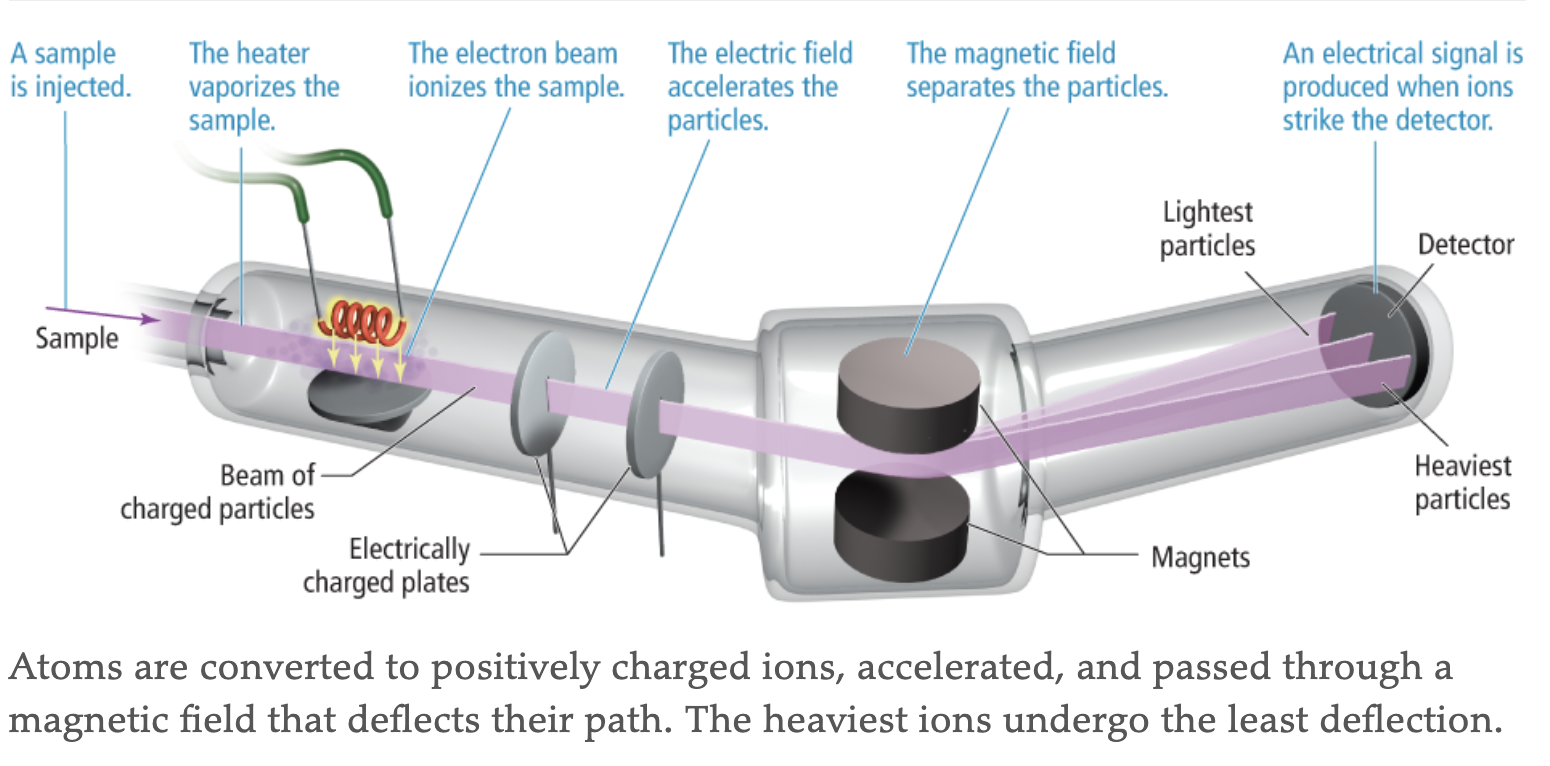
Mass Spectrometer
mass spectrometer: an experimental method of determining the precise mass and relative abundance of isotopes
Sample is injected into vaporizing part of instrument
Vaporized atoms are ionized by an e- beam
e- in beam collide with the atoms-- removing e- and creating positively charged ions
Ion move to a magnetic field that bends their trajectory
the amount of bending depends on the mass of the ions; bending the lighter ions more than heavier ones
three paths lie around the corner measuring the bend/mass of the ion
they strike a detector d make an electrical signal
Página 9
Avogadro >number
Amedeo Avogadro Italian physicist discovered the mole (mol): the amount of a substance
6.02214 x 10^23 (rounded to 4sf)
1 mole C ats = 12 g C = 10^23 C ats
gives a relationship between mass (grams of C) and number of atoms (Avo's #)

Información
- Descripción
- Chemistry Apunte sobre Scientists & their Experiments, creado por Ariana Isaacs el 12/10/2020.
- Creado por
- Ariana Isaacs
- Visitas
- 0
- Valoración