
Apuntes
Tourism
Contenido del apunte (11)
Página 1
Growth in Tourism.
REASONS FOR GLOBAL INCREASE OF TOURISM:
Social: more leisure time; more package holidays; more paid holidays so more free time.
Economic: more disposable income (spare money); travel has become cheaper; countries invested in infrastructure and marketing for tourism.
Technology: car ownership has grown; improvement in transport - more motorways and airports; online booking - cheaper and easier.
KEY AREAS IN TOURISM DEVELOPMENT:
Cities: attracted to the culture (museums etc.); entertainment (bars etc.); and shopping.
Mountains: beautiful scenery; activities (walking, climbing, skiing etc.).
Coastal Areas: the beach scenery; activities (swimming; snorkeling, surfing etc.).
ECONOMIC IMPORTANCE OF TOURISM IN MEDC'S AND LEDC'S:
Key Terms: multiplier effect - money earnt by tourism is spent in the local economy; leakages - money earnt by tourism is actually leaving the country (such as big foreign travel companies setting up hotels and foreigners working in other countries, only for the money to be sent out).
LEDC's: employment; income - the government taxes visitors for the services they use; foreign exchange - tourists spend money in the country; businesses - small businesses can be set up to supply tourists and income increased for other companies; the country's economy is often dependent on tourism.
MEDC's: tourism makes a huge amount of money but it doesn't make a big impact on the economy.
Página 2
UK Tourism.
CONTRIBUTION TO THE UK ECONOMY:
Tourism makes a huge contribution to the UK's economy, earning lots of money and creating lots of jobs.
Popular due to the countryside, historic landmarks, churches/cathedrals and castles - honeypot sites.
Almost all UK tourism used to be Domestic Tourism (people holidaying in the UK) but now more people go abroad.
FACTORS AFFECTING TOURISM TO THE UK:
Weather: bad weather can discourage tourists.
Cheap Package Holidays: guaranteed good weather in overseas resorts, grew in number and affordability - often cheaper than staying in UK.
World Economy: in periods of recession people don't often spend on luxuries such as going abroad.
Exchange Rates: the pound may drop so it'll become cheaper to visit the UK.
Terrorism: threats of bombings so people are less willing to visit.
Major Events: such as the Olympics, big events can attract a lot of new tourists.
Página 3
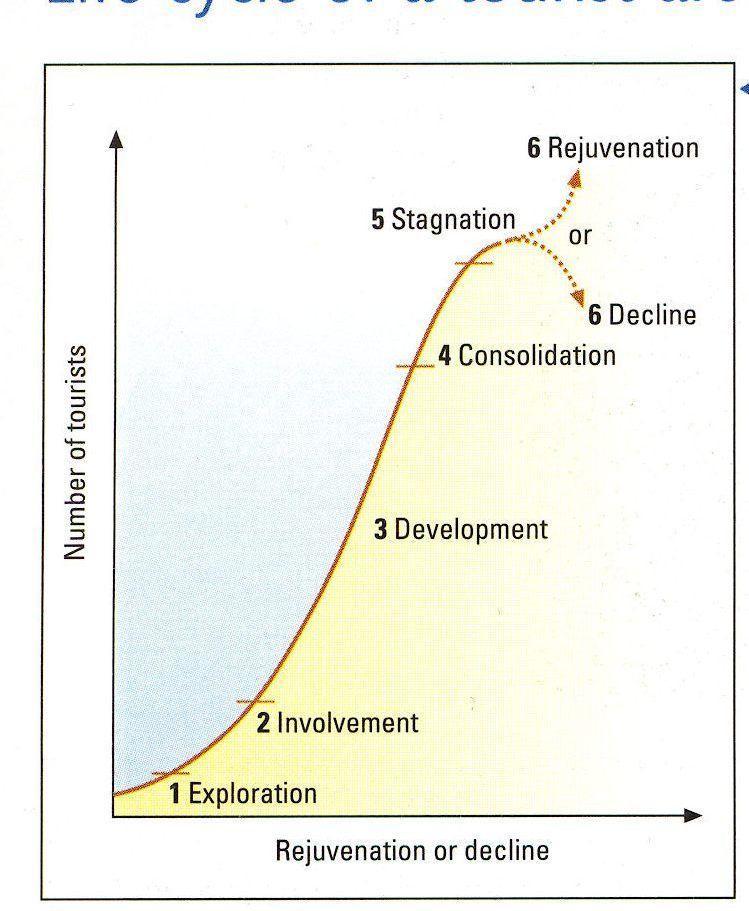
The Butler Tourist Resort Life Cycle Model.
Página 4
The Butler Tourist Resort Life Cycle Model.
1: EXPLORATION:
Small number of visitors attracted to area, who then may share how good it is.
Locals have not developed any tourist facilities.
2: INVOLVEMENT:
Local people see the opportunity start providing tourist facilities.
This attracts more tourists.
3: DEVELOPMENT:
Number of tourists rise dramatically as more facilities are built.
Control of tourism passes from the locals to big companies, building hotels and advertising package holidays.
Job opportunities for locals rise dramatically.
4: CONSOLIDATION:
Tourism a big part of the local economy, with most locals having a job in it.
Some hotels and facilities are becoming old and unattractive, so tourist numbers begin to level off but numbers are still very high.
5: STAGNATION:
The resort becomes unfashionable, with tourist numbers declining.
Facilities aren't as good and tourism has largely affected the environment, making it less attractive; businesses are beginning to fail.
6: REJUVENATION:
Attempts to modernise the resort and more tourists will come once more due to the new facilities; jobs created once more.
OR: DECLINE:
Fewer and fewer tourists come since the area is very unattractive, day trippers become the main source of income.
Facilities become run down or shut completely.
Página 5
UK Tourism Case Study - The Lake District, Cumbria.
BACKGROUND INFORMATION:
A National Park in Cumbria, North England.
8 million tourists per year.
CAUSES OF TOURISM:
Scenery - mountains such as Scafell Pike (977m), the tallest mountain in England, and lakes such as Lake Windermere (17km), the longest lake in England.
Activities - walking, rock climbing, sailing, fishing and canoeing; visiting picturesque towns such as Keswick and Ambleside.
Heritage/Culture - famous writers Beatrix Potter and William Wordsworth's houses are now attractions.
Good Transport Links - the West Coast Main Line Railway from London to Glasgow passes close.
IMPACTS OF TOURISM:
Positive - 20, 000 full time jobs; £600 million spent per year which provides local businesses with income.
Negative - 89% of people come by car - congestion and pollution; landscape scarring - Cat Bells walk a big sufferer of erosion; 8 million tourists to 42, 000 residents.
STRATEGIES TO COPE WITH TOURISTS:
Traffic + Parking - dual carriageways; public transport improved and campaigns promoting them; cattle grids and speed limits to prevent erosion; fence of roadsides so people don't park on verges; develop new small car parks.
Footpaths - repairing footpaths so people stick to them; reinforcing them with gravel so less erosion; signposting routes.
Litter - providing more litter bins and emptying them often; designated picnic areas.
Wildlife + Farmland - speed limits on lakes (10 mph on Windermere for hired boats) prevents erosion, noise and water pollution; campaigns and signs encouraging tourists to be responsible, such as closing gates and keeping dogs on leads.
PLANS TO ENSURE THE SUCCESS OF TOURISM:
Go Lakes Travel costing £6.9 million helps all above factors - hired bikes and cars, more public transport, cycle routes.
Other official tourism strategies expected to attract an extra 2 million tourists by 2018, increasing income from £1.1 billion to £1.5 billion per year; farms encouraged to provide activities such as archery, and strategies to increase tourism outside the National Park and into towns that will be rejuvenated, such as Whitehaven.
Página 6
Mass Tourism.
Mass Tourism: organised tourism for a large number of tourists all visiting the same destination.
IMPACTS OF TOURISM:
Economic:
Brings money into the local economy which can be reinvested in local projects.
Creates jobs for local people and increases other industries income (eg: farming, that supply food to tourists); however, these jobs are often badly paid and seasonal.
Lots of profit made from tourism is kept by large travel companies instead of going into the local economy, who will need it more.
Environmental:
Income from tourism can be reinvested in protecting the environment (eg: running National Parks and conservation work).
Transport over long distances produces air pollution - greenhouse gases.
Increases amount of litter and sewage - pollution.
Leads to destruction of habitats (eg: erosion from boats destroys coral reefs).
REDUCING NEGATIVE IMPACTS OF MASS TOURISM:
Improving public transport - reduces congestion and pollution.
Limiting no. of people visiting environmentally sensitive areas.
Providing bins - reduces litter.
STRATEGIES FOR MAINTAINING TOURISM:
Build and improve facilities, as well as improving the environment to make the area more attractive.
Advertise the area to attract new tourists.
Improve transport links.
Offer new activities.
Make it cheaper to visit.
Página 7
Mass Tourism Case Study - Jamaica, Caribbean.
BACKGROUND INFORMATION:
Jamaica is an island in the Caribbean sea off the East coast of Mexico and is one of the Caribbean's top destinations.
The main attractions are: Blue Lagoon, Montego Bay, the Coyaba River, Dunn's River Falls and cultural attractions such as famous singer Bob Marley.
In 2001, 1.8 million tourists visited the island.
IMPACTS OF TOURISM:
Economic:
Positive: $1.3 billion total earnings in 2001; on average, $931 spent per tourist; provides income for local businesses; employs locals in well-paid jobs by Jamaican standards; multiplier effect - Jamaican tourism workers earn money from tourists and then spend it in local businesses so they become more profitable.
Negative: economic leakages - foreign businesses and employees set up hotels so money earned sent out of country; seasonal jobs; local people and culture don't get business as the big companies encourage tourists to stay inside their resorts, for example: the Ocho Rios Craft Market.
Environmental:
Positive: money earned from tourism can be spent on conversation projects.
Negative: travel and traffic into and around Jamaica causes congestion and pollution; The Great Morass Wetland drained for land for hotels; beach erosion due to clearing mangroves; coral reefs damaged by jet skis and boat anchors.
STRATEGIES TO REDUCE NEGATIVE IMPACTS:
Logwood Water Treatment Plant - limits pollution from Negril's hotels.
Negril Marine Park - nature reserve to protect sea life; the tourists will want to see these animals, so brings in income too.
Building Limit - hotels not allowed to build above palm tree height.
Rio Grande River - local guides take visitors to small scale attractions which limits damage done in honeypot sites (such as the popular Dunn's River Falls).
STRATEGIES TO MAINTAIN TOURISM:
The Master Plan - involve local people by giving tourists the opportunity to meet them; educate locals and tourists.
Página 8
Extreme Tourism.
Extreme Environment: a place with an extreme climate/temperature and with not many people around - sparsely populated.
Why Are Tourists Attracted to Extreme Environments:
Ideal for adventure holiday activities.
Want something different and exciting.
Enjoy the riskiness and adrenaline harsh environments provide.
Unique wildlife and scenery (eg: Polar Bears in the Arctic).
Why Tourism is Increasing in Extreme Environments:
Improvements in transport - quicker and easier.
Keen to see places whilst you have the chance - Antarctica and the ice melts due to global warming.
Quite expensive, but nowadays people have more dispensable income (spare cash).
Adventure holidays becoming more popular due to advertising and programmes.
Impacts of Tourism to an Extreme Environment - the Himalayas:
Trees cut down to provide fuel for tourists - deforestation.
Deforestation destroys habitats.
Deforestation means fewer trees intercept rain - increased risk of flooding.
Deforestation leads to soil erosion since roots hold the soil together - washed into rivers and raises river bed; flooding.
Footpath erosion from tourists - landslides.
Toilets are poor/non-existent - rivers polluted by sewage.
Página 9
Extreme Tourism Case Study - Antarctica.
GROWTH OF TOURISM:
Area around the South Pole covering 14 million km2 - 98% covered with ice.
More people can afford expensive holidays so numbers are rising - in 1992 there were 9000 tourists and by 2010 there were 75000 tourists.
Nearly 1/2 of tourists are American since it's easiest access from Ushuaia in Argentina - most southern city in the world.
ACTIVITIES FOR TOURISTS:
First cruise ship in 1969 - most often come by small boats, but there are 3 airports such as William's Fields.
Tourism is very concentrated onto the Antarctic Penninsula since it's closest to South America.
Climb ice faces; visit scientific stations; wildlife (penguins and whales); scuba diving under the ice; historic sites; visiting the actual South Pole.
Mount Erebus is the world's most active volcano.
Scott of the Antarctic's hut.
IMPACTS OF TOURISM:
Tourists may trample plants, disturb wildlife and drop litter.
Fears that tourists could accidentally introduce new species and diseases that could wipe out native species - delicate ecosystem.
Fuel and oil spillages from ships - especially after the sinking of the MS Explorer in 2007.
Water pollution from boats - brownwater (faeces) and greywater (washing up) - in area for 1-2 weeks.
However, contributes money to scientific investigation, promotes awareness of Antarctica and people that go then want to protect it.
MEASURES TO PROTECT ANTARCTICA:
The Antarctic Treaty 1961 - international agreement signed by 47 countries that is designed to conserve the area and its wildlife; in 2009, new limits on tourism were agreed on: only ships with less than 500 passengers were allowed to land; max. of 100 tourists on shore at a time.
The International Association of Antarctic Tour Operators (IAATO) has a code of conduct: specially protected areas and sites of special scientific interest (SSSI) are off limits; wildlife must not be disturbed (stay 10m away); no litter left behind; tourists must stay supervised in their group and have a qualified guide; tourists must not walk on fragile plant life; waste stored on board the ships.
Ships not allowed to release greywater in Antarctic waters (still allowed to release brownwater).
Not allowed to build permanent structures.
However, the the IAATO's code is voluntary and guidelines are questionable (not practical, such as not stepping on lichen when you can't even see it); guidelines also can't be enforced - no police.
Página 10
Ecotourism.
Ecotourism: doesn't harm the environment (or has a low impact on it) and benefits the local people socially and financially. Ecotourism involves:
Conservation: protecting and managing the environment.
Stewardship: taking responsibility and caring for/conserving the environment as if it were your own.
BENEFITS OF ECOTOURISM:
Environmental:
Local people encouraged to conserve the environment over using it for damaging activities (logging or farming); can only earn money from ecotourism if the environment isn't damaged.
Reduces poaching and hunting of endangered species; locals benefit more from protecting these species over killing them.
Try to reduce use of fossil fuels - using renewable energy sources and local food so it doesn't have to be imported.
Waste tourists create is disposed of carefully.
Economic:
Creates jobs for local people - growth of local economy.
Locals can make money by selling local crafts to tourists or by supplying the tourist industry with goods.
Social:
Higher and more stable incomes than other jobs such as farming.
Many ecotourism schemes fund community projects such as schools, water tanks and health centres.
ECOTOURISM HELPS SUSTAINABLE DEVELOPMENT:
Sustainable development: improving quality of life for local people, but not stopping people in the future getting what they need.
Increases quality of life for locals since profits can be used within the local community.
Development is sustainable since it's done without damaging the environment (otherwise, people would have to do a job that harms the environment, such as logging).
Página 11
Ecotourism Case Study - Galapagos Islands.
BACKGROUND INFORMATION:
The Galapagos Islands are made of 50 volcanic islands, 1000km away from South America; it's where Charles Darwin studied the giant tortoise and came up with his theory of evolution.
BENEFITS OF ECOTOURISM ON THE GALAPAGOS ISLANDS:
Environmental:
90% of the islands are a National Park/Marine Reserve so they're protected.
Max. 20 people on the islands from each [small] boat at one time.
Local animals not scared of humans because they've never been hunted.
Economic:
Every tourist pays £25 to the Conservation Trust - this trains locals to get Biology and Ecology degrees so they can get jobs as guides and scientists.
Tour guides must be locals; this creates the multiplier effect and prevents leakage.
Social:
Get free university degrees.
Small tour boats must be owned by locals and hotels must be local owned and small.
CONTRIBUTION TO SUSTAINABLE DEVELOPMENT:
90% of the islands are a National Park/Marine Reserve so they're protected.
Protected by the UN since 1979 - UN World Heritage Site.
Small groups on the island can be policed.
Información
- Descripción
- GCSE Geography Apunte sobre Tourism, creado por Louise Sherry el 30/04/2017.
- Creado por
- Louise Sherry
- Visitas
- 0
- Valoración