
Apuntes
Genes
Contenido del apunte (7)
Página 1
Genes and Loci
DNA is the genetic blueprint which codes for, and determines, the characteristics of an organism
This includes the physical, behavioural and physiological features of the organism
DNA is packaged and organised into discrete structures called chromosomes
A gene is a sequence of DNA that encodes for a specific trait (traits may also be influenced by multiple genes)
The position of a gene on a particular chromosome is called the locus (plural = loci)
Página 2
Alleles
Alleles are alternative forms of a gene that code for the different variations of a specific trait
For example, the gene for eye colour has alleles that encode different shades / pigments
As alleles are alternative forms of the one gene, they possess very similar gene sequences
Alleles only differ from each other by one or a few bases
Página 3
Mutations
A gene mutation is a change in the nucleotide sequence of a section of DNA coding for a specific trait
New alleles are formed by mutation
Gene mutations can be beneficial, detrimental or neutral
Beneficial mutations change the gene sequence (missense mutations) to create new variations of a trait
Detrimental mutations truncate the gene sequence (nonsense mutations) to abrogate the normal function of a trait
Neutral mutations have no effect on the functioning of the specific feature (silent mutations)
Cause of Sickle Cell Anaemia
Sickle cell anaemia results from a change to the 6th codon for the beta chain of haemoglobin
DNA: The DNA sequence changes from GAG to GTG on the non-coding strand (CTC to CAC on the coding strand)
mRNA: The mRNA sequence changes from GAG to GUG at the 6th codon position
Polypeptide: The sixth amino acid for the beta chain of haemoglobin is changed from glutamic acid to valine (Glu to Val)
Página 4
Página 5
Genomes
The genome is the totality of genetic information of a cell, organism or organelle
This includes all genes as well as non-coding DNA sequences (e.g. introns, promoters, short tandem repeats, etc.)
The human genome consists of:
46 chromosomes (barring aneuploidy)
~3 billion base pairs
~21,000 genes
The completion of the Human Genome Project in 2003 lead to many outcomes:
Mapping – The number, location, size and sequence of human genes is now established
Screening – This has allowed for the production of specific gene probes to detect sufferers and carriers of genetic diseases
Medicine – The discovery of new proteins have lead to improved treatments (pharmacogenetics and rational drug design)
Ancestry – Comparisons with other genomes have provided insight into the origins, evolution and migratory patterns of man
Página 6
Types of mutation
Point mutations are changes to one base in the DNA code and may involve either:
The substitution of a base (e.g. ATG becomes ACG)
The insertion of a base (e.g. ATG becomes ATCG)
The deletion of a base (e.g. ATG becomes AG)
The inversion of bases (e.g. ATG becomes AGT)
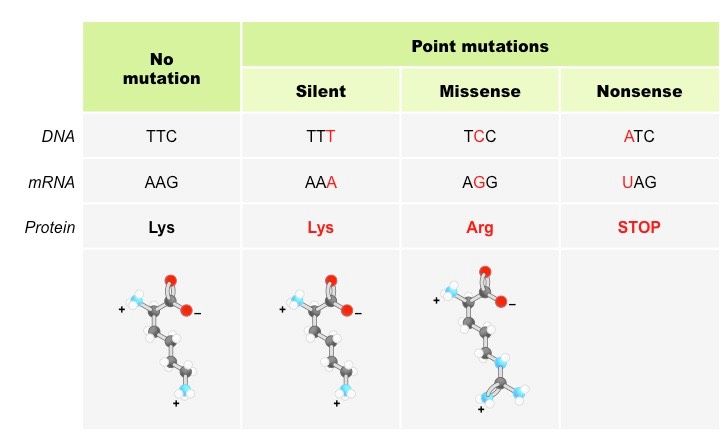
Base substitutions may create either silent, missense or nonsense mutations, while insertions and deletions cause frameshift mutations
Effects of Point Mutations
Silent mutations occur when the DNA change does not alter the amino acid sequence of the polypeptide
This is possible because the genetic code is degenerate and certain codons may code for the same amino acid
Missense mutations occur when the DNA change alters a single amino acid in the polypeptide chain
Sickle cell anaemia is an example of a disease caused by a single base substitution mutation (GAG → GTG ; Glu → Val)
Nonsense mutations occur when the DNA change creates a premature STOP codon which truncates the polypeptide
Frameshift mutations occur when the addition or removal of a base alters the reading frame of the gene
This change will affect every codon beyond the point of mutation and thus may dramatically change amino acid sequence
Página 7
Información
- Descripción
- GCSE (Reproduction and cell division) Biology Apunte sobre Genes, creado por Arianna Weaving el 23/07/2017.
- Creado por
- Arianna Weaving
- Visitas
- 0
- Valoración