
Fichas
Applied Year 10: Unit 1.1.2 Obtaining the materials for respiration
Fichas del conjunto (35)
- 1Describe the pathway for air into the lungs.1. Through the nasal cavity or mouth
2. Down the trachea
3. Splits at the bronchi
4. Into the bronchioles
5. Into the alveoli where gas exchange will occur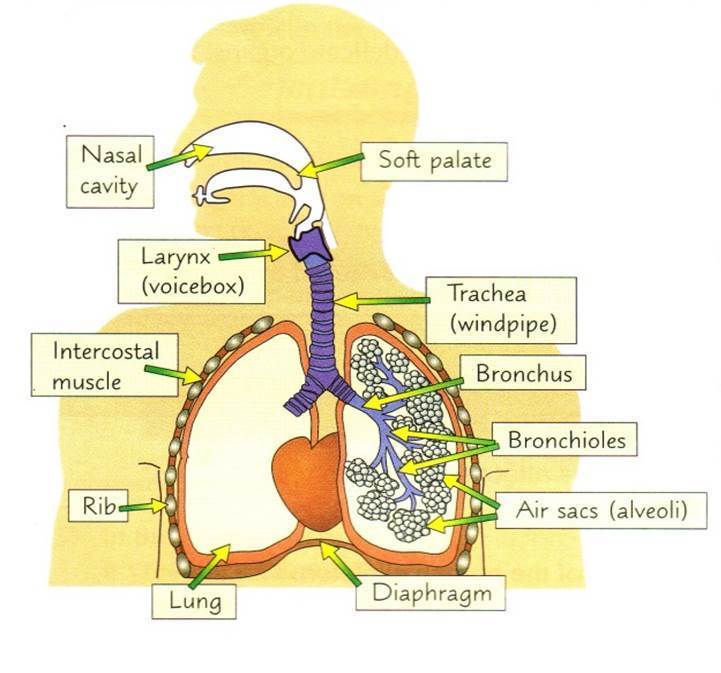
- 2Describe the process of inspiration (inhaling).Diaphragm contracts and flattens.
Intercostal muscles contract causing ribs to expand.
Volume inside chest increases.
Pressure inside chest decreases.
Air moves in. - 3Describe the process of expiration (exhaling).Diaphragm relaxes and moves up.
Intercostal muscles relax causing ribs to move in and down.
Volume inside chest decreases.
Pressure inside chest increases.
Air forced out. - 4What is the composition of gases in inhaled air?79% Nitrogen
21% Oxygen
0.04% Carbon dioxide - 5What is the composition of gases in exhaled air?79% Nitrogen
16% Oxygen
4% Carbon dioxide - 6Why is digestion needed?To breakdown large molecules
into smaller molecules so they
can be absorbed for use by
body cells - 7What is an enzyme?Biological catalyst - speeds up the rate of a chemical reaction
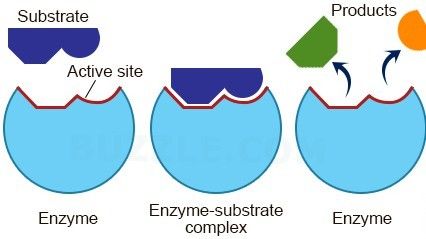
- 8Describe the function of enzymes' action (lock and key hypothesis).
- 9What 3 factors affect enzyme activity?Temperature
pH
Substrate concentration - 10What does optimum temperature mean?The temperature an enzyme works best at.
- 11What does optimum pH mean?The pH an enzyme works best at.
- 12What enzyme breaks down fats?Lipase
- 13What are fats broken down into?Fatty acids and glycerol
- 14What enzyme breaks down proteins?Protease
- 15What are proteins broken down into?Amino acids
- 16What enzyme breaks down carbohydrates?Carbohydrase
- 17What are carbohydrates broken down into?Simple sugars
- 18What enzyme breaks down starch?Amylase
- 19What is starch broken down into?Glucose
- 20How would you test for the presence of starch?Use iodine - it would turn from a brown to blue/black colour
- 21How would you test for the presence of glucose?Benedict's reagent and heat - it would turn from a blue colour to brick red
- 22How would you test for the presence of protein?Biuret solution - will change from blue to violet
- 23Label the parts of the digestive system.1. Mouth
2. Oesophagus
3. Stomach
4.Small intestine
5. Pancreas
6. Large intestine
7. Anus
8. Liver
9. Gall bladder
- 24What is the role of the mouth?Digestion starts here - teeth break down food into smaller pieces. This increases surface area for amylase to start breaking down starch. Saliva contains amylase and lubricates the food bolus.
- 25What is the role of the stomach?Contains protease to break down proteins.
Also contains hydrochloric acid to aid digestion and kill microbes. - 26What is the role of the pancreas?Secretes lipase, proteases and carbohydrases into the small intestine
- 27What is the role of the small intestine?Digests carbohydrates, proteins and fats. The digested molecules are absorbed across the villi of the small intestine.
- 28What is the role of the large intestine?Water is absorbed out of the remaining food to leave behind faeces.
- 29What is the role of the liver?Secretes bile (which is stored in the gall bladder and secreted into the small intestine when required)
- 30Why is bile required?1. Bile emulsifies fat into smaller fat droplets. This increases the surface area for lipase to digest the fat.
2. Bile increases the pH in the small intestine to the optimum pH for enzyme acitivity. - 31How is food moved along the alimentary canal (through the digestive system)?Peristalsis - muscles contract above the food bolus to push the food along
- 32How is the small intestine adapted to absorb soluble subtances into the blood stream?1. Villi increase the surface area
2. Rich blood supply - maintains a concentration gradient - 33How does the body use fatty acids and glycerol?For energy
- 34How does the body use glucose?For energy
- 35How does the body use amino acids?To build proteins in the body
Información
- Descripción
- GCSE Biology Fichas sobre Applied Year 10: Unit 1.1.2 Obtaining the materials for respiration, creado por Mrs Z Rourke el 28/02/2018.
- Creado por
- Mrs Z Rourke · feb 2018
- Actualizado
- 29 mar 2018
- Visitas
- 556
- Valoración