
Apuntes
2014-2015 : Geometry Honors
Contenido del apunte (1)
Página 1
Theorem 8-5: 45-45-90 Triangle Theorem
In a 45-45-90 triangle, both legs are congruent and the length of the hypotenuse is (the square root of 2)*(leg).
Theorem 8-6: 30-60-90 Triangle Theorem
In a 30-60-90 triangle, the length of the hypotenuse is twice the length of the shorter leg. The length of the longer leg is (the square root of 3)*(the shorter leg).
Pythagorean Triples
3,4,5
5,12,13
8,15,17
7,24,25
No perfect square can be a factor under a radical sign.
x^1.5=square root of x.
No fractions under a radical.
No radicals in the denominator.
1.1 Through any two points there is exactly one line
1.2 If two lines intersect, then they intersect in one point
1.3 If two planes intersect, then they intersect in a line
1.4 Through any three noncollinear points, there is a plane.
1.5 The distance between any 2 points is the absolutely value of the difference of their coordinates
1.6 If A,B, and C are collinear, and B is between A and C, AB+BC=AC.
Either two lines are parallel, or they intersect in exactly one point.
Either a line and a plane are parallel, or they intersect in exactly one point, or the plane contains the line.
Either two planes are parallel, or they intersect in a line.
Point: Location. No length, no width, no thickness.
Line: An infinite set of points that extend in two directions. Length, but no width or thickness.
Plane: An infinite set of points that creates a flat surface that extends without ending. Length and width, but no thickness.
Space: The set of all points.
Collinear: Points on the same line.
Noncollinear: Points not on the same line.
Coplanar: Points in the same plane.
Noncoplanar: Points not in the same plane.
Intersection: The set of points in both figures.
Postulate: A basic assumption accepted without proof.
Theorem: A statement that can be proved using postulates, definitions, and previously proved theorems.
Exists: There is at least one.
Unique: There is exactly one.
One and only one: Exactly one.
Determine: To define or specify.
Angle: Two rays with the same end point.
Acute angle: Angle is less than 90*, more than 0*.
Right angle: Angle is exactly 90*.
Obtuse angle: Angle is over 90*, but less than 180*.
Straight angle: Angle is exactly 180*.
Congruent angles: Angles with the same measure.
Vertical angles: Two angles whose sides are opposite rays.
Adjacent angles: Two coplanar angles with a common side, a common vertex, and no common interior points.
Complementary angles: Two angles whose measures total 90*. Each angle is the complement of the other.
Supplementary angles: Two angles whose measures total 180*. Each angle is the supplement of the other.
Linear pair: Supplementary and adjacent angles that add together to form a 180* angle.
Angle bisector: A ray that divides an angle into two angles that both have the same measure.
2.1 Vertical angles are congruent.
2.2 If two angles are supplements of the same angle, then the two angles are congruent.
2.3 If two angles are complements of the same angle, then the two angles are congruent.
2.4 All right angles are congruent. (90*)
2.5 If two angles are congruent and supplementary, then each is a right angle.
Constructions:
Copying angle
Bisecting an angle
Perpendicular bisector of an angle
Circumcenter
Reflexive Property: AB = AB
Symmetric Property: If AB = CD, then CD = AB.
Transitive Property: If AB = CD, and CD = EF, then AB = EF.
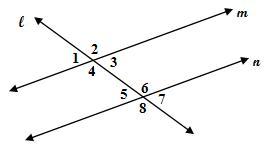
3.1 Corresponding angles are congruent
3.1 Alternate interior angles are congruent
3.2 Same side interior angles are supplementary
3.3 Alternate exterior angles are congruent
3.4 Same side exterior angles are supplementary
Equiangular: All angles congruent
Acute: All angles Right: 90* angle
Obtuse: All angles are >90* and Equilateral: All sides congruent
Midpoint Formula: (x1+x2/2, y1+y2/2)
Distance Formula: Square root of (x2-x1)^2+(y2-y1)^2
5.10 If two sides of a triangle are not congruent, then the side opposite the smaller angle will be the shorter side, and the side opposite the larger angle must be the larger side.
5.11 The sum of the lengths of any two sides of a triangle is greater than the remaining side.
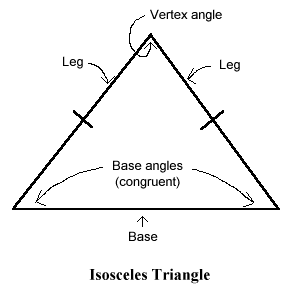
*If two angles of a triangle are equal, then two sides are equal and the triangle is isosceles
5.1 The midsegment of a triangle is parallel to side 3 and half the length of side 3.
5.6 The perpendicular bisectors of the sides of a triangle are concurrent at a point equidistant from the vertices.
5.7 The angle bisectors of a triangle are concurrent at a point equidistant from the sides of the triangle.
5.8 The medians of a triangle are concurrent at a point that is 2/3 the distance from each vertex to the midpoint of the opposite side.
5.9 The lines that contain the altitudes of a triangle are concurrent.
With side lengths a, b, and c,
a + b > c
b + c > a
c + a > b
A (Angle bisectors) : I (Incenter)
P (Perpendicular bisectors) : C (Circumcenter)
M (Medians) : C (Centroid)
A (Altitudes) : O (Orthocenter)
4.3 If two sides of a triangle are congruent, then the angles opposite them are congruent.
Concurrent- 3 or more lines that meet at one point.
Circumcenter- The intersection of any two of the three perpendicular bisectors.
Circumscribed- To draw a circle around a figure, touching all of its vertices.
No decimals under √
Cannot add different √ values
2014-2015:Geometry Honors
8.1 In a right triangle, the sum of the squares of the lengths of the legs is equal to the square of the length of the hypotenuse.
a^2 + b^2 = c^2
8.2 If the square of the length of one side of a triangle is equal to the sum of the squares of the lengths of the other two sides, then the triangle is a right triangle.
8.3 If the square of the length of the longest side of a triangle is greater the sum of the squares of the lengths of the other two sides, the triangle is obtuse.
8.4 If the square of the length of the longest side of a triangle is lesser the sum of the squares of the lengths of the other two sides, the triangle is acute.
8.5 In a 45-45-90 triangle, both legs are congruent and the length of the hypotenuse is √ 2 times the length of the leg.
Hypotenuse= √ 2 * leg
8.6 In a 30-60-90 triangle, the length of the hypotenuse is twice the length of the shorter leg. The length of the longer leg is √ 3 times the length of the shorter leg.
Hypotenuse= 2 * shorter leg
Longer leg= √ 3 * shorter leg
Trigonometry- The study of the ratios of the sides of triangles.
SOH CAH TOA:
sine= opposite / hypotenuse
cosine= adjacent / hypotenuse
tangent= opposite / adjacent
Law of Sines:
*When you know 2 angles and a side, or 2 sides and an excluded angle.
For any triangle ABC, where a,b,c are the lengths of the sides opposite the angles with measures A,B,C, respectively, sin A / a = sin B / b = sin C / c and the reciprocal equation is also true.
Sine of any angle/opposite side = Sine of any angle/opposite side
Law of Cosines:
*When you know 2 sides and an angle, or 3 sides.
For any triangle ABC, where a,b,c are the lengths of the sides opposite the angles with measures A,B,C, a^2 = b^2 + c^2 - 2(bc)(cosA)
7.1 a/b = c/d is equal to b/a = d/c ; ad = bc ; a+b/b ; c+d/d
7.2 If the scale factor of tow similar figures is a:b then the ratio of perimeters is a:b and the ratio of areas is a^2 : b^2
7.3
Triangles are similar if
AA: Two angles in one triangle are equal to two angles of another.
SAS: If two sides of one triangle are proportional to two sides of another triangle, and the included angles are equal.
SSS: If three sides of one triangle are proportional to three sides of another triangle.
7.4 The altitude to the hypotenuse of a right triangle divides the triangle into two triangles that are similar to each other and to the original triangle. The altitude is the geometric mean between the two parts of the hypotenuse. Each leg is the geometric mean between the hypotenuse and the part closest to that leg.
7.5 A line parallel to one side of a triangle divides the other sides proportionally. If three parallel lines intersect 2 transversals, they divide them proportionally.
7.6 An angle bisector in a triangle divides the opposite side into two segments that are proportional to the other two sides.
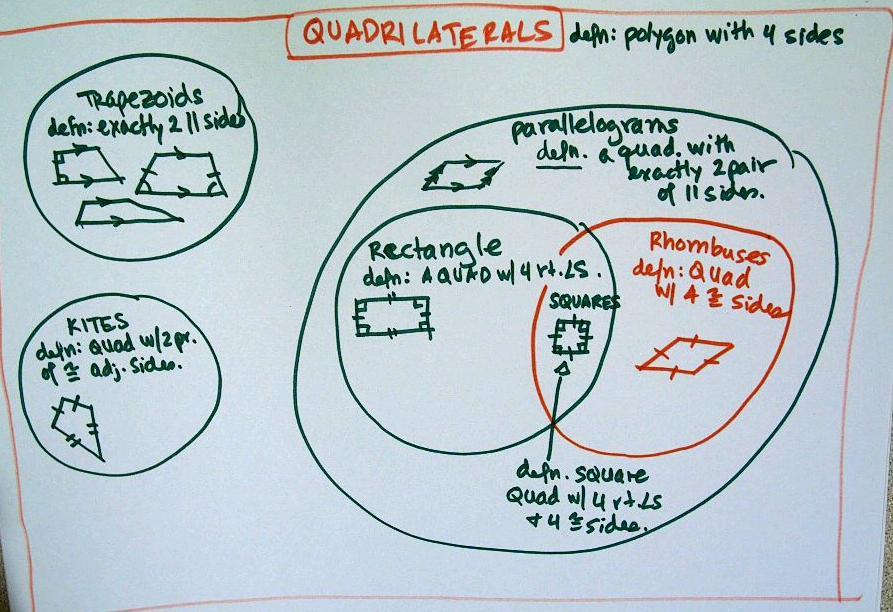
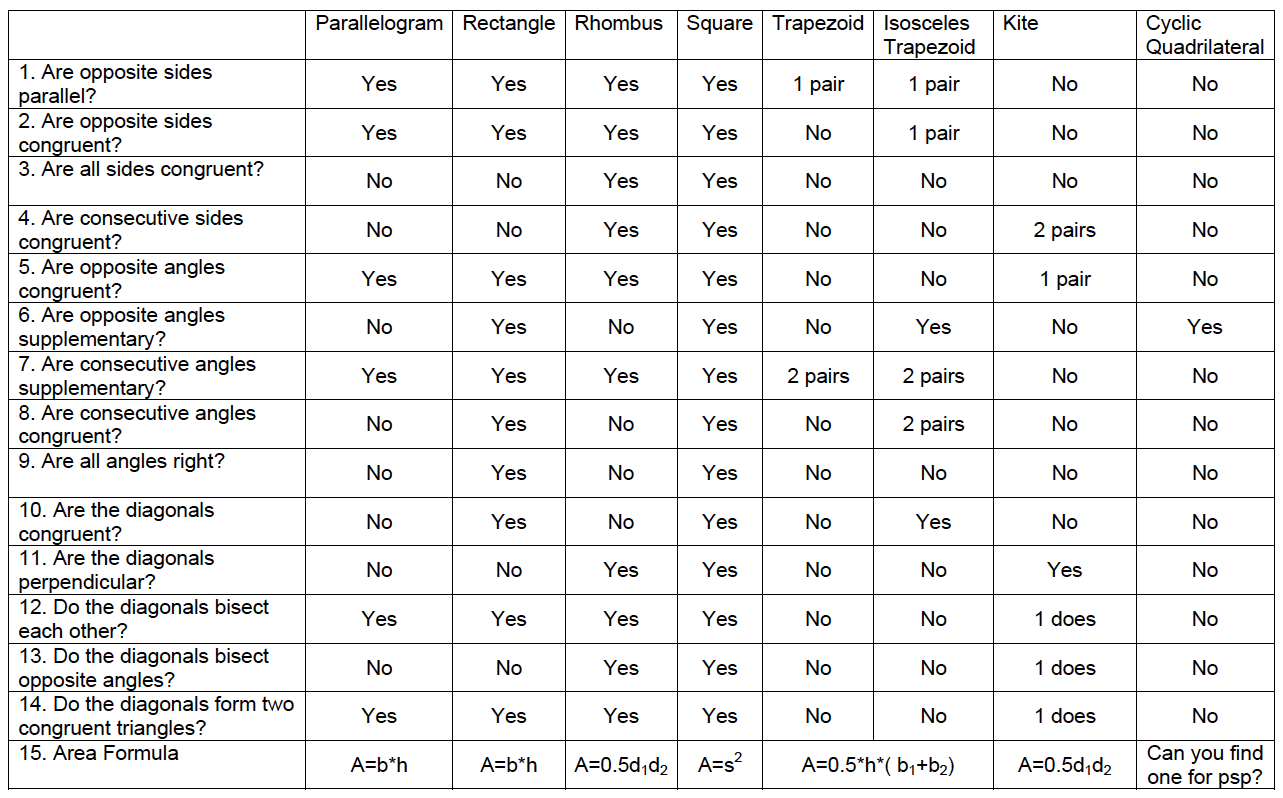
Parallelogram- Quadrilateral with two pairs of parallel sides.
Rhombus- Parallelogram with four congruent sides.
Rectangle- Parallelogram with four right angles.
Square- Parallelogram with four congruent sides and four right angles.
Kite- Quadrilateral with 2 pairs of congruent adjacent sides and no opposite sides congruent.
Trapezoid- Quadrilateral with one pair of parallel sides (bases). Nonparallel sides are legs.
Isosceles Trapezoid- Trapezoid whose nonparallel opposite sides are congruent.
6.1 Opposite sides of a parallelogram are congruent.
6.2 Opposite angles of parallelogram are equal.
6.3 The diagonals of a parallelogram bisect each other.
6.4 If three or more parallel lines cut off congruent segments on one transversal, then they cut off congruent segments on every transversal.
6.5 If both pairs of opposite sides of a quad are congruent, then the quad is a parallelogram.
6.6 If both pairs of opposite angles of a quad are congruent, then the quad is a parallelogram.
6.7 If the diagonals of a quad bisect each other, then it is a parallelogram.
6.8 If one pair of opposite sides of a quad are congruent and parallel, then it is a parallelogram.
6.9 Each diagonal of a rhombus bisects the angles of the rhombus.
6.10 The diagonals of a rhombus are perpendicular.
6.11 The diagonals of a rectangle are congruent.
6.12 If the diagonals bisect the angles, the quad is a rhombus.
6.13 If the diagonals are perpendicular, the quad is a rhombus.
6.14 If the diagonals are congruent, the quad is a rectangle.
6.15 Base angles of an isosceles trapezoid are congruent.
6.16 The diagonals of an isosceles trapezoid are equal.
6.17 The diagonals of a kite are perpendicular.
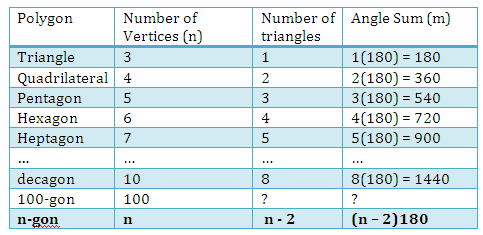
3.14 The sum of the measure of the interior angles of an n-gon is 180(n-2).
3.15 The sum of the measures of the exterior angles of a polygon, one at each vertex, is 360*.
Heron's Formula: For finding the area of a triangle given the lengths of its sides.
s= perimeter/2 a,b,c= sides
a= √s(s-a)(s-b)(s-c)
Apothem- A perpendicular line from the center to a side.
Radius- A bisector drawn from center to vertex.
Area of a regular polygon- A=1/2(apothem)(perimeter)
Circle- The set of all points equidistant from a given point.
Center- A point by which all points of a circle are equidistant from. Circles are named according to this.
Radius- A segment with one endpoint at the center and other endpoint on the circle.
Congruent circles- Possess congruent radii.
Diameter- A segment containing the center and two endpoints on the circle.
Central angle- Angle whose vertex is the center of the circle.
Semicircle- A type of arc; Half a circle.
Minor arc- Less than a semicircle.
Major arc- Greater than a semicircle.
Adjacent arcs- Arcs of the same circle with a single point in common.
Circumference- The distance around the circle.
Concentric circles- Circles in the same plane and same center.
Arc length-Fraction of a circle's circumference.
Congruent arcs- Arcs with the same measure and in the same circle.
10.9 The circumference of a circle is πd or 2πr.
10.10 The length of an arc of a circle is a fractional part of the circumference. Length of arc AB= measure of AB/360 (2πr)
11.1 Prisms: ((2W+2L)h)+2LW
11.2 Cylinder: ((2πr)h)+2πr^2
11.3 Triangular Pyramid: (1/2*p*s)+(base)
Square Pyramid: 2(sides*s)+base
11.4 Cone: (πr*s)+base
Información
- Descripción
- Honors Geometry Honors 2014 Apunte sobre 2014-2015 : Geometry Honors, creado por Amanda Valentine el 11/01/2015.
- Creado por
- Amanda Valentine · ene 2015
- Actualizado
- 23 mar 2016
- Visitas
- 31
- Etiquetas
- Historial
-
- Creado por Amanda Valentine · 11 ene 2015
- Copiado por Amanda Valentine · 11 ene 2015
- Valoración