
Geometry Basics and Shapes
339 resources created by 279 users
This GoConqr page gathers over 1,500 community-made resources on Geometry Basics and Shapes: quizzes, mind maps, flashcards and notes to revise and practise with.
Top Geometry Basics and Shapes resources
-
Mind map Circle Geometry
-
38 questionsGeometry Midterm Practice LEVEL 3: In the figure, RZ and WT are transversal of line s and t. If m∠ RVT = 5x + 6, m∠ VWY = 8x + 7, and...
-
42 cardsComprehensive Geometric Theorems For Integrated Math 2 Segment Addition Postulate
-
17 questionsGeometry Quality Core A person had a rectangular-shaped garden with sides of lengths 16 feet and 9 feet. The garden was changed i...
-
23 cardsMaths formulas Flash Cards Revision
-
24 cardsPostulates / Theorems Postulate 1-1-1 Through any two points there is exactly one line.
-
52 cardsGeometry Formulas Here are all the formulas we use in Geometry. There are some *quality core* formulas as well.
-
14 questionsPythagorean Theorem Quiz Find the perimeter of the triangle: Hypotenuse = 100 cm, "b" = 28 cm, and "a" = ?
Quizzes
See all 68 quizzes-
38 questionsGeometry Midterm Practice LEVEL 3: In the figure, RZ and WT are transversal of line s and t. If m∠ RVT = 5x + 6, m∠ VWY = 8x + 7, and...
-
17 questionsGeometry Quality Core A person had a rectangular-shaped garden with sides of lengths 16 feet and 9 feet. The garden was changed i...
-
14 questionsPythagorean Theorem Quiz Find the perimeter of the triangle: Hypotenuse = 100 cm, "b" = 28 cm, and "a" = ?
-
11 questionsGeometry Regents Practice Questions Practice questions for the Geometry Regents. Attibute: nysregents.org
-
20 questionsChapter 1 Retake Name three noncollinear points.
-
18 questionsSurface Area and Volume Prisms and Cylinders Determine the Surface Area in cm squared.
-
15 questionsMatemáticas. IX If each of the small squares in the figure above has area 1, what is the area of the shaded region?
-
10 questionsGeometry Vocabulary An angle with a measure of 45 degrees is what type of angle?
Mind maps
See all 88 mind maps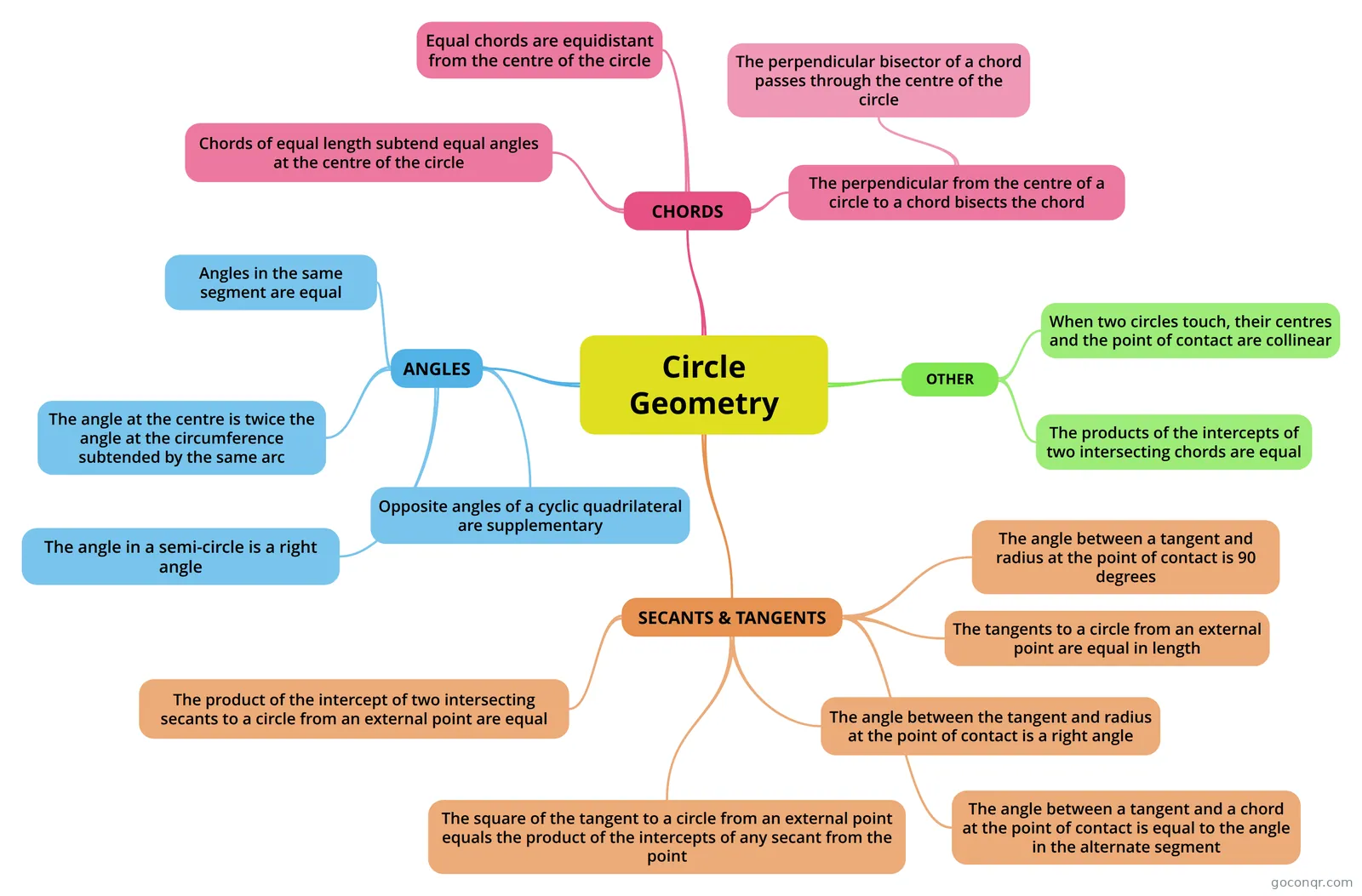
Flashcards
See all 138 flashcards-
42 cardsComprehensive Geometric Theorems For Integrated Math 2 Segment Addition Postulate
-
23 cardsMaths formulas Flash Cards Revision
-
24 cardsPostulates / Theorems Postulate 1-1-1 Through any two points there is exactly one line.
-
52 cardsGeometry Formulas Here are all the formulas we use in Geometry. There are some *quality core* formulas as well.
-
24 cardsAngle rules
-
33 cardsUnit 2.1-2.8 Honors Geometry Definitions 2.1-2.8
-
25 cardsPolygons And Perimeters
-
34 cardsNCEA Level 1 Angle Rules The angle rules for NCEA geometry at Year 11
Flowcharts
Notes
See all 31 notes-
Geometry Theorems Exterior Angles of a TriangleThe exterior angle has two interesting properties that follow from one another. 1) The exterior angle at a given vertex is equal in measure to the sum of the two remote interior angles. Th...
-
maths notes Angle RelationshipsNaming and measuring angles, types of angles, vertically opposite angles, complementary and supplementary angles, angles and parallel lines. Solving geometrical problems using reasoning.Revolution -...
-
Geometry Regents - Theorem Review Notes Theorem #1: If 2 angles form a linear pair, then they are supplementary. Unit 1 Theorem #2: If 2 angles are complementary to the same angle, they their measures are equal.
-
Chapter 8: Pythagoras' Theorem Chapter 8: Pythagoras' Theorem Mathematicians Employ A Method Called The Pythagoras' Theorem To Calculate The Distance/Length Of The Third Side Of A Right-Angled Triangle If Two Of Its Sides, Which Are Perpendicular T...
-
Regents Geometry Geometry Notes Distance formula: Midpoint:
-
Trigonometry and Geometry Parrellel lines, Triangles, Polygons, Pythagoras Similar figures/Triangles, Volume TSA, Similar Shapes
-
Circle
-
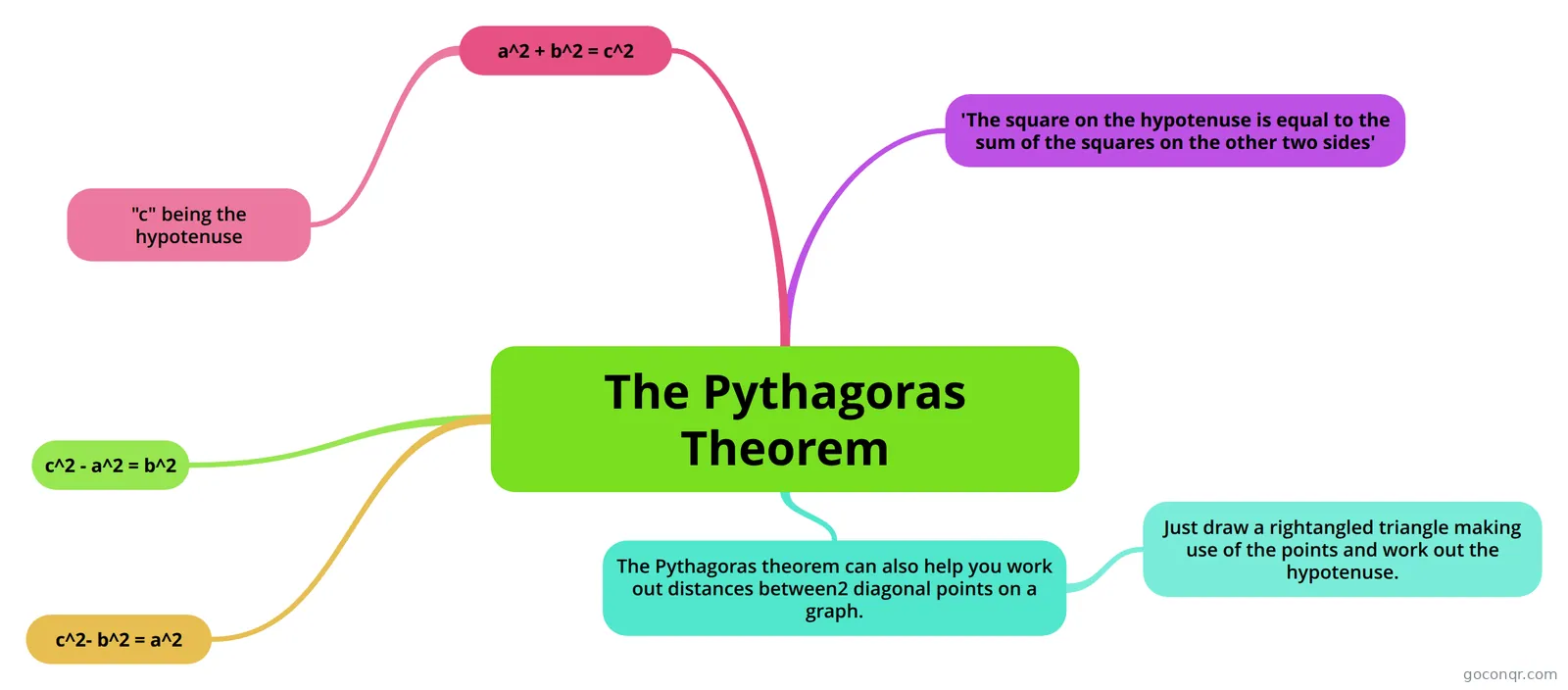
Pythagoras Theorem Pythagoras Theorem Formula: c2 = a2 + b2
Slides
See all 12 slidesMore Mathematics topics
About Geometry Basics and Shapes
GoConqr OriginalWhat you will find here
The page covers the core of school geometry. Angles come first: the flashcard deck Angles asks what is special about corresponding and alternate angles, and how many degrees sit on a straight line or in a circle. The Parallel Lines and Transversal Quiz then asks you to classify angle pairs.
Circles have plenty of room. The Circle Geometry mind map branches into chords, cyclic quadrilaterals, tangents and intersecting secants. Shape measurement is covered by the Area, Volume & Perimeter Mind Map, which sorts 2D area from 3D volume and lists formulae for each.
Where to start
- Begin with the Angles flashcards to fix the basic rules.
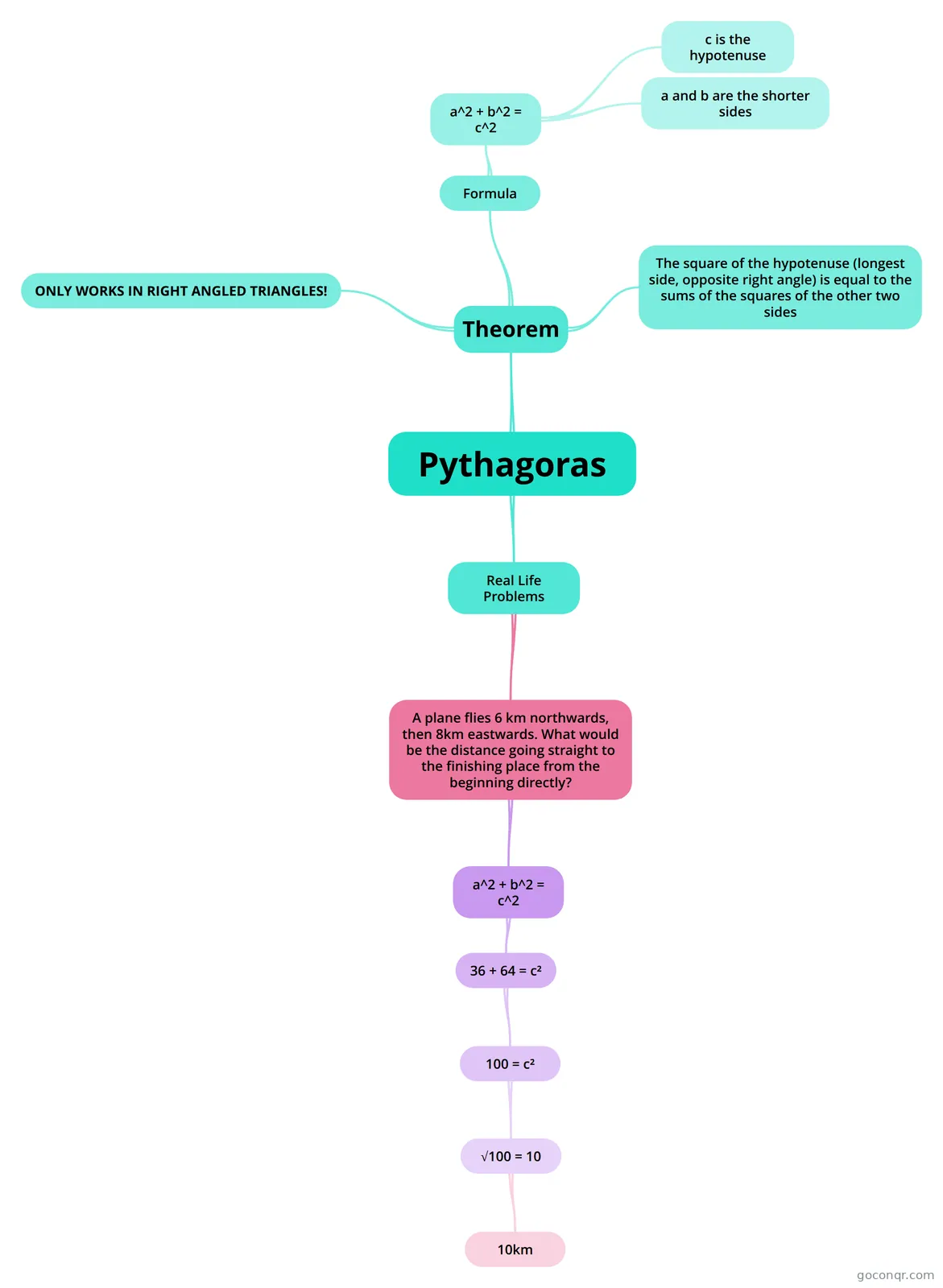
- Open the Pythagoras mind map. It stresses that the theorem only works in right-angled triangles.
- Read the slide set GCSE Maths: Understanding Pythagoras' Theorem, then take the Pythagorean Theorem Quiz.
- Move on to the Similarity and congruency mind map and the circle resources.
Using quizzes and maps together
Read a mind map first, so the structure is clear. Then take a quiz on the same topic and note which questions slip. Go back to the map branch that matches, and try again. The Geometry Midterm Practice quiz works well for this, as it sets levelled questions that ask you to solve for x using angle facts.
For exam practice, the Geometry Regents Practice Questions include circle equations and parallel lines on a coordinate grid. The Geometry Regents - Theorem Review Notes back them up. Other listed resources mention GCSE Maths, Edexcel IGCSE Maths, ACT and GMAT.
Where it fits
This unit sits in the Geometry, Measurement and Trigonometry strand of Mathematics. Teachers can pick a quiz or mind map to set as revision, and students can use the same items alone.
Choose one topic today, try its quiz, and then build your own flashcards from the gaps you find.
Frequently asked questions
Which resource should I open first?
Start with the Angles flashcard deck if you need the basic rules, such as corresponding and alternate angles. If angles feel solid, open the Pythagoras mind map, then try the Pythagorean Theorem Quiz to check you can apply the formula.
What do the mind maps on this page cover?
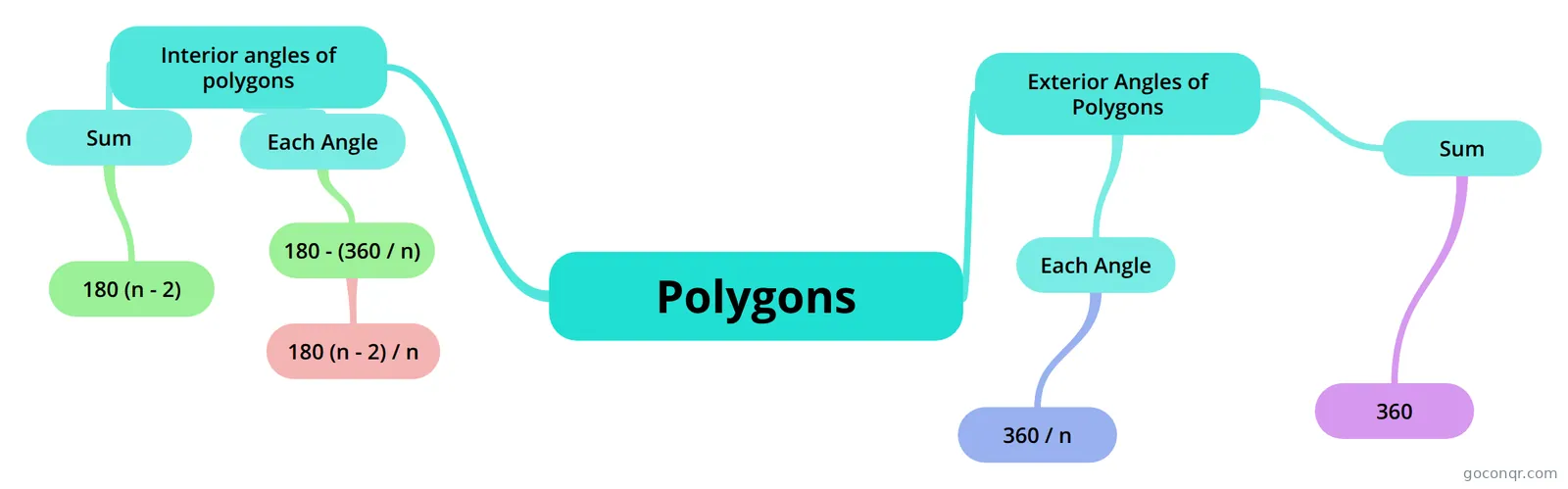
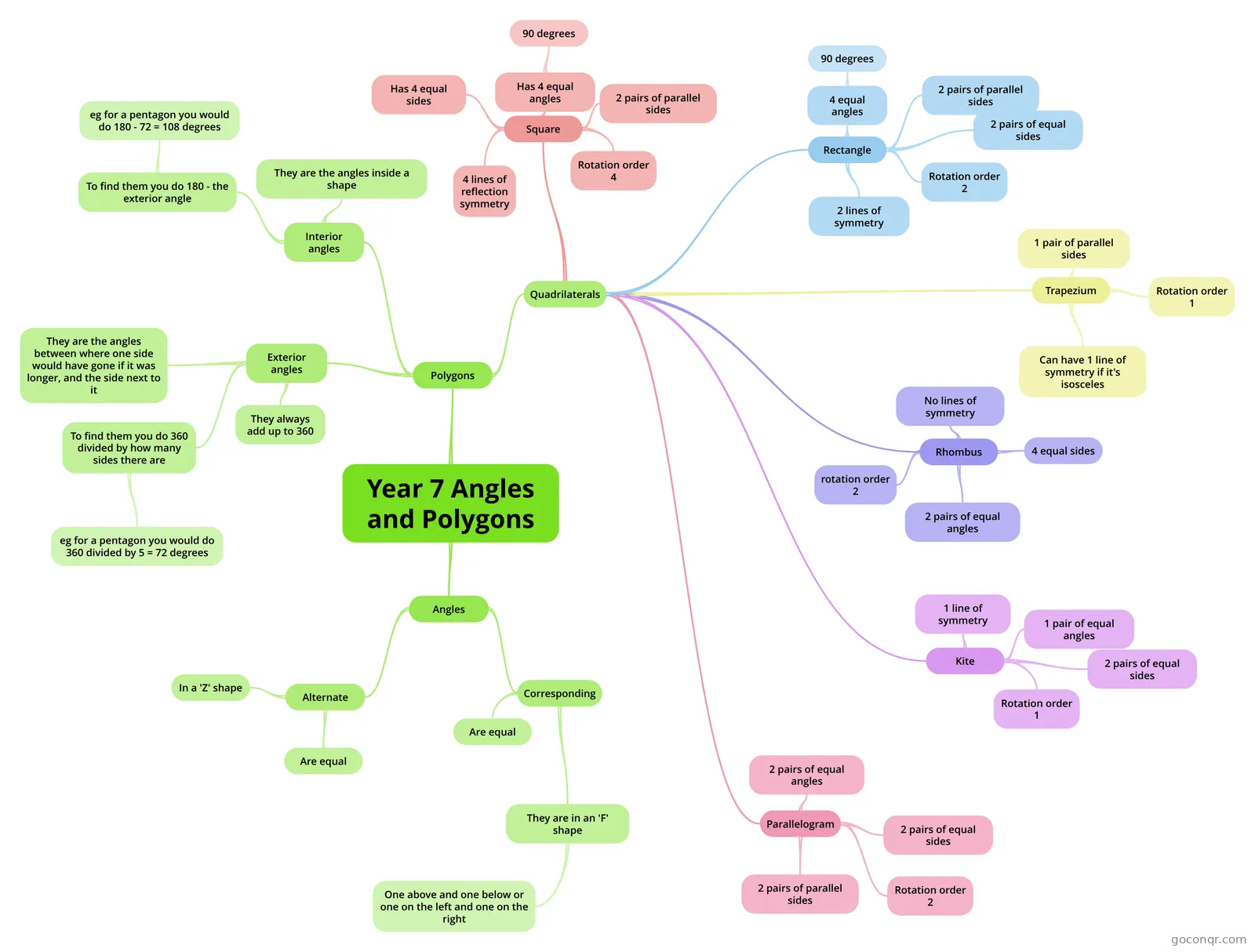
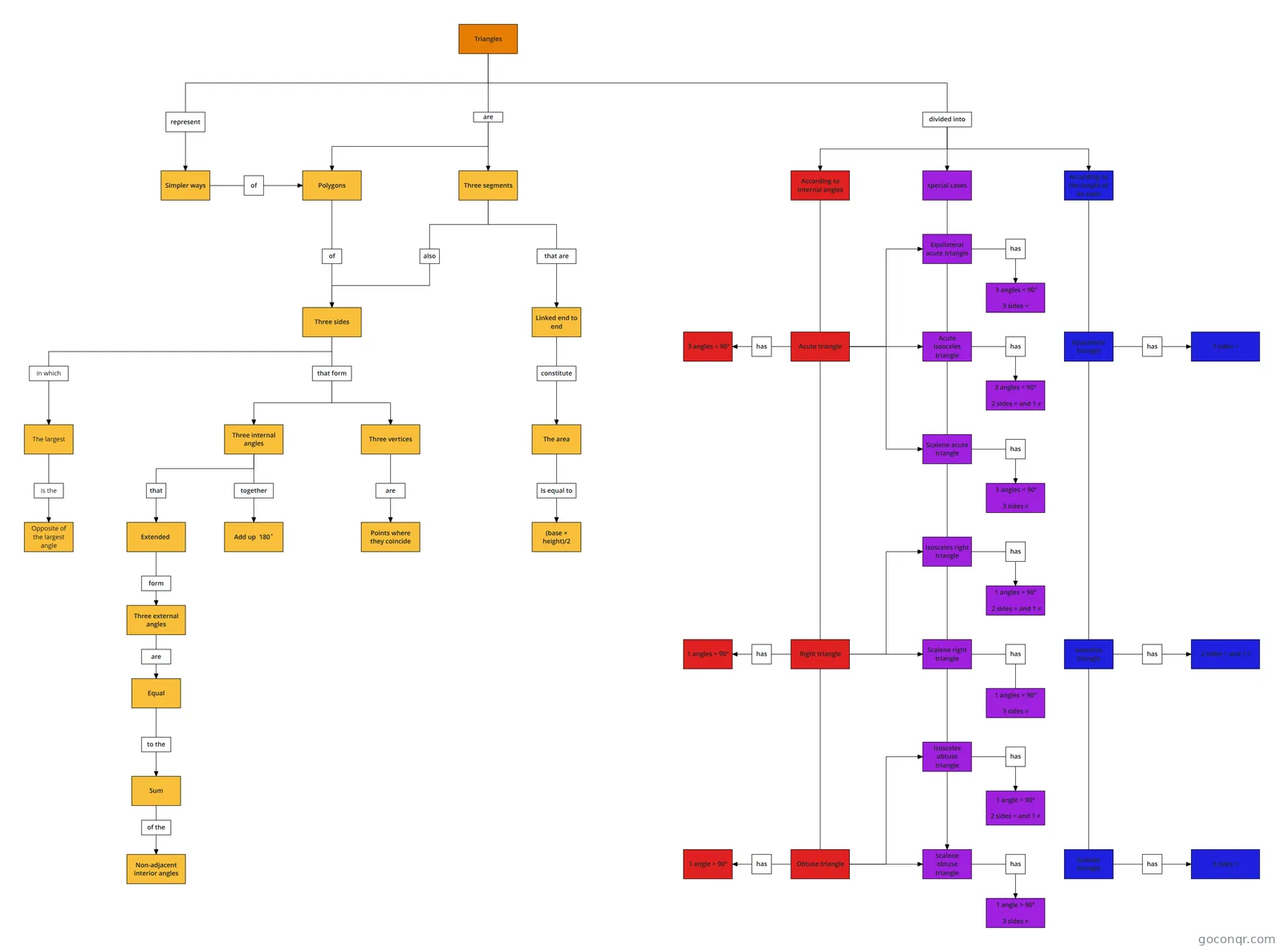
They cover angles, polygons, triangles, 3D shapes, circle theorems, similarity and congruency, Pythagoras, and area, volume and perimeter. Circle Geometry, for example, branches into chords, cyclic quadrilaterals, tangents and intersecting secants, so you can see how the ideas connect.
Are the resources free to use?
Yes. Every resource listed here is free to open, study and take, with no account needed. They were made by GoConqr users, not by GoConqr itself, so styles and depth vary from one item to the next.
Which exams do these resources suit?
Most resources are aimed at secondary school. Listed items mention GCSE Maths, Edexcel IGCSE Maths, Geometry Regents, ACT and GMAT. Check each quiz or deck title and excerpt to see whether it fits the course you are taking.
What if I cannot find the topic I need?
Browse by format, since a topic may appear as a mind map, a deck or notes under a different title. A free account also lets you make your own quizzes, mind maps, flashcards and notes, so you can fill any gap yourself.
Can teachers use these in lessons?
Yes. Teachers can use the quizzes as quick checks, the slide sets for explanations and the mind maps as revision summaries. Look over each item first, because community-made material varies in level and style.