
Fichas
52- WK5 Flashcards (Midterm)
Fichas del conjunto (100)
- 1Natural distribution"Where and how
hair is moved over the head, when locating the bang area," (390). - 2Neck StripA strip of paper is used as a barrier between the client and the cape.
Is also used to test hot tools.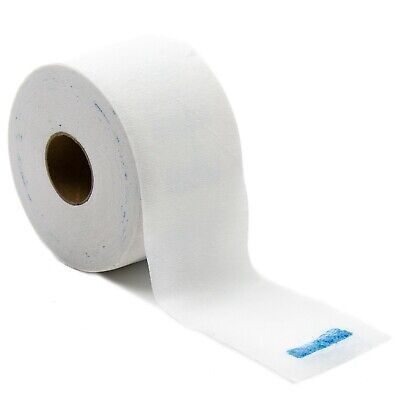
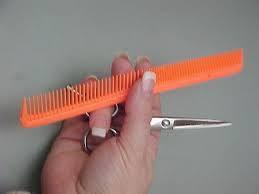
- 3Palming the shears"Remove your thumb from the thumb grip, leaving your ring and little fingers in the grip and finger rest. Curl your fingers in to palm the shears, which keeps them closed while you comb or part the hair," (378.)
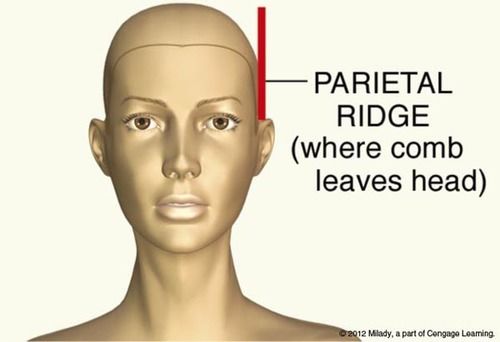
- 4Parietal ridge"Widest area of the head, usually starting at the temples and ending at the bottom of the crown," (440).
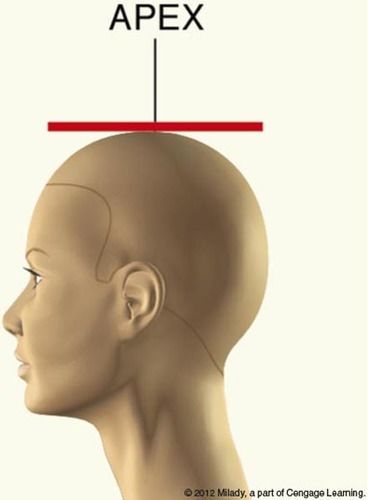
- 5Apex"Highest point on the top of the head," (438).
- 6Tension"Amount of pressure applied when combing and holding a section, created
by stretching or pulling the section," (441). - 7Below 90 degreesThis will build weight.
- 8GraduatedHair cut using 45° to 90° angles.
- 9Hair densityThe total number of hair on the head. Usually about 100,000.
- 10Stationary guidelineA guideline that does not move.
- 11Angle"Space between two lines or surfaces that intersect at a given point," (438).
- 12DegreesGraduation of hair is described in degrees.
- 13Angels"Space between two lines or surfaces
that intersect at a given point," (361). - 14Bang or fringe"Also known as fringe area:
a triangular section that begins at
the apex, or high point of the
head, and ends at the front corners," (316).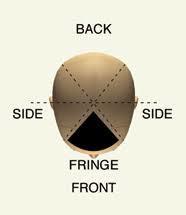
- 15Growth patterns"Direction in which the hair
grows from the scalp; also referred
to as natural fall or natural falling
position," (1112). - 16Traveling guideline"Also known as a movable guideline; guideline that moves as the haircutting progresses, used often when creating layers or graduation," (1127.)
- 17Gravity"Hair that grows below the parietal ridge, or crest, hangs because of gravity," (360).
- 18Back and forth motionsBlow dryer back and forth to prevent burning.
- 19Scalp astringent lotions"Product used to remove oil accumulation from the scalp; used after a scalp treatment and before styling," (1123).
- 20Protein conditioners"Product designed to penetrate the cortex and reinforce the hair shaft from within," (1122).
- 21Color enhancing shampoos"used to brighten, to add a slight hint of color, and to eliminate unwanted color
tones, such as gold or brassiness and overly cool strands," (334). - 22Neutralizing shampoo"designed to re-balance the pH level of your hair by neutralizing any alkali and unwanted residues in the hair," (334).
- 23Dry shampoo"also known as powder shampoo, which cleanses the hair without the use of soap
and water," (333). - 24Non strippingconditioning shampoo
Does not remove the color from the hair. - 25Oil attracting"A surfactant molecule has two ends: a hydrophilic or water-attracting head and a lipophilic or oil-attracting tail," (330).
- 26Primary surfactant"The second ingredient that most shampoos have in common is the
primary surfactant (or base detergent)," (330). - 27Deionized water (DEE-eye-on-ized WAHter)"Water that has had impurities, such as calcium and magnesium and
other metal ions that would make a product unstable, removed," (330). - 28Soft or hard water"rainwater or chemically softened water that contains only small amounts of minerals and, therefore, allows soap and shampoo to lather freely," (330).
- 29DistillationRemoval of minerals
- 30Filtration"Fresh water from lakes and streams is purified by sedimentation (matter sinking to the bottom) and filtration (water passing through a porous substance, such as a filter paper or charcoal) to remove suspended clay, sand, and organic material," (330).
- 31Universal solventWater
- 32Scalp steamer"Resembles a hooded dryer,
can be used to help resolve the moisture balance in the hair," (325). - 33Hair and scalp examination"hair or scalp treatment should be recommended only after a hair and scalp examination," (325).
- 34Cleanliness and stimulation"Two basic requirements for a healthy scalp," (323).
- 35Harmony"The creation of unity in a design;
the most important of the art
principles. Holds all the elements of
the design together," (1113). - 36Rhythm"Regular pulsation or recurrent
pattern of movement in a design," (1123). - 37Symmetrical balance"two halves of a style;
form a mirror image of one another," (1126). - 38Balance"establishing equal or appropriate
proportions to create symmetry. In
hairstyling, it is the relationship of
height to width," (1104). - 39Haircolor"(one word) a professional,
industry-coined term referring to
artificial haircolor products and
services," (1112). - 40Keratin"fibrous protein of cells that is also
the principle component of hair and
nails," (1115). - 41Curly hair"Curly hair is more coiled and often grows more compact together. Curly hair will reflect less light and can create a larger form than straight or wavy hair," (300).
- 42Design Texture"wave patterns that must
be taken into consideration when
designing a style," (1109). - 43Transitional lines"Usually curved lines that are used to blend and soften horizontal or vertical lines," (319).
- 4490-degree angle"Contrasting lines are horizontal and vertical lines that meet at a
90-degree angle," (299). - 45Vertical line"create length and height in hair design," (298).
- 46Furuncle"boil; acute, localized bacterial
infection of the hair follicle that
produces constant pain," (1112). - 47Pityriasis steatoides"A severe case of dandruff
characterized by an accumulation
of greasy or waxy scales mixed with
sebum that sticks to the scalp in
crusts," (1121). - 48Pityriasis"The technical term for dandruff;
characterized by excessive
production and accumulation of skin
cells," (1121). - 49Fragilitas crinium (fruh-JIL-ih-tus KRI-nee-um)brittle hair
- 50Hypertrichosis (hi-pur-trih-KOH-sis)hirsuties (hur-SOO-shee-eez)
abnormal hair growth - 51Postpartum alopeciaHair lost after baby.
- 52Alopecia UniversalisTotal hair loss
- 53AnagenThe first phase of hair growth
- 54TelogenLast stage or resting phase of hair growth.
- 55CatagenThe transition phase of hair growth.
- 56Wave pattern"The shape of the hair strands; described as straight, wavy, curly, and
extremely curly," (251). - 57Disulfide bonds"Strong chemical side bond that joins the sulfur atoms of two neighboring cysteine amino acids to create one cystine, which joins together two polypeptide strands like rungs on a ladder," (249).
- 58Salt bonds"A weak, physical, cross-link side bond between adjacent polypeptide
chains," (251). - 59Amino acids"Units that are joined together end-to-end like pop beads by strong,
chemical peptide bonds (end bonds) to form the polypeptide chains that
comprise proteins," (248). - 60Arrector piliGoosebumps
- 61Hair bulbClub-shaped, lowest part.
- 62TrichosThe Greek word for trichology.
- 63Antiseptics"Are chemical germicides formulated for use on skin and are registered and regulated by the," (93).
- 64Asymmetrical balance"Established when
the two imaginary halves of a hairstyle have equal visual weight, but
are positioned unevenly," (304). - 65MelaninPigment
- 66EumelaninDark pigment
- 67Pheomelaninlight pigment
- 68Efficacyto product effect
- 69Viscositythick or thinness of a liquid
- 70Hepatitisblood borne, damage liver
- 71Impetigo"Contagious bacterial skin infection characterized by weeping lesions;
usually caused by a staphylococcus bacteria," (193). - 72Protoplasm"A colorless, jelly-like substance
found inside cells in which food
elements such as proteins, fats,
carbohydrates, mineral salts, and
water are present," (1122). - 73CocciRound bacteria
- 74Nonpathogenic bacteria"Harmless microorganisms that may perform useful functions and are safe
to come in contact with since they do not cause disease or harm," (110). - 75Cleaningthe mechanical process to scrub.
- 76Infection"The invasion of body tissues by disease-causing pathogens," (109).
- 77Environmental protection agency (EPA)regulates disinfectants
- 78Safety data sheet (SDS)16 categories of info
- 79CuticleDead skin on the nail plate.
- 80Cortexmiddle layer
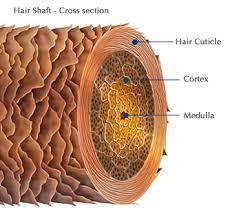
- 81Medullainner layer of round cells
- 82Reference pointsFour corners
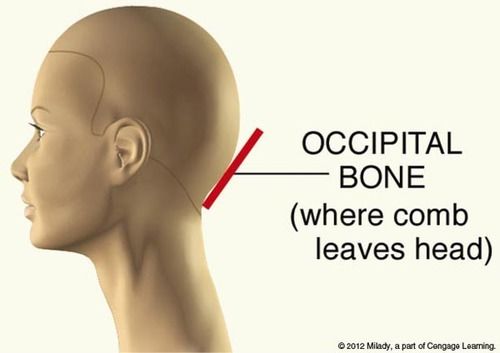
- 83Occipital bonefound at the back of the head.
- 84Weight linewhere the hair falls together
- 85Nape"back part of the neck; the hair below
the occipital bone," (1118).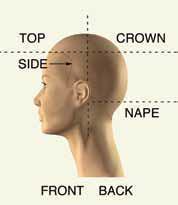
- 86Crown"area of the head between the apex
and back of the parietal ridge," (1108). - 87Cutting line"angle at which the fingers are
held when cutting, and, ultimately,
the line that is cut; also known as
finger angle, finger position, cutting
position, cutting angle," (1108). - 88Elevationprojection or lifting
- 89Effilatingslithering
- 90Head formshape
- 91Cross-checkingchecking hair from opposite as it was cut
- 92Design Texture"the directional wave patterns or illusion of motion in the hair," (300).
- 93Convex profileReceding forehead and chin
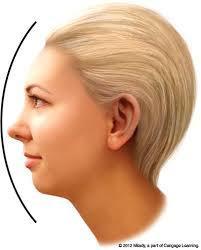
- 94Concave profileprominent forehead and chin
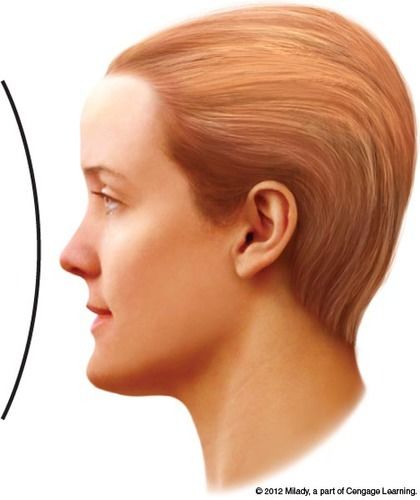
- 95Vellus hairlanugo, soft hair
- 96Canitiesgray hair
- 97Trichoptilosissplit ends
- 98Malassezia"naturally occurring
fungus that is present on all human skin but causes the symptoms of
dandruff when it grows out of control," (239). - 99Monileththrixbeaded hair
- 100Tinearingworm
Información
- Descripción
- Milady Standard Cosmetology. Milady/Cengage Learning, 2016.
- Creado por
- Tricia Wilson · ago 2022
- Actualizado
- 1 sep 2022
- Visitas
- 5
- Valoración