
Apuntes
Chemistry Revision
Contenido del apunte (1)
Página 1
Atomic Structure And The Periodic Table
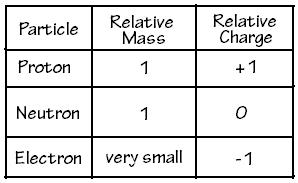
Electrons - Negative Charge - Atomic Mass 0
Protons - Positive Charge - Atomic Mass +1
Neutrons - No Charge - Atomic Mass +1
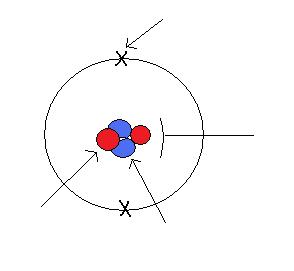
Elctrons
Nucleas
Protons
Neutrons
24
Mg
12
Atomic mass
(Protons And Neutrons)
Atomic Number
(Number of Protons)
= Number of Elctrons
The symbol for relative Atomic Mass is Ar
Looking At Chlorine
35.5
Cl
17
Cl - 35 = 75%
Cl - 37 = 25%
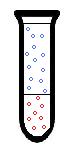
Relative Atomic Mass
% x Ar % x Ar
(75 x 35) + (25 x 37)
75 + 25
Ionic Bonding
Salt = Sodium and Chlorine
(Na) (Cl)
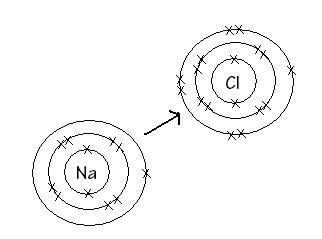
Sodium give
Chlorine an
Electron
(Cation)
(Anion)
A
An Ion is an atom or group of atoms with a positive or negative charge, because they have gained or lost electrons.
I
Ionic Compunds
Al2 O3 -Aluminium Oxide
Al3+ O2-
Al3+ O2-
Al3+ O2-
Al3+ O2-
Al2 O3
Compound Ions contains more than one element. For example, the nitrate ion, NO3- contains one nitrogen atom joined to three oxygen atoms and an extra electron. If two or more compound ions of the same type are needed in a formula, the ions of the same type are needed in a formula, the ion must be written inside brackets. For Example, the formula of Magnesium Nitrate is Mg(NO3)2. This shows that the two positive charges in one Mg2 ion are balanced by two negative charges from two NO3 ions.
Ionic Substances
Solid -Doesn't conduct electricity
Molten Liquid - Does Conduct electricity
Dissolved in Water - Does conduct electricity
2 Conditions for Electrolysis:
It must contain charged particles
Must be free to move
Simple Molecular Covalent Substances
Low Melting Points
Low Boiling points
Poor Conductors of Electricity
Includes gases, such as hydrogen and oxygen
Weak Bonds
Giant Molecular Covalent Substances
Billions of atoms joined together
High Melting Point
High Boiling Point
Strong bonds
Giant Molecular Structure
Conduct Electricity
Halogens
The
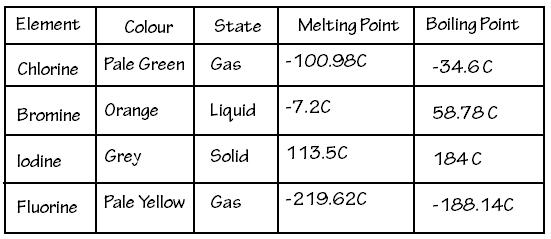
The halogens or halogen elements are a group in the periodic table. Consisting of five chemically related elements - Fluorine, chlorine, iodine, bromine and astatine.
Chlorine's Reaction With Metals
Chlorine combines directly with all metals forming metal chloride salts.
Bromine's Reaction With Metals
Bromine reacts vigorously with metals, especially in the presence of water, to give Bromide Salts.
Iodine's Reaction With Metals
When A small quantity of powdered aluminium is mixed with some iodine crystals and a few drops of water are added, a reaction happens, producing purple iodine vapor and flame. Aluminium iodine is the product.
Metallic Bonding
The useful properties of metals include malleability and the ability to conduct electricity
Transition Metals
Are found in the middle of the periodic table
Are all solids at room temperature (Except Mercury)
Are usually malleable
Examples are iron, silver and titanium
Usually have high melting points
Are usually good conductors of electricity
Usually ductile
Usually dense
Have lots of uses
Are usually strong
Noble Gases
The Noble gases are in group 0 of the periodic table
It is difficult to make them react with anything
All have full outer electron shells
Xenon and Argon were formerly used inside filament lamps
Argon and Helium are used in welding
Argon is used in fire-extinguishers
Helium had a low density and so is used in balloons and airships
Neon is used in florescent lamps and advertising displays
Exothermic and Endothermic Reactions
When a chemical reaction takes place there is often an energy transfer between the reactants and the surroundings. If the energy transfer is in the from of heat energy then there is a change in temperature.
Exothermic changes give out heat energy. Most chemical reactions are exothermic the head energy given out causes the temperature of the reaction mixture and its surroundings to increase.
Endothermic changes take in heat energy from the surroundings, so the temperature of the surroundings decreases. Not many chemical reactions are endothermic.
Catalysts
Catalysts are used to speed up a reaction to increase the rate at which a product is made or to make a process cheaper. They are not normally used up in a reaction.
Quantitative Chemistry
Relative Formula Mass (Mr)
The Relative formula mass of a compound is the relative atomic masses of all the elements in the compound added together.
Empirical Formula
Empirical Formula is simply a way of showing how many atoms are in a molecule.
A
A Classic EXAM Question - Find the simplest formula of 2.24g of iron reacting with 0.96g of oxygen
Step 1 - Divide both masses by their relative atomic mass
Iron 2.24/56 = 0.04
Oxygen 0.96/16 = 0.06
S
Step 2 - Write this as a ratio and simplify
0.04 : 0.06 is equivalent to 2:3
Step 3 - Write the formula
2 iron atoms for 3 oxygen atoms means the formula is Fe2O3
Calculating Percentage Mass
Practice EXAM Question - Calculate the percentage mass of magnesium in magnesium Oxide (MgO)
Ar for Magnesium = 24
Ar for Oxygen = 16
Mr for Magnesium Oxide = 24 + 16 =40
Percentage Mass = 24/40 x 100 = 60% of Magnesium Oxide is Magnesium
Calculating the Mass of a Product
Step 1 - Read the equation
2mg + O2 ----> 2MgO
Step 2 - Work out the relative formula masses
2Mg + O2 ----> 2MgO
48 + 32 ----> 80
Step 3 - Learn and Apply the following three points
1) 48kg of Mg makes 80g of MgO
2) 1g of Mg makes 80/48 = 1.66g of MgO
3) 60g of Mg makes 1.66 x 60 = 100g of MgO
Percentage Yield
Theoretical Yield - The amount of product that should be made as calculated from the masses of atoms.
Actual Yield - What was actually produced in the reaction
Percentage Yield = Actual Yield (in grams)
Theoretical Yield
Practice EXAM Question - 65g of Zinc reacts with 73g of hydrochloric acid and produces 102g of Zinc Chloride. What is the percentage yield?
Zn + 2HCl ----> ZnCl2 + H2
102/138 = 73.9%
Subatomic Particles
Atoms are made from three types of subatomic particle. The Nucleus Contains protons and Neutrons. Subatomic particles have very, very small masses and electrical charges.
Atoms and Elements
Every atom of a particular element has the same number of protons. No two elements have the same number of protons, all atoms contain the same number of protons as electrons.
Isotopes
Isotopes are different atoms of an element with the same number of protons and electrons but different numbers of neutrons.
Electron Shells
Electrons are arranged in shells around the nucleus of the atom.
Different shells can contain different numbers of electrons. The first shell can hold up to two electrons, the second and third shells can hold up to 8 electrons.
Spotting Connections
There are several connections between an elements electronic configuration and where it is found in the periodic table. The number of occupied shells is the same as the period number, apart from the elements in group 0, which all have full outer shells, the number of outer electrons is the same as the group number.
New Page
Información
- Descripción
- GCSE (Chemistry) Science Apunte sobre Chemistry Revision, creado por lisharding el 06/01/2014.
- Creado por
- lisharding · ene 2014
- Actualizado
- 23 feb 2016
- Visitas
- 143
- Etiquetas
- Valoración