
Fichas
All math revision
Fichas del conjunto (87)
- 1direct proportion If two quantities are in direct proportion, as one increases, the other increases by the same percentage. If y is directly proportional to x, this can be written as y ∝ xIf y is directly proportional to x.
When x = 12 then y = 3
Find the constant of proportionality and the value of x when y = 8.
We know that y is proportional to x so y = kx
We also know that when x = 12 then y = 3
To find the value of k substitute the values y = 3 and x = 12 into y = kx
3 = k × 12
So k = 3/12 = 1/4
To find the value of x , when y = 8 substitute y = 8 and k = 1/4 into y = kx
8 = (1/4) x
So x = 32 when y = 8 - 2indirect proportion Inverse proportion is when one value increases as the other value decreases.y is inversely proportional to x. When y = 3, x = 12 .
Find the constant of proportionality, and the value of x when y = 8.
y ∝ 1/x
y = k/x
So xy = k
Substitute the values x = 12 and y = 3 into xy = k
3 × 12 = 36
So k = 36
To find the value of x when y = 8, substitute k = 36 and y = 8 into xy = k
8x = 36
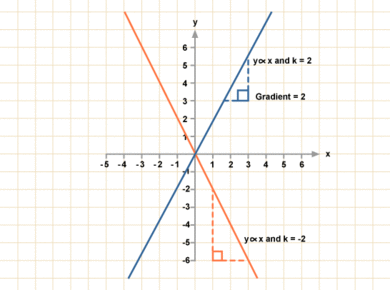
So x = 4.5 - 3Straight line y ∝ x y = kx This equation gives us a straight line. The gradient of the line is k.
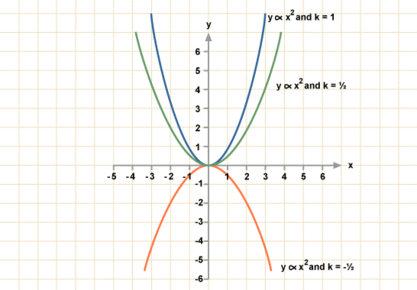
- 4Quadratic y ∝ x2 y = kx2 This equation gives us a curve. The larger the value of k, the steeper the graph.
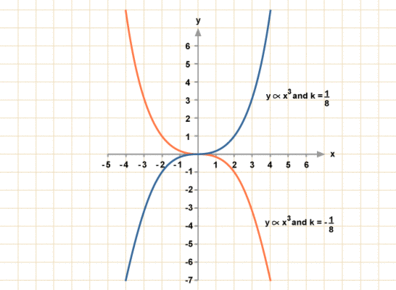
- 5Cubic y ∝ x3 y = kx3
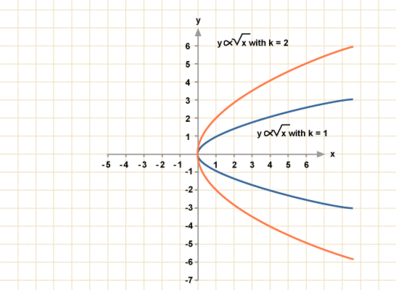
- 6Square root y ∝square root of x y = ksquare root of x You have similar shaped curves for any powers between 0 and 1. Again, increasing k will make the graph steeper.
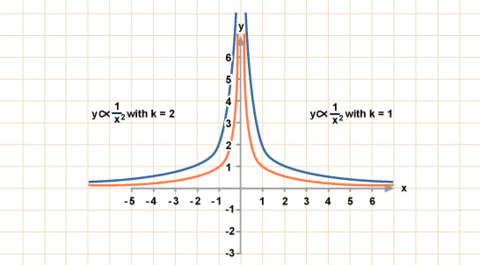
- 7Inverse proportion y ∝ 1/x ² y = k/x ² Inverse proportion leads to curved graphs.
- 8surds square root of ab = square root of a x square root of b square root of a x square root of a = aSimplify square root of 12 over square root of 6
Answer
square root of 12 over square root of 6
= square root of 12 over 6
(in general square root of a over square root of b = square root of a over b)
square root of 2 - 9equations with fractionsHow do we solve the equation x/2 − 4 = 3?
One way is to multiply everything by 2:
x/2 − 4 = 3
x - 8 = 6
x = 14
Or, alternatively, add 4 and then multiply both sides by 2:
x/2 − 4 = 3
x/2 = 7
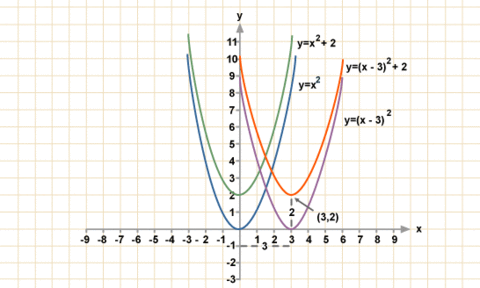
x = 14 - 10graph transformations f(x) + a [0/a] f(+ ) = left f(x- ) = right 2f(x) = y coordinates x 2 -f(x) = reflection of f(x) f(2x) = 1/2 x coordinate
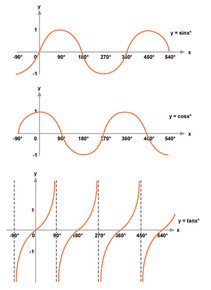
- 11sin cos tan graphs
- 12factorising( x + 2 ) ( x + 5 ) = x2 + 7x + 10
( x + 2 ) ( x + 3 ) = x2 + 5x + 6
( x - 3 ) ( x - 5 ) = x 2 - 8x + 15
( x + 6 ) ( x - 5 ) = x2 + x - 30
( x - 6 ) ( x + 5 ) = x2 - x - 30 - 13quadratic equations To solve a quadratic equation, the first step is to write it in the form: ax2 + bx + c = 0. Then factorise the equationSolve the equation: x2 - 9x + 20 = 0
Solution
First, factorise the quadratic equation x2- 9x + 20 = 0
Find two numbers which add up to 9 and multiply to give 20. These numbers are 4 and 5.
(x - 4) (x - 5) = 0
Now find the value x so that when these brackets are multiplied together the answer is 0.
This means either (x - 4) = 0 or (x - 5) = 0
So x = 4 or x = 5.
You can check these answers by substitutuing 4 and 5 in to the equation:
x2- 9x + 20
Substituting 4 gives:
42 - 9 × 4 + 20 = 16 - 36 + 20 = 0
Substituting 5 gives:
52 - 9 × 5 + 20 = 25 - 45 + 20 = 0 - 14completing the square This is another way to solve a quadratic equation if the equation will not factorise. It is often convenient to write an algebraic expression as a square plus another term. The other term is found by dividing the coefficient of x by 2, and squaring it.Rewrite x2 + 6x as a square plus another term.
The coeffient of x is 6. Dividing 6 by 2 and squaring it gives 9.
x2 + 6x = (x2 + 6x + 9) - 9
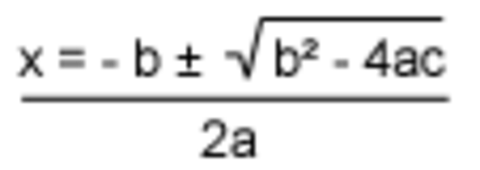
= (x + 3)2 - 9 - 15quadratic formula Solve 2x2 - 5x - 6 = 0 Here a = 2, b = -5, c = -6
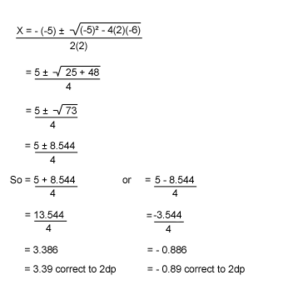
- 16the quadratic formula
- 17—To find the area of the large triangle, you will need to first find the linear/length scale factor as the Step 1. In general to find the scale factor we divide the large quantity with the small quantity.
Scale factor = BIG/SMALL
=6/4
=1.5
Then Step 2 we would find the Area scale factor by squaring the linear scale factor;
ASF = LSF2
=1.52 = 2.25
Step 3 we would multiple the area scale factor with the small area to find the area for the large triangle.
Area = 12 x 2.25
= 27cm2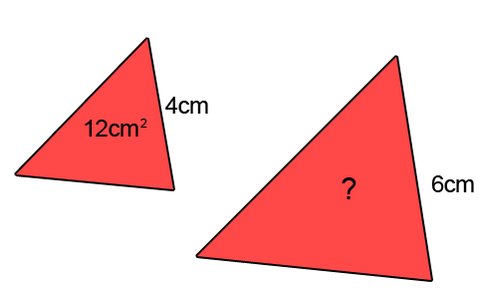
- 18A taxi firm charges £0.50 per mile plus a fixed charge of £2.00. Write down a formula for the cost (C) of hiring this taxi to travel 'n' miles.Solution
It costs £2 + £0.50 to travel 1 mile.
It costs £2 + 2 x £0.50 to travel 2 miles.
It costs £2 + 3 x £0.50 to travel 3 miles.
So travelling for 'n' miles will cost £2 + n x £0.50.
The formula is C = £2 + (n x £0.50). - 19Collecting like terms To simplify an expression, we collect like terms. Look at the expression: 4x + 5x -2 - 2x + 7To simplify:
The x terms can be collected together to give 7x.
The numbers can be collected together to give 5.
So 4x + 5x -2 - 2x + 7 simplified is 7x + 5. - 20(2x + 5) squared(2x + 5) (2x + 5) = 4x squared + 20x + 25
- 21multiplying out brackets Multiply out: 3(4x - 7)First multiply: 3 × 4x = 12x
Then multiply: 3 × -7 = - 21
Therefore: 3(4x - 7) = 12x - 21 - 22multiplying out negatives Multiply out the expression: -3(2n - 8)First, multiply -3 × 2n = - 6n
Then multiply -3 × -8 = 24
-6n + 24
Therefore, -3(2n - 8) = - 6n + 24 - 23multiplying out 2 brackets Multiply out these two brackets: (x + 4) (x + 3)Multiply everything in the first bracket by the second bracket:
x (x + 3) + 4 (x + 3)
= x2 + 3x + 4x + 12
= x2 + 7x + 12 - 24FOIL first outer inner last(n + 4) (n + 4)
F n squared
O 4n
I 4n
L 16
n squared + 8n + 16 - 25proof prove (3n + 1) squared - (3n - 1) squared is a multiple of 6(3n + 1) (3n + 1) = 9n squared + 6n + 1
(3n -1) (3n -1) = 9n squared - 6n + 1
= 12n divided by 6 = 2n
its true - 26Index notation: used to represent powersa2 means a × a and here the index is 2
b3 means b × b × b and here the index is 3
c4 means c × c × c × c and here the index is 4
etc.
When there is a number in front of the variable:
4d2 means 4 × d × d
2e3 means 2 × e × e × e - 27index multiplying and dividingp^3 × p^7 = p^10, and s^5 ÷ s^3 = s^2
- 28solving equationsx - 6 + 6 = 9 + 6
x = 15 - 29solving inverse equations Here is how to solve 2a + 3 = 7 using inverses.2a + 3 = 7
Undo the + 3 by subtracting 3
2a + 3 - 3 = 7 - 3
2a = 4
Then undo the multiply by 2 by dividing by 2 - again on both sides
2a ÷ 2 = 4 ÷ 2
The answer is: a = 2 - 30unknowns on both sides of the equation Solve the equation 3b + 4 = b + 12, and find the value of b.Answer
First, you need to get all the b terms on the same side of the equation.
Subtract b from both sides.
3b - b + 4 = 12
Then simplify.
2b + 4 = 12
Subtract 4 from both sides.
2b = 8
To find the value of b, divide both sides by 2.
b = 4 - 31equations with brackets Solve the equation: 3(b + 2) = 153(b + 2) = 15
Multiply out the brackets. Remember, everything inside the brackets gets multiplied by 3.
3 × b + 3 × 2 = 15
When you have multiplied out the brackets you get: 3b + 6 = 15
Next, undo the + 6. In other words, do the inverse and subtract 6 from both sides.
3b + 6 - 6 = 15 - 6
So 3b = 9 - 32trial and improvement Find the answer to the equation x3 – 2x = 25 to one decimal place.First we'll try: x = 3
33 - (2 x 3)
3 x 3 x 3 - (2 x 3)
27 - 6
= 21; too small
even if the answer is to 1 decimal place, trial an answer with more than 1 decimal place - 33simultaneous equationsSolve these simultaneous equations and find the values of x and y.
Equation 1: 2x + y = 7
Equation 2: 3x - y = 8
Add the two equations to eliminate the ys:
2x + y = 7
3x - y = 8
------------
5x = 15
x = 3
Now you can put x = 3 in either of the equations.
Substitute x = 3 into the equation 2x + y = 7:
6 + y = 7
y = 1
So the answers are x = 3 and y = 1 - 34solving inequalities Solve the expression 3x - 7 < 83x - 7 < 8
Then add 7 to both sides, to cancel out the -7:
3x < 15
Next, simplify the inequality by dividing both sides by the number in front of x - in this case 3.
x < 5 - 35double inequalities Solve the inequality -4 < 2x - 6 < 12Add 6 to all parts: 2 < 2x < 18
Divide all parts by 2: 1 < x < 9 - 36equations for a straight line graph can containan x term,
a y term,
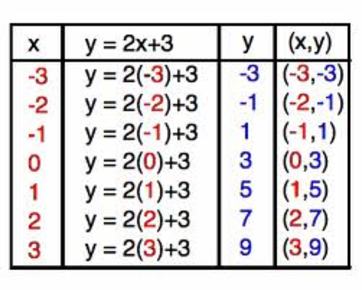
and a number - 37tables for graph plotting
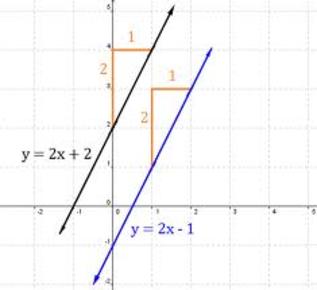
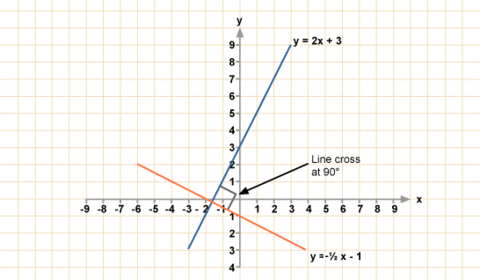
- 38On a graph, parallel lines have the same gradient. For example, y = 2x + 3 and y = 2x - 4 are parallel because they both have a gradient of 2.
- 39the lines y = 2x + 3 and y = -1/2 x -1 cross at right angles
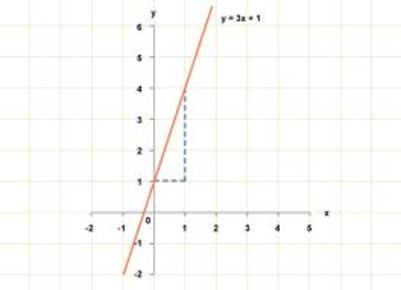
- 40y = mx + c m = gradient c = y intercept
- 41cubic graphsy = x^3
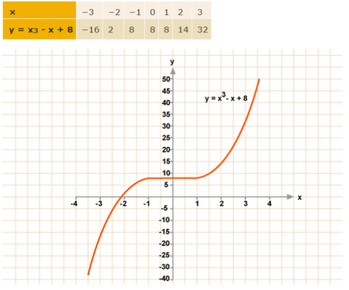
- 42Calculate the points and then plot the graph for the equation y = x3 - x + 8
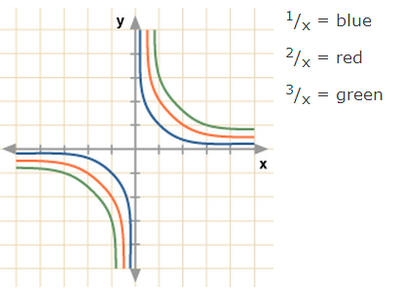
- 43reciprocal graphs Graphs of the form y = 1/x, 2/x, 3/x
- 44quadratic sequences If the difference between the terms changes, this is called a quadratic sequence. If you use the formula n^2 + n to make a sequence, it means that: When n = 1 you get 1^2 + 1 = 2 When n = 2 you get 2^2 + 2 = 6 When n = 3 you get 3^2 + 3 = 12 When n = 4 you get 4^2 + 4 = 20 - giving the sequence 2, 6, 12, 20.

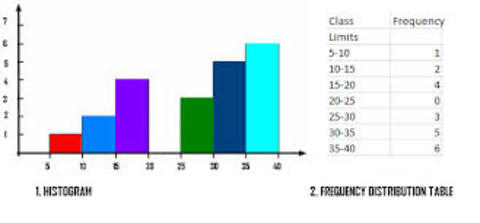
- 45histograms frequency density = frequency / class width
- 46frequency tables finding the mean and medianmean = add all (midpoint x frequency) then divide by total frequency
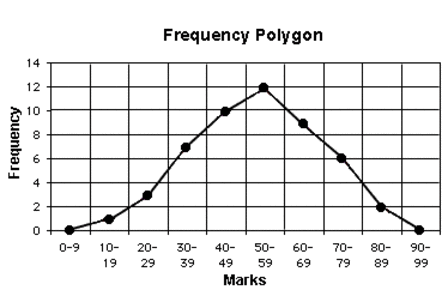
median = total frequency + 1 divided by 2 - 47frequency polygons dot in midpoint
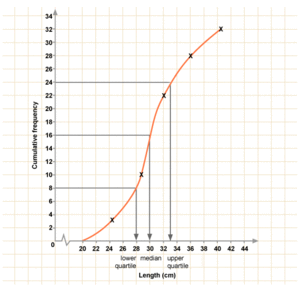
- 48median upper quartile lower quartile and interquartile range of frequencymedian = frequency + 1 divided by 2
lower quartile = half median
upper quartile = median + LQ
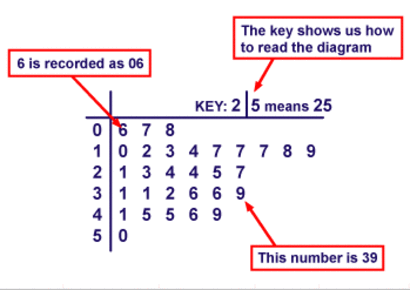
interquartile range = UQ - LQ - 49stem and leaf diagram
- 50—
- 51box plots
- 52—The probability of three heads is:
P (H H H) = 1/2 × 1/2 × 1/2 = 1/8
P (2 Heads and a Tail) = P (H H T) + P (H T H) + P (T H H)
= 1/2 × 1/2 × 1/2 + 1/2 × 1/2 × 1/2 + 1/2 × 1/2 × 1/2
= 1/8 + 1/8 + 1/8
= 3/8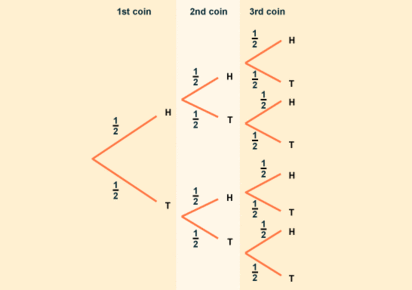
- 53Amit is 12 years old. His brother, Arun, is 9. Their grandfather gives them £140, which is to be divided between them in the ratio of their ages. How much does each of them get?The ratio of their ages is 12:9.
We can simplify this. Dividing by 3 gives 4:3.
So Amit gets 4 parts, and Arun gets 3.
This means that the money has to be divided into 7 parts (4 + 3).
£140 ÷ 7 = £20, so 1 part is £20.
Amit gets 4 parts: 4 × £20 = £80.
Arun gets 3 parts: 3 × £20 = £60. - 54standard form15 000 000 = 1.5 × 10 000 000
This can be rewritten as:
1.5 × 10 × 10 × 10 × 10 × 10 × 10 × 10
= 1. 5 × 10^7 - 55adding and subtracting standard form4.5 × 10^4 + 6.45 × 10^5
= 45,000 + 645,000
= 690,000
= 6.9 × 10^5 - 56multiplying and dividing standard formTo multiply powers you add, eg, 10^5 × 10^3 = 10^8
To divide powers you subtract, eg, 10^5 ÷ 10^3 = 10^2 - 57parts of a circle
- 58circumference of a circlepi x diameter
- 59area of a circlepi x (radius squared)
- 60area of a semi circlepi x (radius squared) divided by 2
- 61perimeter of a semi circle(pi x radius) + (2 x radius)
- 62circle theorems
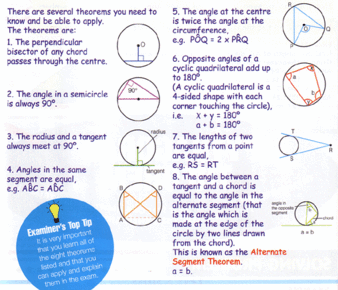
- 63angle at the centre of a circle
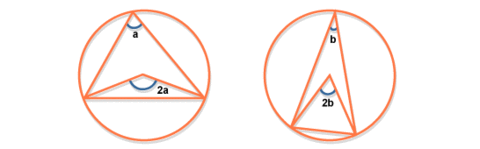
- 64angles in the same segment are equal
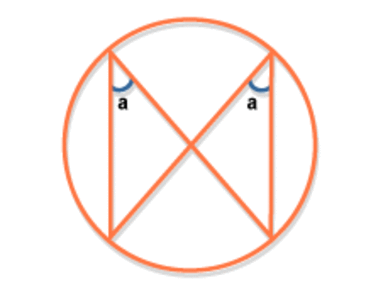
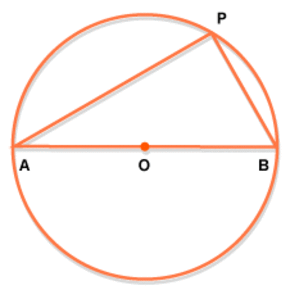
- 65angles in a semi circle are 90 degrees The angle at the centre (AOB) is twice the angle at the circumference (APB). As AOB is 180°, it follows that APB is 90°
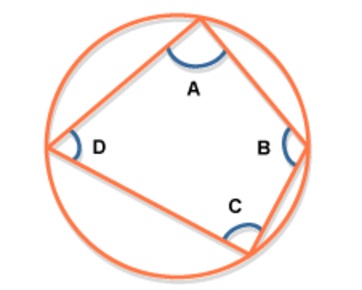
- 66Opposite angles in a cyclic quadrilateral add up to 180° A cyclic quadrilateral is a quadrilateral whose vertices all touch the circumference of a circle. The opposite angles add up to 180o. In the cyclic quadrilateral below, angles A + C = 180o, and angles B + D = 180o
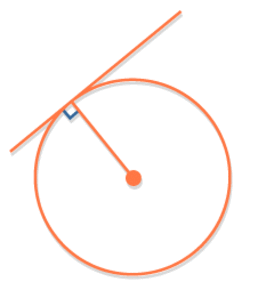
- 67The angle between the tangent and radius is 90° A tangent to a circle is a line which just touches the circle.
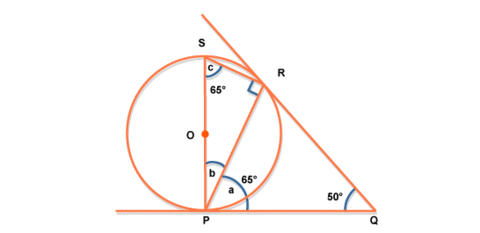
- 68difficult circle theorem
- 69quadrilateral has been divided into two triangles, so the interior angles add up to 2 × 180 = 360°.pentagon has been divided into three triangles, so the interior angles add up to 3 × 180 = 540°
- 70interior angles of polygonsInterior angle of a regular polygon = sum of interior angles ÷ number of sides
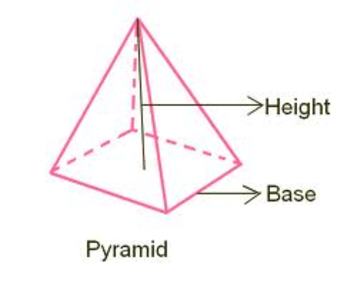
- 71The volume of a pyramid is: 1/3 × base area × perpendicular height The surface area of a pyramid is the area of the base + the area of all the other sides.
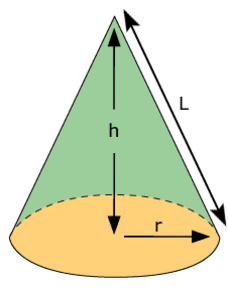
- 72The volume of a cone is: 1/3πr^2h The curved surface area of a cone is: πrL (where L is the slant height). Note this doesn't include the area of the base, which is a circle, area πr^2.
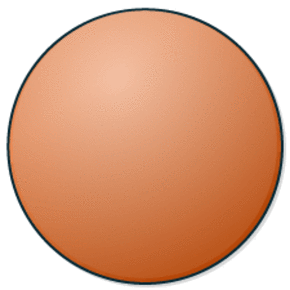
- 73The volume of a sphere is 4/3πr^3 The surface area of a sphere is: 4πr^2
- 74volume and arealength × length = area
length × area = volume
area ÷ length = length
volume ÷ area = length
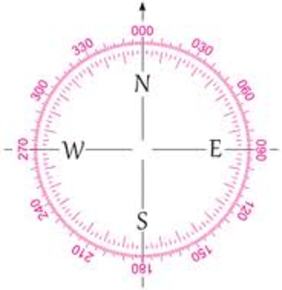
volume ÷ length = area - 753 figure bearings
- 76Pythagorasa^2 + b^2 = c^2
- 77—find length of AF
AC^2 = 6^2 + 2^2
AC = √40
AF^2 = AC^2 + CF^2
AF^2 = 40 + 3^2
AF = √49
AF = 7cm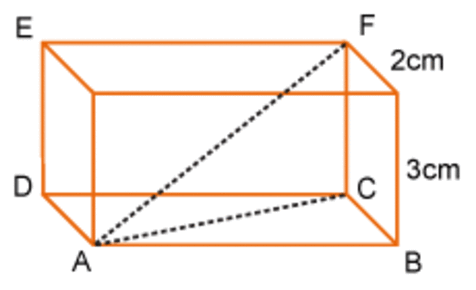
- 78—We are given angle A and side AB.
AB is the hypotenuse.
BC is opposite angle A.
Therefore we use the formula:
sin = opposite / hypotenuse
sin 30 = BC / 7
Multiply both sides by 7
7 x sin30 = BC
Using a calculator we get
BC = 3.5cm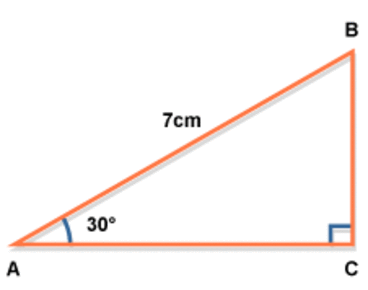
- 79—The answer is 4.77cm (3 sf).
Can you see that PQ is opposite the given angle and that QR is adjacent to it?
Use the formula:
tan = opposite / adjacent
tan50 = PQ / 4
4 × tan50 = PQ
PQ = 4.77 (3 sf)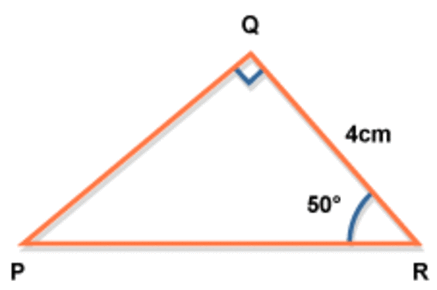
- 80—We are given angle Z
XZ is adjacent to angle Z.
YZ is the hypotenuse.
Therefore we use the formula: cos = adjacent / hypotenuse
cos 25 = 5 over YZ
This time our unknown side (YZ) is the denominator. If we multiply both sides by YZ, we get:
YZ x cos 25 = 5 over YZ x YZ
YZ x cos25 = 5
Now we can divide both sides by cos25:
YZ x cos 25 over cos 25 = 5 over 25
YZ = 5 over cos 25
Using a calculator:
YZ = 5 ÷ 0.9063 = 5.52cm (3 sf)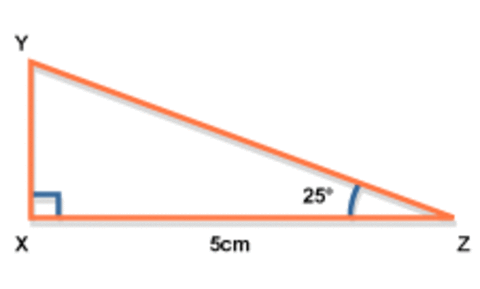
- 81—AC is adjacent to angle C.
BC is the hypotenuse.
So we use the formula:
cos = adjacent / hypotenuse
cosC = 5/7
To calculate C we need to find the inverse of cos (INV cos or SHIFT cos):
C = Inv cos(5/7)
Using a calculator: C = 44.4°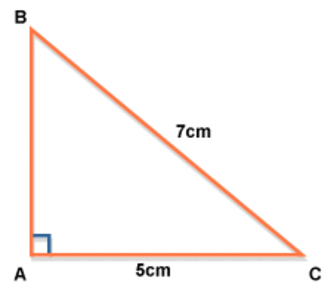
- 82the sine rule
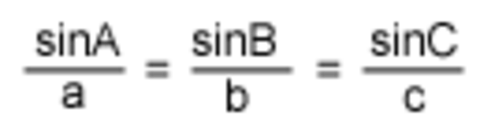
- 83—R = 25.4°
Using the sine we can write: sinR over 4 = sin75 over 9
Multiplying both sides by 4, we get
sinR = sin75 over 9 x 4 = 0.4293...
SO R = inv sin(0.4293)
R = 25.4° (1dp)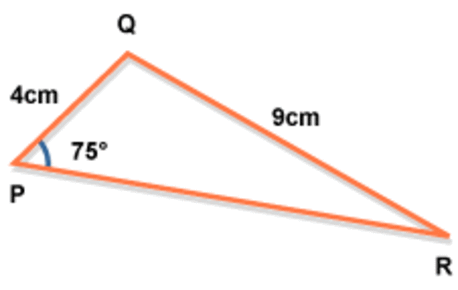
- 84the cosine rule
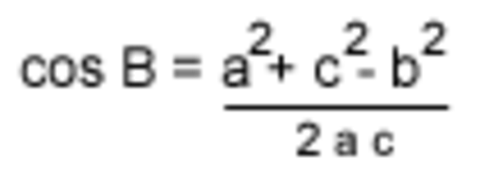
- 85—a^2 = b^2 + c^2 - 2bc cos A
Substitute the values into the formula.
a^2 = 7^2 + 3^2 - 2 × 3 × 7 cos 35
a^2 = 58 - 42 cos 35
a^2 = 23.5956
a = 4.86cm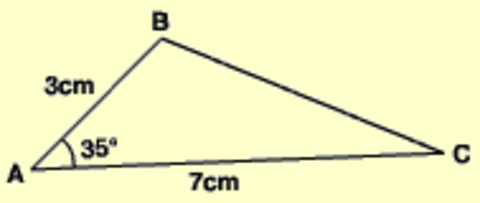
- 86area of a triangleABC = 1/2 ab sin C
- 87—Area = 12.4cm^2
The area of the triangle is
1/2 × 5.2 × 7.1 x sin42 = 12.4cm^2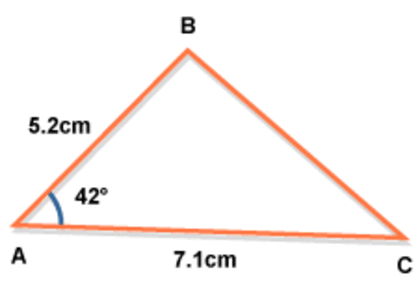
Información
- Descripción
- GCSE Math Fichas sobre All math revision, creado por katiehumphrey el 16/01/2014.
- Creado por
- katiehumphrey · ene 2014
- Actualizado
- 25 abr 2017
- Visitas
- 500
- Etiquetas
- Valoración