
Test
Stem cells and differentiation Biology AS cellular organisation
Este test tiene tipos de pregunta que se abren en el reproductor de siempre.
Preguntas del test (16)
1What are stem cells?
- AThey are cells that are specialised to carry out their function.
- BThey are unspecialised cells that can develop into a different types of cell.
- CThey are cells that are in plant stems.
2Where are stem cells found in humans?
- AHeart
- BKidney
- CBone Marrow
- DLungs
- EEarly embryos
- FTissue fluid
3Stem cells [blank_start]divide[blank_end] to become new cells, which then become [blank_start]specialised[blank_end].
The process by which a cell becomes specialised for its job is called [blank_start]differentiation[blank_end].
Stem cells are able to divide to produce more [blank_start]undifferentiated[blank_end] cells, i.e. they can [blank_start]renew[blank_end] themselves.
In animals, stem cells are used to [blank_start]replace[blank_end] damaged cells.- Adivide
- Bspecialised
- Cdifferentiation
- Dundifferentiated
- Erenew
- Freplace
4Bones are living [blank_start]organs[blank_end], containing [blank_start]nerves[blank_end] and [blank_start]blood vessels[blank_end].
The main bones in the body have [blank_start]marrows[blank_end] in their centres.
Here, adult stem cells [blank_start]divide[blank_end] and [blank_start]differentiate[blank_end] to replace worn out blood cells – [blank_start]erythrocytes[blank_end] (red blood cells) and [blank_start]neutrophils[blank_end] (white blood cells to fight infection).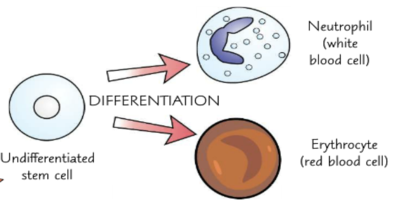
- Aorgans
- Bsystems
- Cstructures
- Dnerves
- Eneurons
- Fneutrophils
- Gblood vessels
- Hcollagen
- Ielastic fibres
- Jmarrows
- Kmemory cells
- Lmeristem
- Mdivide
- Njoin
- Omove
- Pdifferentiate
- Qchange
- Rgo
- Serythrocytes
- Tphagocytes
- Uneutrophils
- Vneutrophils
- Werythrocytes
- Xphagocytes
5Plants are always [blank_start]growing[blank_end] so they need new [blank_start]shoots[blank_end] and roots throughout their lives.
Stem cells in plants can [blank_start]differentiate[blank_end] into various plant tissues.
In plants, stem cells are found in [blank_start]meristems[blank_end] (place where [blank_start]growth[blank_end] can take place).
In the root and the stem, stem cells of the [blank_start]vascular cambium[blank_end] divide and differentiate to become [blank_start]xylem[blank_end] vessels and [blank_start]phloem[blank_end] sieve tubes.- Agrowing
- Bphotosynthesising
- Crespiring
- Dshoots
- Eleaves
- Fdifferentiate
- Gdivide
- Hchange
- Imeristems
- Jmarrow
- Kmesophyll
- Lvascular cambium
- Mventricle
- Nveins
- Ogrowth
- Prespiration
- Qphotosynthesis
- Rxylem
- Sphloem
6What are the uses of stem cells in medicine?
- AScientists think they can be used to repair damaged tissue (e.g. heart)
- BScientists think they can be used to treat neurological disorders (like Alzheimer’s and Parkinson’s).
- CScientists think they can be used to cure bacterial diseases like TB.
- DScientists think they can enable doctors to diagnose illnesses instantly.
7Heart disease means the [blank_start]heart[blank_end] tissue is [blank_start]damaged[blank_end] so the body can’t replace damaged heart cells. Researchers are trying to develop ways of using stem cells to make [blank_start]replacement[blank_end] heart cells to repair the damaged tissue.
Alzheimer’s nerve cells in brain [blank_start]die[blank_end] in increasing numbers causing severe [blank_start]memory[blank_end] loss. Researchers hope to use stem cells to regrow healthy [blank_start]nerve[blank_end] cells in people with Alzheimer’s.
Parkinson’s disease causes uncontrollable tremors. Loss of [blank_start]nerve[blank_end] cells in the brain that produce dopamine, which is needed to [blank_start]control[blank_end] movement. Transplanted stem cells may help to [blank_start]regenerate[blank_end] the dopamine-producing cells.- Aheart
- Bdamaged
- Creplacement
- Ddie
- Ememory
- Fnerve
- Gnerve
- Hcontrol
- Iregenerate
8Red blood cells have the following functions and adaptations:
- AThey carry oxygen in the blood.
- BThey have a biconcave disc shape so their is a larger surface area for gas exchange.
- CThey have no nucleus so there is more room for haemoglobin.
- DThey have a biconvex disc shape to give a larger surface area.
- EThey send signals to the central nervous system.
- FThey defend body against disease.
9What is the function of a neutrophil?
- ATo defend the body against disease.
- BTo transport oxygen.
- CTo send signals to brain.
10What are the adaptations of a neutrophil?
- AFlexible shape allows them to engulf pathogens/foreign particles.
- BMany lysosomes in cytoplasm have digestive enzymes to break down engulfed particles
- CThey have many mitochondria to provide energy for active transport
- DThey have no nucleus.
- EThey have multi-lobed nucleus.
- FThey have cilia on their surface to beat pathogens away.
11[blank_start]Epithelium[blank_end] cells cover the surfaces of organs.
Cells joined by [blank_start]interlinking[blank_end] membranes and membranes at base.
Ciliated epithelia (airways) have [blank_start]cilia[blank_end] that beat to remove particles away.
Other ones (in [blank_start]small[blank_end] intestine) have [blank_start]microvilli[blank_end] to increase their surface area.
[blank_start]Squamous[blank_end] epithelia (in lungs) are very thin to allow efficient diffusion of [blank_start]gases[blank_end]- AEpithelial
- BSkin
- CSurface
- Dinterlinking
- Eplasma
- Fcilia
- Groot hairs
- Hmicrovilli
- Igoblet cells
- Jsmall
- Klarge
- LSquamous
- Mgases
- Nwater
12[blank_start]Sperm[blank_end] cells have a flagellum so they can [blank_start]swim[blank_end] to the egg.
Have lots of [blank_start]mitochondria[blank_end] to provide [blank_start]energy[blank_end] to swim.
[blank_start]Acrosome[blank_end] in head contains [blank_start]digestive[blank_end] enzymes to enable sperm to penetrate the surface of the egg.- ASperm
- BEgg
- Cswim
- Djump
- Emitochondria
- Flysosomes
- Genergy
- Henzymes
- IAcrosome
- JPhagosome
- Kdigestive
- Lbiological
13Palisade mesophyll cells are in the roots.
- AVerdadero
- BFalso
14[blank_start]Palisade[blank_end] mesophyll cells do most of [blank_start]photosynthesis[blank_end].
They contain many [blank_start]chloroplasts[blank_end] so absorb lots of sunlight.
They have [blank_start]thin[blank_end] walls – so CO2 can easily diffuse into the cell.- APalisade
- Bchloroplasts
- Cthin
- Dphotosynthesis
15[blank_start]Root hair[blank_end] cells:
absorb water + [blank_start]mineral ions[blank_end] from soil.
have a [blank_start]large[blank_end] surface area for absorption.
Have thin, [blank_start]permeable[blank_end] wall for entry of water and ions.
Have extra [blank_start]mitochondria[blank_end] (energy for active transport) in their [blank_start]cytoplasm[blank_end].- ARoot hair
- BEpithelium
- CMeristem
- Dmineral ions
- Ecarbon dioxide
- Fwaste
- Glarge
- Hsmall
- Ipermeable
- Jlong
- Kimpermeable
- Lmitochondria
- Mlysosomes
- Nribosomes
- Ocytoplasm
- Pplasma membrane
- Qvacuole
16[blank_start]Guard[blank_end] cells are found in [blank_start]pairs[blank_end] with gap between them to form [blank_start]stoma[blank_end].
These are tiny pores in surface of leaf for [blank_start]gas[blank_end] exchange.
In light, guard cells take up water and become [blank_start]turgid[blank_end] (swollen).
Thin outer walls and thickened inner walls force them to bend outwards, [blank_start]opening[blank_end] stomata.
Allows gas exchange for [blank_start]photosynthesis[blank_end].- AGuard
- Bpalisade mesophyll
- Ccompanion
- Dpairs
- Etriplets
- Fstoma
- Gstem cells
- Hgas
- Iwater
- Jsolute
- Kturgid
- Lflaccid
- Msmall
- Nopening
- Oclosing
- Pphotosynthesis
- Qrespiration
Información
- Descripción
- AS - Level Biology Test sobre Stem cells and differentiation Biology AS cellular organisation, creado por Aaisha Ahmed el 02/04/2016.
- Autor
- Aaisha Ahmed
- Idioma
- English
- Visitas
- 172
- Historial
- Creado el 2 abr 2016 · actualizado el 1 ene 2018
- Etiquetas
- Valoración
- Aún sin valoraciones Valora este test