
Quiz
Stem cells and differentiation Biology AS cellular organisation
Este quiz tem tipos de pergunta que abrem no player de sempre.
Perguntas do quiz (16)
1What are stem cells?
- AThey are cells that are specialised to carry out their function.
- BThey are unspecialised cells that can develop into a different types of cell.
- CThey are cells that are in plant stems.
2Where are stem cells found in humans?
- AHeart
- BKidney
- CBone Marrow
- DLungs
- EEarly embryos
- FTissue fluid
3Stem cells [blank_start]divide[blank_end] to become new cells, which then become [blank_start]specialised[blank_end].
The process by which a cell becomes specialised for its job is called [blank_start]differentiation[blank_end].
Stem cells are able to divide to produce more [blank_start]undifferentiated[blank_end] cells, i.e. they can [blank_start]renew[blank_end] themselves.
In animals, stem cells are used to [blank_start]replace[blank_end] damaged cells.- Adivide
- Bspecialised
- Cdifferentiation
- Dundifferentiated
- Erenew
- Freplace
4Bones are living [blank_start]organs[blank_end], containing [blank_start]nerves[blank_end] and [blank_start]blood vessels[blank_end].
The main bones in the body have [blank_start]marrows[blank_end] in their centres.
Here, adult stem cells [blank_start]divide[blank_end] and [blank_start]differentiate[blank_end] to replace worn out blood cells – [blank_start]erythrocytes[blank_end] (red blood cells) and [blank_start]neutrophils[blank_end] (white blood cells to fight infection).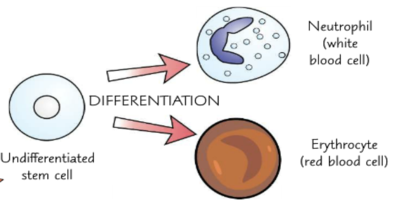
- Aorgans
- Bsystems
- Cstructures
- Dnerves
- Eneurons
- Fneutrophils
- Gblood vessels
- Hcollagen
- Ielastic fibres
- Jmarrows
- Kmemory cells
- Lmeristem
- Mdivide
- Njoin
- Omove
- Pdifferentiate
- Qchange
- Rgo
- Serythrocytes
- Tphagocytes
- Uneutrophils
- Vneutrophils
- Werythrocytes
- Xphagocytes
5Plants are always [blank_start]growing[blank_end] so they need new [blank_start]shoots[blank_end] and roots throughout their lives.
Stem cells in plants can [blank_start]differentiate[blank_end] into various plant tissues.
In plants, stem cells are found in [blank_start]meristems[blank_end] (place where [blank_start]growth[blank_end] can take place).
In the root and the stem, stem cells of the [blank_start]vascular cambium[blank_end] divide and differentiate to become [blank_start]xylem[blank_end] vessels and [blank_start]phloem[blank_end] sieve tubes.- Agrowing
- Bphotosynthesising
- Crespiring
- Dshoots
- Eleaves
- Fdifferentiate
- Gdivide
- Hchange
- Imeristems
- Jmarrow
- Kmesophyll
- Lvascular cambium
- Mventricle
- Nveins
- Ogrowth
- Prespiration
- Qphotosynthesis
- Rxylem
- Sphloem
6What are the uses of stem cells in medicine?
- AScientists think they can be used to repair damaged tissue (e.g. heart)
- BScientists think they can be used to treat neurological disorders (like Alzheimer’s and Parkinson’s).
- CScientists think they can be used to cure bacterial diseases like TB.
- DScientists think they can enable doctors to diagnose illnesses instantly.
7Heart disease means the [blank_start]heart[blank_end] tissue is [blank_start]damaged[blank_end] so the body can’t replace damaged heart cells. Researchers are trying to develop ways of using stem cells to make [blank_start]replacement[blank_end] heart cells to repair the damaged tissue.
Alzheimer’s nerve cells in brain [blank_start]die[blank_end] in increasing numbers causing severe [blank_start]memory[blank_end] loss. Researchers hope to use stem cells to regrow healthy [blank_start]nerve[blank_end] cells in people with Alzheimer’s.
Parkinson’s disease causes uncontrollable tremors. Loss of [blank_start]nerve[blank_end] cells in the brain that produce dopamine, which is needed to [blank_start]control[blank_end] movement. Transplanted stem cells may help to [blank_start]regenerate[blank_end] the dopamine-producing cells.- Aheart
- Bdamaged
- Creplacement
- Ddie
- Ememory
- Fnerve
- Gnerve
- Hcontrol
- Iregenerate
8Red blood cells have the following functions and adaptations:
- AThey carry oxygen in the blood.
- BThey have a biconcave disc shape so their is a larger surface area for gas exchange.
- CThey have no nucleus so there is more room for haemoglobin.
- DThey have a biconvex disc shape to give a larger surface area.
- EThey send signals to the central nervous system.
- FThey defend body against disease.
9What is the function of a neutrophil?
- ATo defend the body against disease.
- BTo transport oxygen.
- CTo send signals to brain.
10What are the adaptations of a neutrophil?
- AFlexible shape allows them to engulf pathogens/foreign particles.
- BMany lysosomes in cytoplasm have digestive enzymes to break down engulfed particles
- CThey have many mitochondria to provide energy for active transport
- DThey have no nucleus.
- EThey have multi-lobed nucleus.
- FThey have cilia on their surface to beat pathogens away.
11[blank_start]Epithelium[blank_end] cells cover the surfaces of organs.
Cells joined by [blank_start]interlinking[blank_end] membranes and membranes at base.
Ciliated epithelia (airways) have [blank_start]cilia[blank_end] that beat to remove particles away.
Other ones (in [blank_start]small[blank_end] intestine) have [blank_start]microvilli[blank_end] to increase their surface area.
[blank_start]Squamous[blank_end] epithelia (in lungs) are very thin to allow efficient diffusion of [blank_start]gases[blank_end]- AEpithelial
- BSkin
- CSurface
- Dinterlinking
- Eplasma
- Fcilia
- Groot hairs
- Hmicrovilli
- Igoblet cells
- Jsmall
- Klarge
- LSquamous
- Mgases
- Nwater
12[blank_start]Sperm[blank_end] cells have a flagellum so they can [blank_start]swim[blank_end] to the egg.
Have lots of [blank_start]mitochondria[blank_end] to provide [blank_start]energy[blank_end] to swim.
[blank_start]Acrosome[blank_end] in head contains [blank_start]digestive[blank_end] enzymes to enable sperm to penetrate the surface of the egg.- ASperm
- BEgg
- Cswim
- Djump
- Emitochondria
- Flysosomes
- Genergy
- Henzymes
- IAcrosome
- JPhagosome
- Kdigestive
- Lbiological
13Palisade mesophyll cells are in the roots.
- AVerdadeiro
- BFalso
14[blank_start]Palisade[blank_end] mesophyll cells do most of [blank_start]photosynthesis[blank_end].
They contain many [blank_start]chloroplasts[blank_end] so absorb lots of sunlight.
They have [blank_start]thin[blank_end] walls – so CO2 can easily diffuse into the cell.- APalisade
- Bchloroplasts
- Cthin
- Dphotosynthesis
15[blank_start]Root hair[blank_end] cells:
absorb water + [blank_start]mineral ions[blank_end] from soil.
have a [blank_start]large[blank_end] surface area for absorption.
Have thin, [blank_start]permeable[blank_end] wall for entry of water and ions.
Have extra [blank_start]mitochondria[blank_end] (energy for active transport) in their [blank_start]cytoplasm[blank_end].- ARoot hair
- BEpithelium
- CMeristem
- Dmineral ions
- Ecarbon dioxide
- Fwaste
- Glarge
- Hsmall
- Ipermeable
- Jlong
- Kimpermeable
- Lmitochondria
- Mlysosomes
- Nribosomes
- Ocytoplasm
- Pplasma membrane
- Qvacuole
16[blank_start]Guard[blank_end] cells are found in [blank_start]pairs[blank_end] with gap between them to form [blank_start]stoma[blank_end].
These are tiny pores in surface of leaf for [blank_start]gas[blank_end] exchange.
In light, guard cells take up water and become [blank_start]turgid[blank_end] (swollen).
Thin outer walls and thickened inner walls force them to bend outwards, [blank_start]opening[blank_end] stomata.
Allows gas exchange for [blank_start]photosynthesis[blank_end].- AGuard
- Bpalisade mesophyll
- Ccompanion
- Dpairs
- Etriplets
- Fstoma
- Gstem cells
- Hgas
- Iwater
- Jsolute
- Kturgid
- Lflaccid
- Msmall
- Nopening
- Oclosing
- Pphotosynthesis
- Qrespiration
Informações
- Descrição
- AS - Level Biology Quiz sobre Stem cells and differentiation Biology AS cellular organisation, criado por Aaisha Ahmed em 02-04-2016.
- Autor
- Aaisha Ahmed
- Idioma
- English
- Visualizações
- 172
- Histórico
- Criado em 2 abr 2016 · atualizado em 1 jan 2018
- Etiquetas
- Avaliação
- Ainda sem avaliações Avalie este quiz