
Apuntes
Metals
Contenido del apunte (4)
Página 1
Minerals and Ores:
Most metals in Earth’s crust combined with other elements
Individual compounds are minerals
Examples of iron-containing minerals - FeS2 (pyrite), Fe3O4 (magnetite), Fe2O3 (hematite)
Minerals normally found mixed with other unwanted minerals in rocks
Ore - contains enough of mineral for it to be worthwhile to extract metal
Price of metal affect by how common ore is, difficulty in extracting metal from ore
Few very unreactive metals E.G. gold, found native
Exist naturally as uncombined element
Silver and copper, although more rarely, found native
Página 2
Extracting the Metal:
Many ores are already oxides, or compounds which can easily be converted to oxides
Metals can be converted to an oxide by heating in air - roasting
To get a metal from the oxide, you need to remove oxygen - reduction
Metals are positive ions in ionic compounds so you need to add electrons - reduction
Methods of extraction:
The cost of energy and cost of reducing agent need to be taken into account - cheap and economically useful
Metals up to zinc - heat with carbon or carbon monoxide E.G. extraction or iron
Metals above zinc - electrolysis - metal ions given electrons by the cathode. However, expensive process so metals more expensive
Some metals E.G. titanium - heating compound with more reactive metal. Also very expensive because more reactive metal also has to be extracted by expensive process.
Página 3
Aluminium:
Main ore - bauxite - impure aluminium oxide
First treated to produce aluminium oxide
Fairly reactive so needs to be electrolysed but very high melting point so not practical - bauxite dissolved in molten cryolite - aluminium compound which melts at a lower temperature
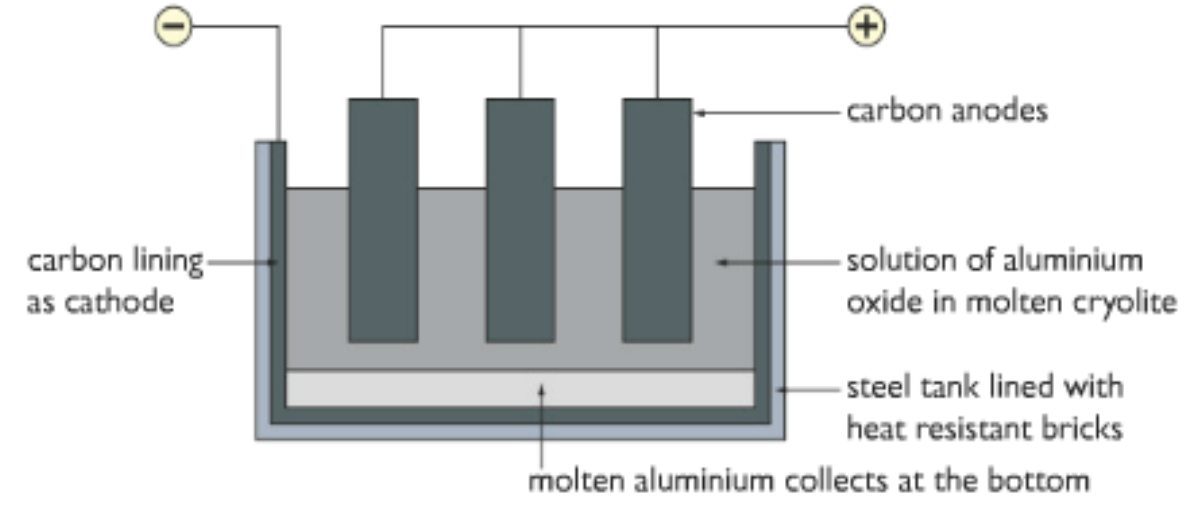
Electrolyte is solution of aluminium oxide in molten cryolite at around 1000C
Molten aluminium siphoned in-between intervals
Fresh aluminium oxide added to cell
Operates at 5-6 volts, currents 100,000 amps
Heat generated by current keeps electrolyte molten
Aluminium ions attracted to cathode, gain electrons and reduced to aluminium. Molten aluminium sinks to bottom:
Al3+ + 3e- --> Al(l)
Oxide ions attracted to anode, form oxygen gas by loosing electrons:
2O2-(l) --> O2(g) + 4e-
Carbon anodes burn in oxygen to produce CO2 so have to be replaced regularly - expensive
Uses:
Aluminium alloys usually used since more strong - elements E.G. silicon, copper, magnesium added
Uses depend on its low density and strength, ability to conduct electricity and heat, appearance
Resists corrosion because has thin but strong layer of Al2O3 on surface which prevents anything getting to surface and reacting
Transportation
Packaging
Food and beverage containers
Overhead power cables
Página 4
Iron:
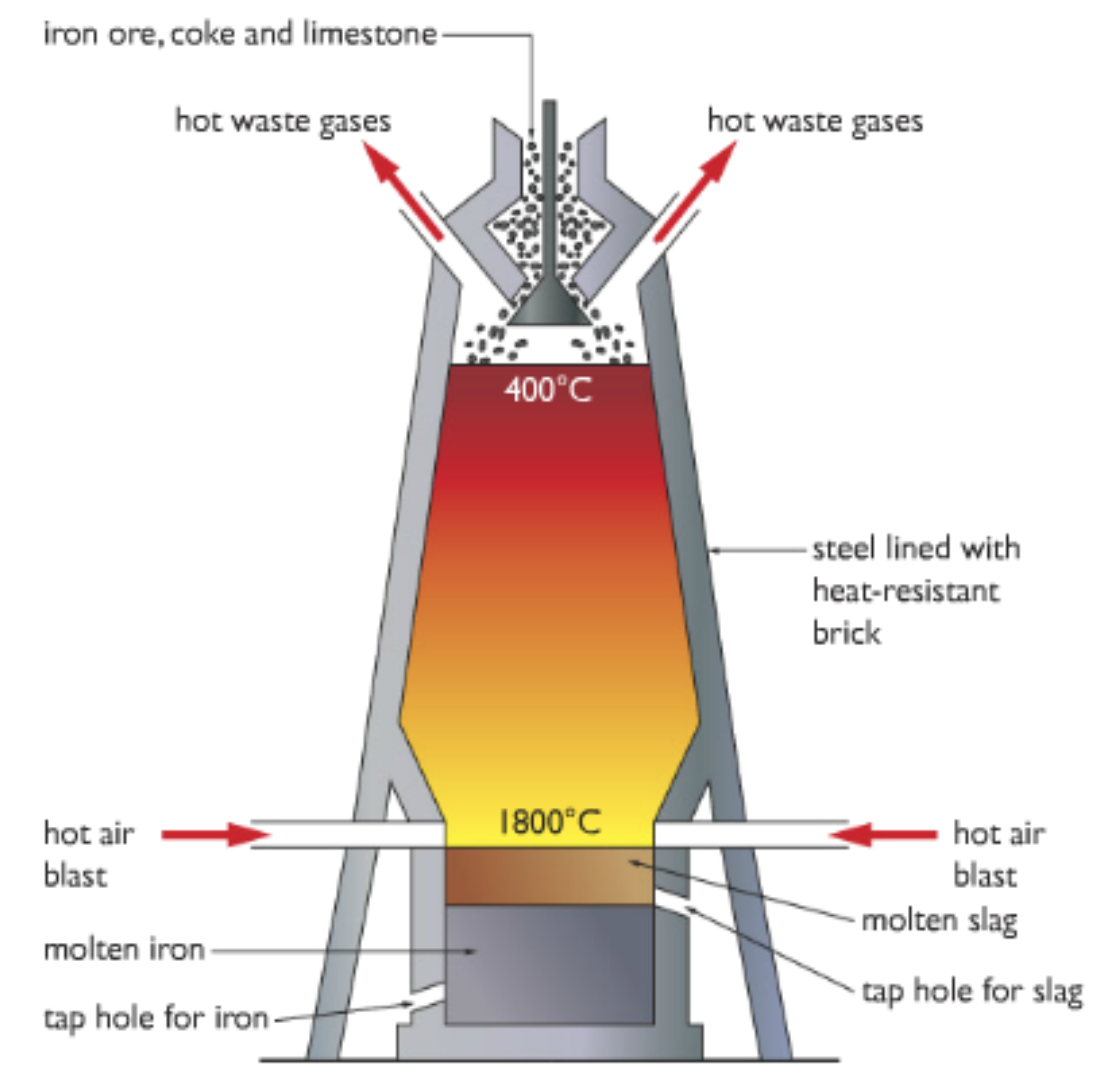
Hot waste gases at top of furnace pumped away to heat air blast at bottom
Coke - impure carbon - burns in hot air blast to form CO2 - strongly exothermic:
C(s) + O2(g) --> CO2(g)
At high temperatures in furnace, CO2 reduced by more carbon to produce carbon monoxide:
CO2(g) + C(s) --> 2CO(g)
CO is main reducing agent in furnace, esp. cooler parts. Assuming iron ore is hematite:
Fe2O3(s) + 3CO(g) --> 2Fe(l) + 3CO2(g)
Iron melts and flows to bottom of furnace - tapped off.
In hotter parts of surface, some hematite reduced by carbon itself, but here, CO formed not CO2:
Fe2O3(s) + 3C(s) --> 2Fe(l) + 3CO(g)
Limestone added to furnace to remove impurities in ore which could clog furnace with solid material. Furnace thermally decomposes limestone to calcium oxide and carbon dioxide - endothermic reaction (absorbs heat) - important to not add too much in case you cool the furnace:
CaCO3(s) --> CaO(s) + CO2(g)
Calcium oxide is a basic oxide - reacts with acidic oxides E.G. silicon dioxide to produce slag.
CaO(s) + SiO2(s) --> CaSiO3(l)
Calcium silicate produced which melts and trickles to bottom of furnace as molten slag. Slag floats on top of molten iron and can be tapped off separately.
Cast iron:
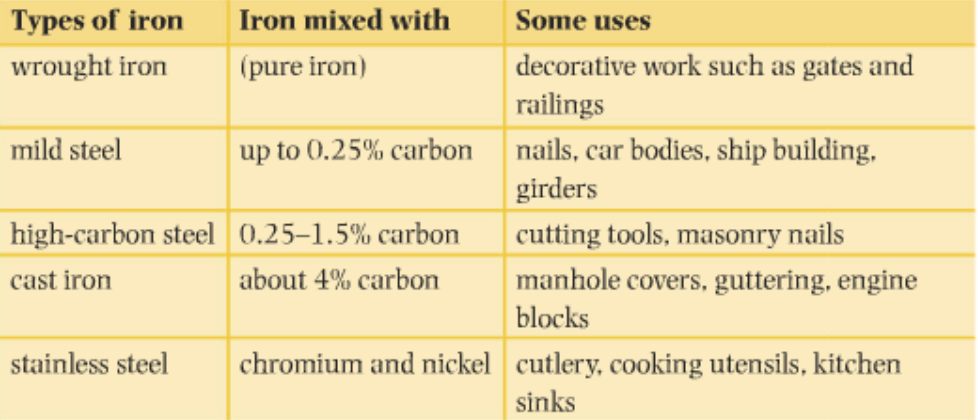
Molten iron straight from furnace holed rapidly, solidified by running into sand moulds - pig iron.
When remelted and cooled in controlled conditions - forms cast iron.
Fluid when molten, doesn’t shrink much when solidifies.
Used to make castings.
Also very brittle so used for manhole covers, guttering, cylinder blocks in car engines.
Mild steel:
Hard and strong.
Used for wire, nails, car bodies, ship building, girders, bridges.
Wrought iron:
Pure iron so daily soft but softness and weakness means useless for structural purposes.
Used to be used for decorative gates, railings, but replaced by mild steel.
High-carbon steel:
Harder but brittle.
Used to cut tools, make masonry nails
Stainless steel:
Alloy of iron with chromium and nickel - form strong oxide layers so resist corrosion and protect iron.
Uses are kitchen sinks, saucepans, knives, forks, gardening tools, corrosion resistant materials in brewing, dairy and chemical industry.
Rusting:
Iron rusts when oxygen and water present.
Accelerated when electrolytes E.G. salt present.
Formula for rust - Fe2O3 · xH2O
Preventing rusting:
Painting
Coating oil or grease
Covering in plastic
Coating iron with a metal below in the reactivity series - barrier method
Alloying iron with chromium and nickel to produce stainless steel - alloying the iron
Galvanising iron - coating with a layer of zinc which corrodes instead of the iron since more reactive - sacrificial metals
Sacrificial anodes - more reactive metals such as zinc used to prevent less reactive metal from corroding
Metal hulls or keels of boats have zinc blocks attached.
Underground pipelines protected by sacrificial anodes - lumps of magnesium
Información
- Descripción
- IGCSE (Chemistry) Chemistry Apunte sobre Metals, creado por Aarushi Jain el 05/03/2017.
- Creado por
- Aarushi Jain · mar 2017
- Actualizado
- 6 abr 2018
- Visitas
- 0
- Valoración