
Test
Previous year Quizz 2
Crea una cuenta gratis para terminar este test
Guarda tu progreso y consulta tu resultado final.
¿Ya tienes cuenta? Inicia sesión
Preguntas del test (18)
1Smell disorders are frequently caused by ...
- ANeurodegenerative diseases
- BSkull fractures
- CSide effects of drugs
- DDiabetes mellitus Type I
- EKallmann Syndrome
2The dorsolateral prefrontal cortex
- Ais involved in triggering of reflexive saccades
- Binhibits unwanted reflexive saccades
- Cis the source of a cortico-cerebellar projection modulating the vestibulo-ocular reflex
- Dis rarely affected in neurodegenerative disorders
- Eis intact when antisaccades are directed towards the target
3Dorsal Horn Lamina II neurons
- Aare all GABAergic
- Breceive primary afferent input from NGF responsive sensory neurons
- Cprocess proprioceptive information
- Dprocess exclusively thermal information from the periphery
- Eare mostly projection neurons
4One of these statements is WRONG: Sensory neurons that respond to noxious heat...
- Aalso respond well to the chili pepper compound capsaicin
- Bcan sometimes also respond to noxious cold
- Crespond to no other type of stimuli
- Dalmost always respond to noxious mechanical stimuli
- Eare never polymodal
5The figure below shows the basal aspect of the human brain. Which of the following statements is false?
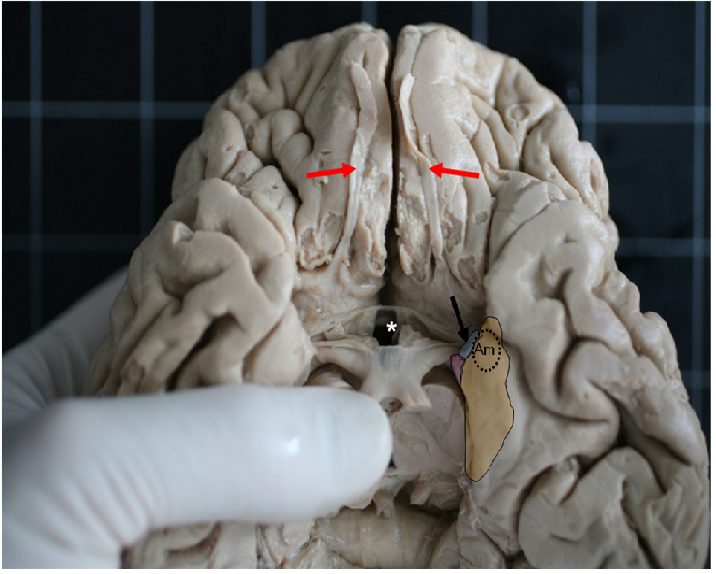
- AThe structure labeled with red arrows contains migrating cells of the rostral migratory stream
- BThe structure labeled with red arrows contains axons of mitral cells
- CThe structure labeled as “Am” is part of the temporal lobe and target of mitral cell axons
- DThe asterisk (*) shows the third ventricle
- EThe black arrow points at the anterior part of the insular cortex
6What afferent fiber type conveys first pinch sensation?
- AGroup Ia spindle afferents
- BThinly myelinated Aδ-fibers
- CLarge myelinated AB−fibers
- DSympathetic efferent fibers
- EMerkel disk afferent fibers
7Inhibition of reflexive saccades is not:
- Acontrolled by the dorsolateral prefrontal cortex
- Bdependent on omnipause neurons in the brainstem
- Cvisible at the patient’s bedside
- Dinvestigated by antisaccade testing
- Edependent on Brodmann’s area 46
8Irrepressible bursts of involuntary saccades ("ocular flutter / opsoclonus")
- Aindicate dysfunction of the prepontine paramedian reticular formation
- Boccur with lesions affecting the oculomotor nuclei
- Cindicate dysfunction of omnipause neurons in the nucleus raphe interpositus
- Doccur with lesions affecting Brodmann's area 46 in the prefrontal cortex
- Eare a sign of frontal eye field dysfunction
9Which of the following is wrong? Saccade velocity…
- AMay be reduced by centrally acting drugs
- BDepends on activity of premotor burst neurons in the brainstem reticular formation
- CIs reduced in neurodegenerative disorders affecting the brainstem reticular formation
- DIs normal in Parkinson’s disease
- EIs always accompanied by disorders of saccade accuracy
10Sensory neurons in the Dorsal root ganglia have myelinated and unmyelinated axons. Which class off fiber convey vibrotactile sensation?
- AUnmyelinated C-fibers
- Bγ−motor fibers
- CThinly myelinated Aδ-fibers
- DLarge myelinated A-fibers
- ESympathetic efferent fibers
11Impaired fixation suppression of the vestibulo-ocular reflex is a sign of
- ADiseases affecting the cerebellar hemispheres
- BDisturbed vergence
- CDiseases affecting the cerebellar flocculus and/or dorsal vermis
- DLesions affecting the dorsolateral prefrontal cortex
- EParkinson’s disease
12Which of the following eye movements changes images of the environment on the fovea?
- AFixation
- BSaccades
- CVergence
- DVestibulo-ocular reflex
- ESmooth pursuit
13The following structure is not involved in brainstem control of saccades:
- ANucleus raphe interpositus
- BNucleus prepositus hypoglossi
- COculomotor nuclei
- DNucleus principalis nervi trigemini
- EPrepontine paramedian reticular formation
14Which of the following statements is correct?
- AOlfactory loss can be an early sign of Parkinson’s disease.
- BOlfactory loss is rarely seen in elderly people.
- COlfactory loss is commonly associated with brain lesion after stroke.
- DOlfactory loss is not associated with Huntington’s disease.
- EOlfactory loss can be an early sign of measles.
15The following sensations are mediated through oral stimuli. What sensations are mediated through neurons with cell bodies in trigeminal ganglion?
- Abitter through caffeine
- Bumami through glutamate
- Csour through vinegar
- Dhot through capsaicin
- Esweet through sucrose
16The most frequent causes of olfactory loss in adults are…
- Aenvironmental pollution.
- Bneurodegenerative diseases.
- Cdrug abuse.
- Dsinunasal diseases.
- Ehead trauma.
17Mature Nerve growth factor
- Ais an endogenous mediator of inflammatory pain in growing individuals
- Bcan activate p75 to produce hyperalgesia
- Cstimulates mast cell proliferation
- Dactivates the sortillin receptor
- Ecan kill adult sensory neurons
18The “neural integrator” in the brainstem and cerebellar flocculus
- AControls the vestibulo-ocular reflex
- BControls accuracy of saccades
- CTransforms a saccade velocity signal into a tonic signal for gaze holding in eccentric positions
- DDetermines saccade velocity by integrating activity of neurons in oculomotor nuclei
- EIs involved in generating vergence eye movements
Información
- Descripción
- Test sobre Previous year Quizz 2, creado por Alba Del Rio Serrato el 02/12/2017.
- Autor
- Alba Del Rio Serrato
- Idioma
- English
- Visitas
- 22
- Etiquetas
- Valoración
- Aún sin valoraciones Valora este test